Best Emerging Markets ETF? See AVEM vs. DFAE vs. SPEM vs. VWO on #ETFBattles
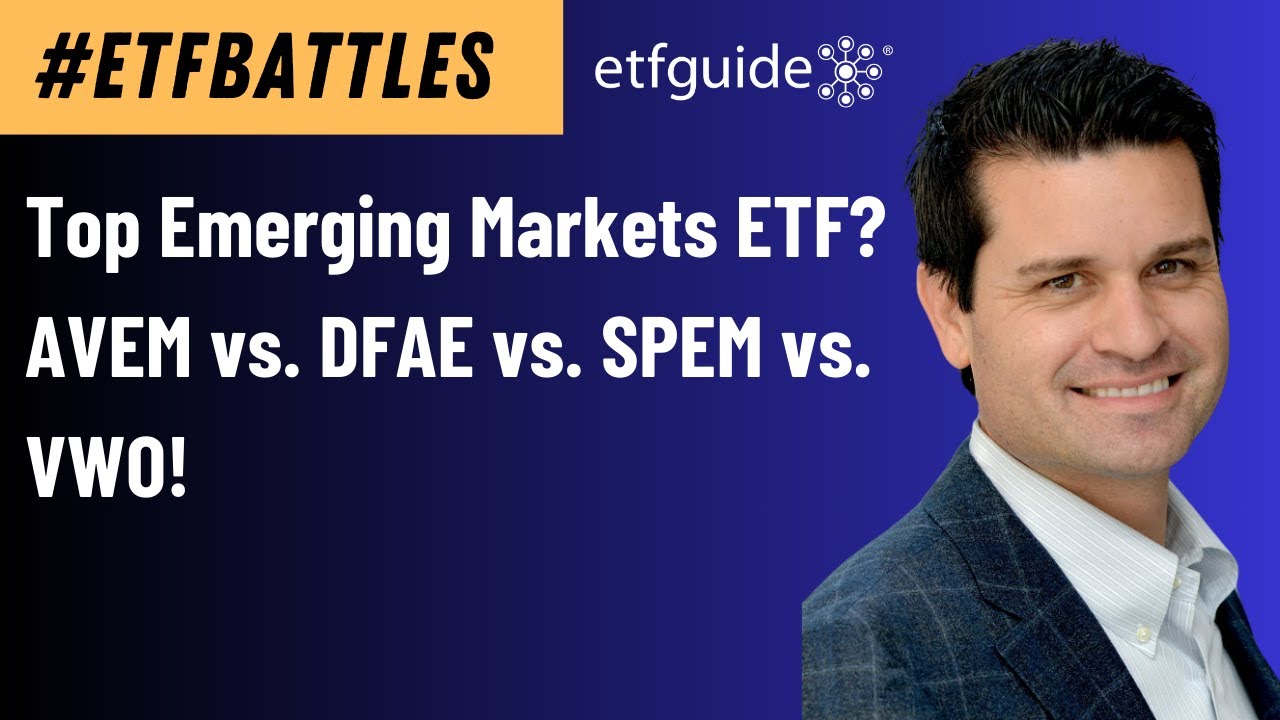
Emerging Markets are up-and-coming countries in the midst of becoming established, fully developed economies. Adding exposure to Emerging Markets can help you diversify your investment risk and avoid Home Country bias. Today's ETF battle is an audience-requested quadruple header between four Emerging Market ETFs. Who wins? Find out right after this.
Welcome to a brand new 2025 season six of ETF battles, and I am Ronda Lee, the chief culprit behind this madness. I hope everyone's New Year is off to a good start, and for our new viewers, hit the Subscribe button to join our community. For longtime viewers, I am thrilled to see you again and to have you back with us.
Don't forget to check the description section below this video. I've got viewer resources which include EB links. We've also got links to our program sponsor, Direction, and we've got links to our program judges, so please get in touch. Keep your fantastic ETF battle suggestions coming. Send me your ETF ticker symbols in the comment section below or on our X feed at ETF guide.
Today's ETF battle request is from a longtime viewer named Kep 19991, and it's a quadruple header between ETFs from Avantis, Dimensional, State Street Global, and Vanguard. The funds that we're going to be analyzing are focused on Emerging Market countries like India and Brazil, among others. Thank you, Kep, for another excellent battle suggestion. Judging today's high-stakes contest, we've got Tony Dong with ETF Central and Mike Akins with ETF action. Guys, great to see you again. Welcome back.
Good to be back, Ron. It's great to be here. Happy New Year, everybody. Our four battle categories are cost, exposure strategy, performance, and then our mystery category. For mystery, that's where our judges can choose any factor or thing that you feel is pertinent and crucial to today's contest. Our judges can also nominate Wild Card ETFs as they feel there's better choices elsewhere, or they can opt for split decisions. I've got the scorekeeping duties, and at the end of the program, we will declare an overall winner. None of the battle outcomes on this program are ever predetermined or known in advance by myself or our judges. Our first category is cost.
Let's get started with Mike. Give us your analysis, please. You bet. I think you're looking at four very broad-based Emerging Market ETFs in this battle. All four of them are very well established in terms of AUM liquidity. It really comes down to breaking this into two buckets. You've got two broad-based passive strategies in SPEM and VWO, which are the cheapest, trading at seven basis points for SPEM and eight basis points for VWO. Then you've got the two what I would call quasi-active from Avantis and Dimensional, which are really factor-type tilt strategies.
They own the broad market. They have high overlap with SPEM and VWO, but they're doing it in a little bit different way, and those are going to come in a little higher because they are putting an active tilt to it. That's 33 basis points for AVEM and 35 for DFA. Liquidity-wise, they're all trading pretty cheap. AVEM is a little bit higher on their spreads, about nine basis points spread compared to two or three basis points for the rest, so a little bit of an outlier there. It could just be timing in the data there because from a size perspective, it's pretty similar to the other strategies, but something to note.
All that being said, I think it's hard to turn down SPEM and VWO as the winners in this category. They're the cheapest, they're the liquid, they're the largest. From a pure cost perspective, it's got to go to those two strategies. Between the two of them, I really can't give it to one or the other. I mean, SPEM's basis point cheaper but trades a little less than VWO, so it's pretty much a toss-up between those two.
That's a very good start. Thank you, Mike. Tony, how do you see it when it comes to cost? Mike covered most of it. For emerging market exposure, it's not going to get cheaper than VWO or SPEM for quite a while. It's worth noting that SPEM, as part of the SPDR portfolio lineup, actually saw its expense ratios slashed a few months ago. If they continue with this trend, I think Vanguard might also jump in with an expense ratio cut just to make it more competitive because the Vanguard run really has been the longstanding fund. Right now, as it goes, flip a coin. I flip my coin, I go with SPEM on this one.
That takes us next to exposure strategy, and Tony, you're still up, so break it down for us. Sure. VWO and SPEM are passive ETFs. They set out to sample or track a benchmark index. For VWO, it is the FTSE Emerging Market index, and then for SPEM, it is a S&P index. We can go down into how these indexes differ, but the point is, for investors, you're getting exposure market cap weighted to all 11 sectors across Emerging Market countries.
Now, the Dimensional and the Avantis ones, they're quasi-active. They have some components of indexing, like the systematic manner in which they approach it, but they're not going to publish their index on their website. Avantis and Dimensional aren't going to tell you their secret sauce. What we do know is that it tilts towards stocks with higher profitability. It tilts toward stocks with higher value, and it tilts towards small caps, so you get exposure to the size, value, and profitability factors, which fall in line with the Fama-French research.
Now, Avantis and Dimensional do approach this differently, and they have discretion with how to vary the portfolio, but the overlap with the two index ones is still there. On strategy, I very much like the factor approach, and when it comes to it, there's no better names in the market right now than Avantis or Dimensional. Again, flip a coin between them, and this time I'm going with Dimensional.
Very, very good analysis. Thank you, Tony. Mike, you're up on exposure strategy. How do you see it? Yeah, so I think Tony did a great job kind of laying out the basics there. A couple of things I would just add to this whole conversation. First and foremost, VWO and SPEM, their allocation to what is emerging and what is not, based on the country allocations that they're using, driven mostly from S&P, they include South Korea, whereas VWO and SPEM consider South Korea as a developed market, and it's not included in their index. There's about a 10% allocation to those two ETFs that it's going to get you into that debate whether or not it's emerging or not, and with that, it can cause some tracking air between the two. 10% is a fair amount of allocation, and recently there's been a lot going on in South Korea, so you always have to understand what's under the hood, how they build that out.
That being said, beyond that, the exposures across these portfolios are so very, very similar. They're all extremely diversified. They all have very good sector allocations. Their sector allocations are within a couple of percent of each other across the board, so really then it comes down to what Tony was alluding to with respect to come of your factor tilts, right? If I go through and just use our derived analytics at ETF action, where we score every single TF on a look-through basis and look at the Fama-French factors, I can tell you that again, on that note, it's just very mild differences between the bunch.
If anything, I would say Avantis is taking the biggest tilts. They're coming in with above average on a value tilt relative to the others, as well as a currently and above average on momentum, and all this is look-through analytics of the underlying companies. Avantis has got a little bit of a value tilt, and relative to the other portfolios is a little bit higher momentum within the portfolios. From that perspective, I like that other they're very, very similar. There's not going to be a ton of tracking area between this, but I kind of like how Avantis is getting a little bit more exposure to that value and momentum, and with that, I'm going to give my exposure win to AVEM.
Next up is performance, so Mike, how do these funds compare when it comes to this particular category? Yeah, so I mean, like I said, performance is pretty tight when you look across these. I'm looking at a one-year, the winner across the board is SPEM, outperforming VWO by 19 basis points, 133% to 12.81%. That's as of returns from January 4th on a one-year look back period. Three-year returns across the board are within a few basis points of each other. I will know they all outperform the broad MSCI benchmark, being EM, but that's a big part of that is because EM's got a higher expense ratio than the rest of them.
On a five-year basis, again, you're talking really close, but you do see AVEM pulling out to a bit of a lead on the five-year, 4% annualized return relative to 3.12 for SPEM and 2.9. DFA does not have a five-year track record yet, so can't compare that one in this one. All those outperform the EM, but again, that's a big part of that, that expense ratio on that fund is so much higher. If we look at that and then kind of dive in a little bit more to the risk statistics and think about it from a risk-adjusted perspective, one thing that sticks out to me other than AVEM kind of winning on the longer-term five-year track record with some of those factor tilts is the up-down capture ratios.
AVEM has a much higher, a better kind of offset of higher up and lower down capture ratios in the other three. I think, you know, they're so close it's now we're not talking about a huge number here. For example, the up ratio on AVEM over the last three years is 101%. All the others are below 100% on the up, and their down ratio shows 92%. I like that characteristics there. There are clearly, you know, as of on that three-year number, adding some value there, so I again just kind of lean into that AVEM as my winner in the performance, both on a backward basis over the five-year period that we can compare them all, but also kind of looking forward, I like the idea of getting at that value, that value tilt. I think the momentum is a byproduct of their underlying screening as well, and I think that can lead to a little bit Alpha over time, but not going to be a big difference between these portfolios across the board, but I'll give the I'll give the win to AVEM.
Tony, you're up next for performance. How do you see it? One thing I'd like to point out to readers is that for Dimensional ETFs, the ETFs don't go back very far, but they're usually very similar to existing Dimensional mutual funds. For DFEM, the closest equivalent in my view would be DFAX, their merging Market portfolio Series 2. That one actually does have a history going back to 1997, and the five-year total annualized returns for it is 4.94. That is compared to the 3.2 of the MSCI emerging market index and higher than AVEM, SPEM, and VWO.
This is my caveat. If these portfolios did in fact follow the same strategies throughout this time, you can draw a bit of a connection there, but I would still be cautious with that because this is active management, and just because they have a similar name doesn't mean that DFEM is being managed in the same way as this fund. To hedge my conclusion there, I'm going to agree with Mike and say that for the past and the future, AVEM is likely to maintain just a little bit of that Tailwind behind it just from those factor tilts. You're going towards momentum, you're going towards profitability, value, and size. These, if done properly and fees kept reasonable like they are, should continue to be a tail win for it, so for me, it's AVEM as well.
That takes us next to our mystery battle category. This is where our judges can pick a single factor or maybe multiple factors that they think are important to today's ETF contest. Tony, what is your mystery category? What is it, and which of these ETFs wins it? It's Chinese Equity exposure to me. For VWO, China's at 29% of the ETF, and for the others, it's relatively there. I don't want to invest in China. I think there is a substantial political risk in the near-term, so over the next 10 years, they don't have free and fair Capital markets like we do. They have excessive amounts of government intervention, and there's a lot of systemic risk present.
I could go on and on about that, but my personal opinion is if you're going to do Emerging Markets, it would help to remove China. I don't think it's a risk you're compensated for, so I have a wild card ETF to throw in. It's from Wisdom Tree. It's called The Wisdom Tree Emerging Markets X China fund. Basically, it's all your Emerging Markets, India, Taiwan, Mexico, Saudi Arabia, all the ones you know and love minus China. It's a bit more expensive, it's at 32 basis points, but historically, I'm going to take a look at the returns here. Give us that ticker, Tony, while you're doing that. XC, it's new, so it doesn't have a five five-year turn, just XC, X China Wisdom Tree Emerging Markets X China fund.
Gun to my head, if someone told me I had to invest in Emerging Markets, this would be the fund I choose, or maybe an Indian Equity one. I'm just not very I'm not bearish on China, but I'm not incredibly bullish either, and if I can avoid it from an allocation perspective, I'm going to do that. Very good analysis. Thank you, Tony.
Mike, you're up next. What is your mystery B category, and which of these ETFs wins it? Well, I had a couple mystery categories. One was China, so I I'll let Tony did a great job explaining the rationale there. I tend to agree with it. They're not alone. It's true if you want to talk about ESG factors, like that's actually doing something. You're removing an entire segment from an index. You're taking a stance. I think there's a lot there, as well as I think from a return perspective, it's going to be a bumpy ride there. If you want, there's a story to be made for emerging markets, probably from somebody smarter than me, but I don't get sold too well on the China story right now.
In fact, when we saw all that money flow into China in November, when there was some positive news and some huge jumps based on the government saying they were going to do X, Y, and Z, huge amount of money flew into the China ETFs, and they got smoked for the third time in the last five years, driving in there, and then all that money, most of it came back out. One thing I would note on Tony, you're not alone. If you decide to go that route, if you look over the past year in the Emerging Market ETFs, the ex China category, there's 14 ex-china ETFs now have brought in 7.3 billion of the 11 11.4 billion in the 992 ETFs that we classify as emerging large cap, so the money is flowing into this x China space. If you throw in X soes and things like that, it even gets bigger, so that I think is well covered.
My other mystery category is just understanding currency risk. There are a lot of great strategies out there that will remove currency risk from your international portfolios. I'm not going to drop a bunch of tickers, but there's a couple of really good ones out there. EXT trackers, Wisdom Tree, have strategies in this space. I shares does where you can get access to a broad diversified basket of merging market stocks, but then they hedge out the exposure to that currency movements. It's hard to say, make a call on dollar has been strong for a long time, but I think if you're just looking forward, it's hard to see that changing. If you want kind of access to these companies, that diversification, but maybe remove some of that risk associated with the dollar staying strong and appreciating your returns of the underlying basket of Securities, it's one way to think about it. That'd be my Myer mystery category. Think about your country exposures and maybe remove China, and then think about your currency exposure and maybe remove it all together.
Good points, and certainly we remember what happened to the Russian ETFs, pretty much got vaporized within a matter of days, so don't know if that'll happen to the China ETFs, but certainly it's on investors' minds, as you guys pointed out. Thank you for that. So now we've come to the part of the program where our judges can give us their overall battle winner. Mike, you're up. Who wins the battle? I think you're looking for exposure. All four of these strategies provide great access. I would say, you know, maybe maybe consider something with ex-china as a core, if you one of you, I believe it might provide better returns looking forward over the next three, five, 10 years, but too, I think just from a standpoint of policy and government accountability, things of that nature, it might make sense also.
From the four ETFs we have, I like AVEM. It's not a huge win. I'm not saying it's it's just a big out out stands out to me that much rela to the others, but I think just something about the analytics of the underlying portfolio, I like that, you know, that a little bit more value tilt, a little bit more momentum in those Securities they're picking. I think that could add some value over time, so I think that's my winner for the overall.
Tony, your final chance to weigh in with your overall winner. Give it to us. I once again do not allocate to emerging, but if I had to deal with these four funds, I just pick the cheapest one. For me, that I don't know, 10, 15% Emerging Market allocation you have is literally there just as a hedge on, you know, oh, crap, what if I'm wrong about the US for the next 10 years? What if China does outperform? What if India's the next big superpower, right? It's just that little what if. If I'm going to make that what if allocation, I want to do do it in the cheapest way possible, and no disrespect to the people who work at Avantage and Dimensional. They're phenomenal with what they do for factor investing. It's just that, you know, if I'm already going through all the efforts to put in an put in a merging Market allocation, I'm not going to spend the extra time to think, okay, do I want factor exposure here as well, or do I want it in a market that's going to be a substantial portion of my portfolio? That is, if you're not going to make Emerging Markets a big part of your portfolio, I don't see the need to also seek a factor til because the overall effect on your portfolio is going to be minim skill. It's just not worth it. Just get the just get the cheap beta and be done with it, so for me, it'd be SPEM there.
That would be even over your wild card nomination XC, you feel? Oh yeah, XC is for like the person who really wants to get a good slug of Emerging Market exposure, but you know, doesn't want the 29% in China, and like it's a lot of money has flowed into these, and most of it's been from people who think this way, but I personally don't think that way, and I think your average retail investor isn't going to think about that as well.
Well, our judges have weigh in, and according to our battle scorecard, today's winner is a split decision between Avantis and State Street Global. We had Mike explaining his reasons for why he liked AVEM in this contest. He liked that value and that momentum tilt. Also, that's an active strategy, and it's pretty affordable too, in in in one ETF package compared to some of those other active strategies that maybe in a mutual fund or another rapper, so it it does have an affordable cost for what it's doing, and then even less cost is the index approach of SPEM, which Tony likes, and this is his what if trade. That's of course adding Emerging Markets if the US in his opinion doesn't work out as a trade. Of course, both of our judges explained some of the risk with Emerging Markets. I think both of them also agreed on the ex China being a a smart way to proceed, which I also by the way agree with, but great job to both of our judges on today's ETF contest. Well done, and we couldn't have done it without you.
Thanks, Ron. Awesome. Be sure to visit the description section below this video. Get in touch with our judges, Mike and Tony. You can also check out our we got a link there to our program sponsor Direction, so get in touch. Lots of good stuff down there, and and what would you like to see in our next ETF Battle episode? Send me your ticker symbols in the comment section below or on our X feed at etfguide. I'm Ronda Lei. Thanks for watching ETF battles. We'll see you on the next show.