ETF Battle: DIVI vs. VYMI - International dividend stocks - Who wins?
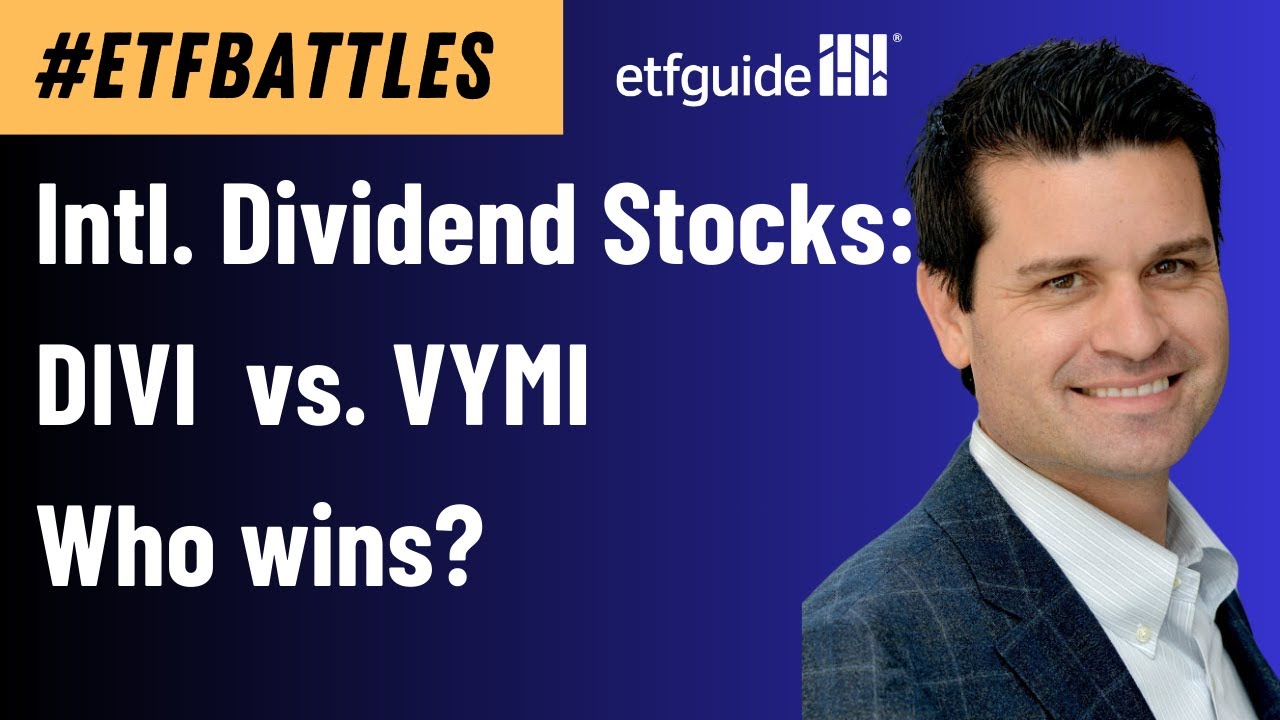
After many years of underperformance, international stocks have turned it around and are thus far outperforming US stocks in 2025. Statisticians call that reversion to the mean. But what if we throw in some dividends to spice things up? Well, today's audience requested ETF matchup features a head-to-head contest between international equity dividend ETFs from Franklin Templeton and Vanguard. So, who wins the battle? Find out right after this.
You're watching ETF Battles. I'm Rod Delegi and this is season 6 and I hope everyone's doing well. If there's an ETF battle that you'd like to see, be sure to send me your ETF tickers in the comment section below or on our X feed at ETF guide. Also, be sure that your ETFs have a performance history of at least one year. So, we don't want to be analyzing ETFs that don't yet have a performance history of at least one year. It's just very difficult to really be able to complete the analysis without that.
Just keep that in mind. Also, be sure to visit the description section below. I've got links to our program judges. Get in touch. Plus, I've got a link to our program sponsor, Direction, and you can also visit direction.com. They continue to expand their ETF lineup. Keep in mind, this is a lineup that doesn't just include the leverage and inverse ETFs on broader indexes and sector indexes, but also single stocks. And we've seen that lineup expand.
So, be sure to check that out. And finally, ETFK Retire, our 401k solution for ETF investors. All of that in the description section below. So today's audience requested ETF battle is from a viewer named Michael and it's between international dividend ETFs from Franklin Templeton and Vanguard. Thank you so much Michael for this excellent suggestion and helping us to sort through the tabernacle of turmoil is a duo extraordinaire. We've got Shane Sisle with Banrian Capital and David Durking with the Street.com judges.
Great to have you back. Good to be here. Yeah, good to see you guys again. Thanks. So, we're going to blaze through our four battle categories, giving each of you an opportunity to give us your preferred ETF. For the mystery category, our judges can choose a certain factor or thing that they feel is important to today's matchup. Our judges can also nominate wildcard ETFs if they feel there's a better choice somewhere else.
Well, keep in mind one final thing before we get started that none of the battle outcomes are ever known in advance by myself or our judges. The first category is cost. Shaina, please get us started. Well, with this particular one, it's pretty easy. I love that I'm finally getting a battle that's only two funds. Sometimes there's like three or four, and that makes everything way more complicated. This is just easy.
So, it's Divvy is for the win for me with nine basis points is its expense ratio. It's spread versus by is not all that dissimilar. With 1.3 billion in assets, it trades very easily. It has plenty of liquidity here. So, VMI's expense ratio 17 basis points, substantially higher. And so, this is a pretty easy winner for me. Divvy is the winner.
That's a great start. Thank you, Shaya. Dave, how do you see it in terms of cost? Well, I'm actually going to go with VMI on this one. And Shane got all the numbers right. I just like that VMI is more liquid, a little more tradable. It's got the substantially higher asset base, so that tends to reduce spreads and trading costs a little bit. Total cost of ownership is pretty close on those, but I'm just going to lean towards the Vanguard fund based on liquidity.
That takes us next to exposure strategy. Dave, you're still up. So, break it down for us. How do these two ETFs compare? Yeah, I've never been a big fan of VM or VMI just because I think their strategy is just a little too broad, a little too unfocused. It does look at forward dividend yields, so that's a good thing. It's not looking at trailing yields. But it starts with its universe and it ranks everything by yield and the top half make the fund and then it's cap weighted.
So, I'd argue you don't really get as good a high yield strategy as you could by including that many stocks in the portfolio. And I don't think that cap weighting is necessarily the best way to do it either because it sort of neuters the fact that you're focusing on high yielders to begin with. So, I'm not necessarily a fan of VMI here. Divvy I don't think is necessarily a whole lot better. It takes a pretty broad approach although it does do some optimization to sort of reduce concentration risk and things like that.
So I'm going to introduce rather a wild card in this one. I'm going to go with the Schwab International Dividend Equity ETF CHY. And I'm sure anybody who's invested in dividend ETFs knows about SCHD. That's the US version of this one. SCHY is the international version. It takes a approach where it looks at dividend growth history. It looks at cash flows and roe to give it a good quality tilt on there. It looks at yield as well and it concentrates that down into the final 100 stocks that have the best composition score of all these factors.
So I think with SCHY, you get the high yield that you're looking for from international stocks, but you got sort of the background check of looking at quality and dividend growth on there as well. So I think you got a little more of a robust strategy. So I'm going to go with SCY is the winner in this one. Thank you, Dave, and appreciate that wild card nomination. Shaina, you're up next. Give us your analysis.
So I'm going to agree with everything that Dave just said. I'm going to add just a little bit more color. Again, these are both passively managed funds that are replicating an underlying index. They're not really doing any active selection or anything of that nature. The main differences I can see between the two funds is one is developed country only and the other one includes emerging markets. It doesn't seem to be making much of a difference in the overall returns or composition in terms of the sector and industry waitings but there is emerging markets in the Vanguard product and there is not emerging markets in the Franklin product.
I also find it interesting that Franklin is an ex North America. So it does not include Mexico or Canada whereas the Vanguard one's just ex USS. So it would include any other North American country beside the US. So it's got a broader mandate which probably is what drives the significantly more holdings that it has at almost 1500 names. It says it uses a sampling effect, but I don't know how much of a sampling it is when you've got 1500 names. Whereas the divvy fund still has a ton of names, 440 plus.
So both of these funds are, you know, big funds with a lot of holdings. They, you know, the Franklin one's looking at trailing 12 months, the Vanguard one's looking at forward 12 months. But those are the little differences between the two. Despite all of that, you know, their performance returns are pretty similar. To be honest, Vanguard will do a little bit better when emerging markets is outperforming. But I agree with Dave.
I don't like this kind of like very broad net that they throw out there. I think there are better ways to do this. I agree with the wild card that Dave put out there. I'm going to throw out a different wild card. It's actually a really small fund, so it might not be for everybody, but when I look at it, I I like the active management and the more concentrated nature of it. And that is the Global X, MSCI super dividend ETF, ticker EFAS. It only has 50 names in it.
And it's much more concentrated. It's equal weighted, so you don't have a market cap bias. It is just developed. So it does reduce the risk of the emerging markets and it does screen for consistency and stability of the dividend and does not invest in anything that's yield is under 5%. So on that alone it's going to have a higher yield than any of the funds in the battle. Because they're just looking at the highest in a very large universe which is going to kind of water down the potential yield opportunity.
But it is a really small fund with a high expense ratio. So just cautious on that end. But when I'm thinking about what I'm looking for, I'd want a slightly more concentrated if I'm going to be focused on dividends, I really want a focused product on dividends. And so that's why I'm going to throw out EFAS as my wild card here. Again, with the caveat that it is a small fund with a high expense ratio. I think methodology wise and exposure strategy.
There's a lot to like with that fund though. Makes sense. And you mentioned earlier sampling, index sampling. Maybe you can just clarify to some of our audience members that might not be familiar with how that works. What what is sampling? So sampling is just a fancy word for optimization. So they're not actually owning the underlying index. They're creating an optimized strategy and then sampling names out of it.
So it's not holding everything in the index. It's just looking to replicate the exposures on a high level. So, it may or may not look exactly like the index. Just because you do sample doesn't mean that you won't look like the index. I helped build an optimization tool when I was at Orion that I used quite a bit. And it didn't necessarily mean I didn't buy all the things in the index, but sometimes just from an optimization standpoint, if it's a very small waiting in the index or something like that or something that's hard to trade, you might leave it out.
I will note that Vanguard does not invest in REITs. So they completely take that out of the index. So that would be an example of sampling. Because the index does include reads. So there's different ways to do that. But the idea of sampling is you're not doing a like to like like if I bought the S&P 500 and I wanted to replicate the S&P 500 perfectly, I'd buy all 500 names.
But if you're doing an optimization and sampling from the index, you might only own 350 names. and it will take into consideration things like liquidity and and what how much you can own as far as awaiting considering how much you have in assets. Those are the kind of things that you know are worth considering. Yeah, thank you so much for that clarification. Helps helps with our understanding of how that works behind the scenes.
So that takes us next to performance and yield and we're going to look at how these two ETFs compare. So Shaina, give us your analysis, please. So, VYMI, if you look at just sheer yield at 4.40%, is the higher yielding of the two, but they're not all that drastically different. Divvy is at 4.10. Performance-wise, again, VMI, it depends on the period. They kind of go back and forth.
But the standout between the two is the one-year and the 5-year. VMI really does shine but again that's largely due to the fact that it includes emerging markets and the divvy does not. I also like to point out that divvy is hedged in terms of its currency which means that it's not getting any potential return or lack thereof from having currency exposure. And so those things make it a slightly more conservative fund. But that being said, because it is kind of minimizing some of the risks that you have with currency, not hedging currency and not including emerging markets, I'm actually impressed that it's able to perform as well as it has without having those higher risk areas where you actually can get some return.
But I have to give this win to VIMI because like just surely on the numbers, it has a higher yield and it has better overall performance if you look at just the cumulative performance over the period. So that's my winner. Dave, you're up next. How do you see it when it comes to performance and yield? Yeah, Shaina said a lot of what I was going to say too and she hit on all the numbers that I was going to hit on. Performance-wise, it's pretty close.
If you look at the last 5 years, VMI comes out a little ahead. If you look at the time frame since since Divvy launched, it's a little ahead. So I think performance is substantially similar for both funds. Like she said, yield, there's a little bit of a yield advantage on VMI. One other factor that I will throw out there is the consistency of dividends on a quarterly basis with these funds. And international dividend equity funds in general are going to see a lot more swings and quarterly payouts than you'll typically get with US dividend ETFs.
So, you've kind of got to expect that a little bit going into investing in one of these funds. VMI, just looking at the range over the last several quarters, has paid anywhere from 60 cents to about a dollar a share quarterly in dividends. Divvy has had a range of anywhere from as low as 2 cents up to 85 cents. And you know, the absolute numbers there aren't necessarily relevant because everything's relative to the share price, but it's more just to give you an idea of kind of, you know, the range of income you can expect to see with those funds. So, VMI, I like that it has a little more consistency there, even though it's volatile.
So, I'm going to use that in the yield as kind of my differentiators. I'm going to call VMI the winner as well. All right, that takes us next to the mystery battle category. This is where our judges can pick a certain factor or thing that they feel is crucial to today's contest. So Dave, what is your mystery battle category and which of these ETFs wins it? Well, I'm going to talk about something that I think is really relevant today and that's tariff exposure and that kind of piggybacks on what Shaina was talking about earlier with geographic distribution on these funds.
With Divvy again, like she said, it doesn't have any emerging markets exposure. It's ex North America, so it doesn't have any Canada exposure as well. It doesn't have any China exposure. This portfolio is heavy in Euro zone stocks and it has about a 20% allocation to to Japan. So, you're really getting developed Asia and developed Europe in this portfolio. The Vanguard Fund again is more emerging markets heavy. It's got Canada in there.
It's got China in there. It's less exposed to Europe and Japan. So, it really kind of comes down to, you know, which area of the world you think might be more exposed to the current trade environment. And VMI, I'll point out as well, if you look at individual countries, it's got small exposures to like Taiwan and India and Indonesia. And individually, it's not much, but it does add up. So, again, it just comes down to what you think is going to be more exposed.
I would lean more towards Divvy as my winner just because it doesn't have some of the China exposure and some of the emerging Asia exposure, but it could literally go either way depending on on what happens. And we've seen so much volatility on the trade front that it's difficult to tell. But I will call Divvy the winner in this category. Shaina, you're up next. What is your mystery battle category and which of these two ETFs wins it? So Dave kind of went the same direction I was.
I didn't take the tariff angle, but I was going to talk about the risk in the two portfolios, which you know is in my opinion the emerging markets versus non-emerging markets. And I didn't even think about the tariff aspect of it to be honest because I I don't even know what that's going to look like. Literally before I came on, I was listening to CNBC with the Secretary of Commerce and walking through, you know, the vision for the tariffs and what might actually be put in. And then also whether or not the companies are doiciled somewhere else is irrelevant.
It's more of where they manufacture the goods. So like it gets very complicated. So I didn't go there. But I will say let me just let me just interject. I'm going to tell you how it the the plan here and how you what's shuck shook out or shook out. It's scrambled eggs and sloppy joe's. Exactly. It like doesn't make a whole lot of sense. So, it's really hard for me to look at this and have any vision for what this might how it might be impacted by something that like is really messy right now.
And you really have no way of kind of looking at it. But I am going to talk about similar things. I'm looking at the risk exposures of these strategies, right? So, I'm looking at, you know, where what would bring risk into the portfolio. Emerging markets is inherently more risky, higher beta historically and by including that and then and you bring in the currency factor which I touched upon in the previous segment about exposure strategy and performance.
If you bring in the the currency exposure and not hedging the currency, the Vanguard fund is just larger potential risk in the portfolio. So, it's not my favorite for that. Now, all of those things also give it greater exposure to tariffs because if you think about tariffs, they're disproportionately on some of those emerging market names. But overall, I'm just thinking about portfolio risk. And when I look at the portfolios and I look at the performance differential you know divvy does underperform at times but considering that it has so much less risk in the portfolio I I'm more comfortable with that.
I I think most people that invest in a dividend paying fund of any kind are tend to be more conservative. Anybody who's more income oriented tends to have less risk tolerance. So looking at that I just want to point out that divvy would be my winner in that sense. I also want to bring back in that wild card I mentioned EFAS. That fund also is developed markets only but it is only developed markets XUS. So it includes Canada and Mexico.
It is highly concentrated but its performance and its yield is substantially better than the other two. So overall, I think I want to look at a portfolio that is inherently less risky when it comes to risk in general because there's less concentration in Divvy and because it doesn't have emerging market or currency exposure, it is my winner in the category. And that's the those are the things that I think somebody who's investing in a dividend paying fund is going to be concerned about. Well, we've reached the part of the program where our judges are going to give us their final overall battle winner.
How will this go down? Shaina, give it to us. So, I think we kind of alluded to this in the beginning, which is that neither Dave nor I love either one of these products. I don't love the passive aspect of them. I don't think that they have enough focus on dividend. And as a result, I think they could be slightly more concentrated and have better outcomes. So, I'm going to give the winner to my wild card, which is EFAS.
Again, with the caveat, this is a very tiny fund with a high expense ratio, so it's not going to be for everybody. But I do like the way that they execute the strategy. And candidly did not spend hours looking for a wild card and more so looking at, you know, a strategy that had inherently less risk and a better yield profile. And this is the product that came up with the screens that I ran. It is just a a better methodology in my opinion and if I'm a dividend focused investor it is developed market only.
It focuses on having high dividends. You're pretty much assured to have a dividend of higher than 5% on a consistent basis since that's part of the process and the imple implementation of the strategy. And so for that reason EFAS is my winner. But if I had to choose from the battle, I'd pick Divvy. All right. Your final chance to weigh in, Dave, with your overall winner.
And I'm going to go with my wild card as the winner, SCHY. Yeah, for all the reasons Shaina mentioned, I if you're going to invest in international dividend stocks, I think there's just better ways to go about it than the two that we've been talking about here. I like multiffactor approach. I think that's important when international investing. If you're going to invest in international high yield stocks, I think that may be even a little more important.
Although these portfolios as a whole tend to be a little more on the conservative side of things, but I just think has a better strategy. It's low cost. You're selecting stocks based on a number of factors. I will mention the caveat here that total return performance over the long term has been lower than the two funds we've been talking about here. So, that might be a consideration if you're judging on past performance, but, these funds are all index based.
So, I'm not hugely concerned about it. I like the strategy going forward. I think it just makes more sense over the long term. Well, our judges have weighed in and according to my final battle scorecard, this is a split decision between SCY and EFAS and both of those were wild card choices from our judges. Of course, SCY nominated by Dave.
That one is from Schwab. It's a multiffactor approach which again doesn't just look at dividends but other factors like quality and also it's low cost. So that that one was Dave's favorite as far as dividend strategies in the international space, SCHY. And as he mentioned, it it is basically the counterpart of the better known CHD, which is focused of course on US dividend payers. And then Shaina mentioning the Global X ETF, EFAS.
And she liked this one the strategy just for its more concentrated exposure just 50 stocks also it's equal weighted she did give us those caveats that it is a higher expense ratio smaller asset base so do keep that in mind but she really liked that strategy and she made some strong arguments I think one of the lessons from today's program is that you can sometimes be too broad and sometimes what we call overdiversified where you own too much of the same thing and not enough of the right thing. And our judges brought that to light. Well done, Shaina and Dave. We couldn't have done it without you.
Thanks so much for having me, Ron. Thanks. It was good seeing you guys again. Well, be sure to visit the description section below. We've got links to our program judges. And while you're there, check out the link to our program sponsor, Direction, and be sure to visit direction.com. Which ETF battle would you like to see on our next episode?
Send me your ETF ticker symbols in the comment section below or on our X feed. I'm Ronda Ley. Thanks for watching ETF Battles. We'll see you next time.