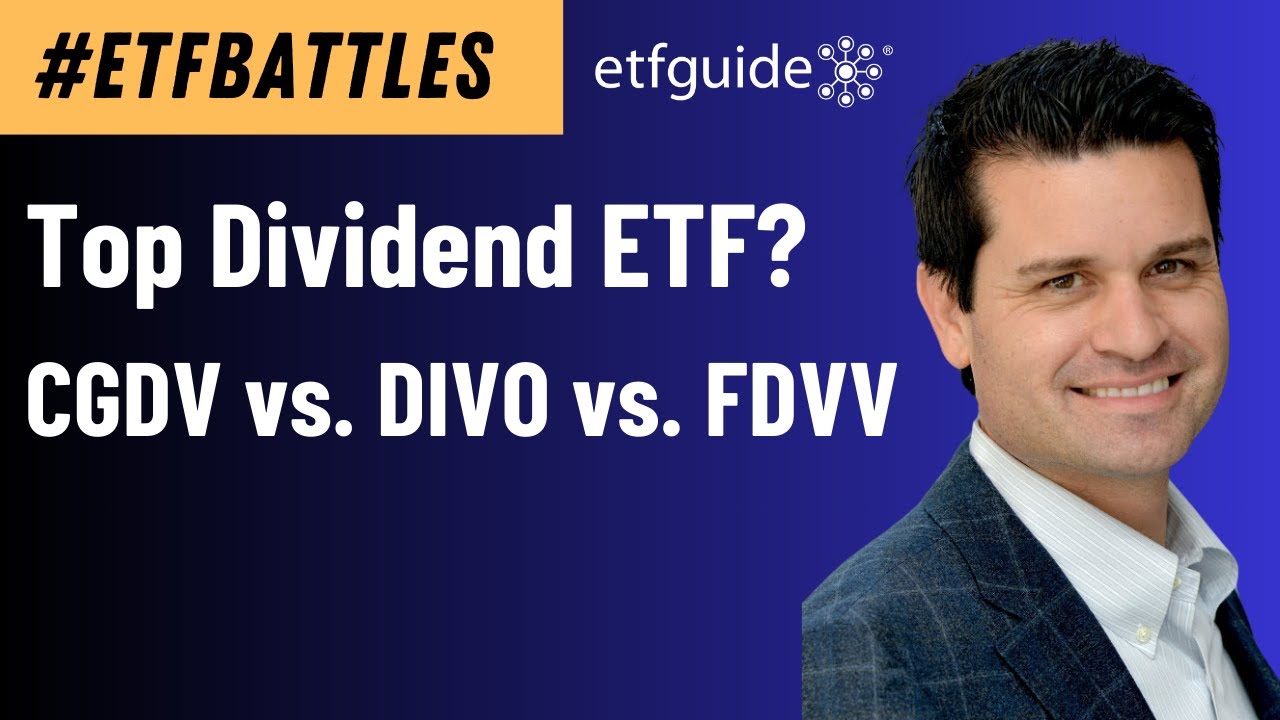
ETF Battles: A Dividend Income Duel with CGDV vs. DIVO vs. FDVV!
Historically, dividends have played a significant role in the total returns of the S&P 500 over long periods of time. Dividends, for example, have contributed to roughly 30 to 40% of the total returns of the S&P 500. That means that a substantial portion of the index's overall performance can be attributed to reinvested dividends rather than solely on capital appreciation.
Today's audience requested a dividend ETF battle between three ETFs from Amplify, the Capital Group, and Fidelity. So which ETF is the best choice? Find out right after this. A cordial welcome to all. You're watching ETF Battles, we're in season six, and I'm Ronda Legi. If you're new to the program, welcome aboard. Be sure to hit that subscribe button to join our community and also hit the like button if you've been enjoying the show.
If there's a certain ETF contest that you'd like to see, send me your ticker symbols in the comment section below or on our X feed at etfguide. We could do double, triple, and quadruple headers, so make it good. Don't forget to visit the description section below. We've got links to our program judges along with our program sponsor, Direction, so be sure to get in touch. We've also got lots of viewer resources with links to free audio and ebooks, so don't miss it.
Today's dividend ETF bout was requested by a viewer named Regal Garcia, and it's between dividend-paying ETFs from Amplify, the Capital Group, and Fidelity. This is going to be a good one. There's a lot of interest in dividend-paying ETFs, so how will this go down? Helping us to sort through it is a duo extraordinaire. We've got Shaina Sisco with banry and Capital Management and David Durkin with the street.com. Judges, great to see you again, happy to be here.
Our four battle categories are cost, exposure strategy, performance and yield combined, and then we've got our mystery battle category. Mystery is, of course, where our judges can surprise us with any factor or thing that they feel is important to today's contest. Our judges can also nominate Wild Card ETFs if they feel there's better choices elsewhere. I've got the scorekeeping chores, and at the end of the program, we'll declare an overall winner. Remember that none of the battle outcomes that we ever do on this program are ever predetermined or known in advance by myself or our judges.
Let's kick things off with the first category, cost. Shaina, please get us started. All right, so for once, I'm in Dave's world. This is a little different than the traditional alt battles, but I take the challenge. When I look at this from an expense ratio standpoint, FDVV, which is the Fidelity Fund at 16 basis points, is the cheapest fund. Now, it doesn't have the best trading spread. That actually belongs to CGDV at one cent, but the difference in the overall expense ratio is so significant that it more than overcomes that. So for me, it's Fidelity FDVV at 16 basis points.
Dave, you're up next on cost. How do you see it? Well, Shaina, I appreciate your kind words. I'm still honored to be in the presence of the queen of alts. Stop. Yeah, I agree. FDVV at 16 basis points is my winner. I think liquidity is still pretty good on all of these funds. CGDV, like Shaina said, has the narrowest spread out of them, but as far as pure expense ratio, I think we'll keep it simple. The Fidelity Fund is the winner.
Exposure strategy is the next category, and Dave, you're still up, so break it down for us. I was in a battle a little while ago where CGDV was included as well, so I will make the same complaint today as I did then, excuse me, and that's to say that I don't like the strategy of the fund where it says it targets companies that pay dividends or may pay dividends. Basically, that just means it can include non-dividend payers. I don't think that you necessarily want that kind of strategy if you're looking at a dividend-paying fund.
Now granted, if you look at the portfolio, the vast majority of them are dividend payers, so you are getting a large-cap dividend fund in there. The last time I looked at this portfolio, it had Meta, it had Google, it had Salesforce. These are all before they were paying dividends, and obviously Meta and Google are paying dividends now, but even in the portfolio today, there's Amazon, there's Uber. These companies aren't paying dividends. I just don't understand why they're in there. I know it gives it a bit of a different profile, but I like my dividend ETFs to be kind of pure plays, and CGDV just isn't quite there.
FDVV has a similar problem. If you look at the index it targets, it looks 70% yield, 15% on the payout ratio, 15% on dividend growth, and how it selects companies. You have the heavy tilt on yield, obviously, but you do get a bit of a dividend growth and quality component in there as well. The issue I have with this fund is that its waiting strategy, once it gets those companies, it heavily tilts towards cap waiting, and what that does is it lifts the mega caps up to the top of the portfolio regardless of what they're paying. If you look at the top four holdings of FDVV, it's Apple, it's Nvidia, it's Microsoft, and it's Broadcom. Those four companies account for nearly 20% of the portfolio, and Broadcom is the only one that's paying even a 1% yield right now, so it doesn't really line up with the high-yield nature of the fund.
Now, if you look at the fund overall, I'm getting a little ahead of myself here, but it pays a 2.7% yield, so it isn't above average yield, but I just don't like how it allocates properly according to what the true objective of the fund should be. DVO is a little different. That's a concentrated portfolio that focuses on dividend payers, dividend growth stocks, and then it layers the covered call strategy on select stocks on top of that to give it the big yield. This takes more of a traditional kind of quality approach. It looks at dividend growth, earnings, cash flows, things like that. It does have a very cyclical lean right now, so I think you need to understand that before jumping in, but I'm going to give the win here to DVO just because I think it does a little more of what I think a dividend ETF should do with the caveat that you need to understand what the fund is. This is a covered call fund, so you're going to be giving up some upside potential in exchange for that higher yield, so with that understanding, I'll give DVO the narrow win on this one.
Got it. Shaina, you're up next. How do you see it when it comes to exposure strategy? As the queen of alts, of course, I'm going to be drawn to the one that does a bught strategy, but it's actually not my winner. I have a wild card for my winner, but let's kind of walk through and add to some of what Dave pointed out. I'm going to start with CGDV, and to add on to what Dave already talked about, I personally hate the way Cap Group manages their products. This approach, where they're so large in their assets, what they end up doing is they have groups of managers, they have teams of PMS, and they all work together, and what Cap Group does is they sleeve positions of the portfolios to different teams, but none of those teams invest the same way, so it makes it really hard to have consistency when you look at the portfolio and know what you're getting because one team could be doing the approach that Dave's talking about, which is what's leading to having some of those growth year names, while the other team could be really actually focused on dividend, and you really don't know.
For that reason, it's just very the Cap Group funds, and I know they're very popular American funds. Obviously, Cap Group is massive. It's very popular for a lot of reasons, which I understand, but for me, I want somebody who takes ownership of the strategy, so I know what I'm getting. I know how to understand the return streams. I know what's going to drive returns in certain markets, but when you have multiple teams that aren't doing the same thing, and you mishmash them together, you don't get anything that you can work with to set expectations for returns or what that portfolio is going to look like at any given time, so that is, for me, my biggest issue with CGDV.
Now, with FDVV, it's important to point out that it is actually not managed by Fidelity. That is sub-advised by Geode, so it's not even really managed in-house at Fidelity. That said, I do like that at least in that product, there's some structure to the way that they screen, and unlike the Cap Group fund, I know what I'm getting. I know the positives, I know the negatives, and I can set somewhat of a return expectation. Obviously, I like DVO because it's a buo strategy. I'm going to be attracted to the thing that's doing the more interesting alternative kind of thing to add to the product. It has the highest yield, and it has a good track record. It's very attractive.
However, if I was just picking from the three we had, DVO would be my winner, but I wanted to think about the audience. We're doing a high-yield dividend battle, and I'm thinking, well, if I'm going to suggest to somebody a strategy that's going to be kind of pure in that sense, and I want high yield and dividend payers in my portfolio, what would I use? For me, that is DHS, which is the Wisdom Tree High Dividend Income Fund. It addresses some of the market cap issues. Wisdom Tree exists because they thought market cap-weighted indexing was the wrong way to approach building portfolios, so they don't do market waiting. It is highly diversified. Believe it or not, most of the funds in this battle are actually really concentrated, which is so weird for me because there's so much money in so and in the case of CF Group, so many people with their hands in that bowl there.
The thing I like about the Wisdom Tree fund is it requires that anything that's in it paid a dividend in the last 12 months, so it's going to hold stuff that paid a dividend because they cannot hold something if it never paid a dividend, so it kind of addresses some of the concerns they brought up. It doesn't require that it paid a dividend like for two years or three years. It's like in the last 12 months, so it actually will have a growth or tilt to it because it can take advantage of newer dividend payers, and if a company newly established a dividend payment, that's usually a good sign for the direction of the company, the stability of the company, and the quality of the company. It has momentum screens, and it has quality screens in their risk metrics that it looks to remove some of the risk in the portfolio. It removes any company that's in the bottom desile of the universe in their composite risk score, which includes quality and momentum factors, and it removes any stock that's a top 5% rank dividend yield that is in the bottom half of that composite risk score, so removing some of the lesser quality names. It is kind of heavy in healthcare. It does tend to have a couple tech names, but it isn't going to have a tech name in there that doesn't pay a dividend.
I think that's of value. Of the battle participants, it has the second-highest yield at 2.88% distribution yield. DVO obviously is going to have the highest because it's juicing its yield by doing the bu rate strategy, but if you are somebody watching this battle and you're just like, look, I just want a dividend focus fund in my portfolio that's going to give me above average yield, and you know, like diversified quality exposure to the market, I would recommend DHS, which is a Wisdom Tree fund.
That takes us next to performance and yield, and Shaina, you're still up, so give us your take. If you look at overall the performance of these funds, the Fidelity Fund FDVV has the strongest overall performance over all time periods, except for the current time period if I throw in DHS, but we'll leave DHS because I don't want to confuse this. For me, it's the Fidelity Fund. It has done the best. One month, it's done the best. Three month, year-to-date, it's a little behind, but it crushes the other two in the one year and the three year and the five year, so for me, it's the Fidelity Fund, just going to make it clean and easy and base it just on the performance, and that's the fund that wins.
Dave, you're up next. How do you see it when it comes to performance and you? Same thing. Fidelity Fund is the winner for me on a total return basis. I agree. I don't need to repeat the numbers. Since we're considering yield in here, I guess it really depends on what you're looking for. If you're looking for a high yield and you're kind of looking purely at yield, DVO is probably the one you want. It's currently paying almost 5% right now, but again, that's just not a traditional dividend equity type fund. You're going to be making some tradeoffs in order to get that yield, so if you're just kind of a pure income seeker, then DVO works well. Other than that, I'm going to go with the Fidelity Fund too.
That takes us next to the mystery battle category where our judges can surprise us with their factor that they feel is crucial to today's contest. Dave, what is your mystery battle category? My category is going to be factor tilts, and I want to look at that because of some of the reasons that I mentioned before with CGV kind of dipping into non-dividend payers and the Fidelity Fund kind of waiting, so it lifts a lot of the mega cap tech names to the top. The Capital Group and the Fidelity Fund, they both categorize as large gap value according to Morningstar. If you dig down into the factors a little bit, CGDV does have more of a growth tilt, which is consistent with what we've seen in the past, does have some higher volatility, which is consistent with the composition of the fund we've seen in the past, so it does kind of tilt in the direction that we thought it would.
FDVV, it lags a little bit on yield in that in the large value category, not a lot though. It also has higher volatility. It also has a higher momentum factor, which I think is probably due to the mega cap tech waiting at the top of the portfolio, so you kind of again get what you're expecting there. DVO is in its own category in the derivative income, so it also skews value, does have some lower volatility. It's a little lower on the quality till, but not much. It's much closer to what you'd expect to see out of maybe more of a traditional dividend ETF because I don't think you necessarily want high Vol, high volatility, or high risk within these. You kind of want your predictable income stream, so I think DVO is my winner in this category just because it's a little more of a conservative approach, focuses on the yield. Again, you've got some concentration in the holdings there, which you know may not be ideal, but I don't think it really skews things too much, so I'm going to go with DVO is my winner in the factor category.
Shaina, you're up next for your mystery B category. What is it, and which of these ETFs wins it? I ask the audience what their objectives are when they buy a dividend income fund. Is it just pure play yield? Because if you're just looking for yield, there are better ways to incorporate that in your portfolio by focusing on BuyRight funds and things that are generally managed to maximize the yield that they are able to generate from the underlying portfolio strategy, but that's different than if you're buying high dival in companies because you think that that is a reflection of a higher quality company with more stability, and that's what you want in your portfolio.
If I was building a portfolio, and I think about when I worked at Fidelity, I actually did cover div paying stocks. It was dividend growth more than it was dividend income in general, but I have a little bit of experience here in evaluating these names, and you have to know why you own the name. If we're going to do a dividend battle, I'm going to come to it with the assumption that the reason I own it is for the fact that there are qualities with dividend payers that I find attractive and that I want my portfolio and not necessarily putting it in my portfolio to generate yield because that's when you do that. Sometimes you bring in more risk because higher dividend-yielding stocks could very well be more risky and not be as stable because things like MLPs and REITs can fall into that category.
With that said, DVO is my winner if you're thinking about it from a yield standpoint. However, I think there's better ways to do a BuyRight strategy and get distribution and yield than what DVO is doing. If I am thinking about it from the standpoint that I mentioned, I am going to choose my Wild Card, which is DHS, which is bringing me the attributes that I attribute to higher dividend, high dividend, and dividend-paying stocks, and I want the growth more than I want the yield because the growth is a sign of quality in a way that yield is not. Yield can go up because the stock got hammered, so a dividend yield and just focusing on the income can bring into your portfolio risks that maybe you didn't think about. For me, I want to focus on a stock, a portfolio that is only investing in stocks that pay a dividend and with a focus on quality and dividend growth because that's going to put the names in my portfolio that bring the most positive attributes to my portfolio in terms of quality, so for that reason, I am choosing DHS as the winner of my mystery battle category.
We've reached a part of the program where our judges can give us their overall battle winner, so how will this go down? Shaina, give it to us. I don't know that I have to say much more than I just did. DHS is my winner of this battle. I'm coming at it from the standpoint of why do I own a dividend-paying or a dividend-focused ETF if it's equities? It's usually not because I'm looking for yield, but it's more that I'm looking for the qualities that typically are attributed to divin-paying companies, and so for me, it's DHS, and so that is my winner. I won't go and say what I already said over again.
Dave, your final chance to weigh in with your overall winner. My thought process is kind of the same. CGDV is out for me. I just can't get behind the idea of a dividend ETF including non-dividend payers. If I'm going to invest in a dividend ETF, I want dividend-paying stocks in there, and granted, it's a small percentage that's non-dividend payers, but it just potentially gives it a bit of an opportunistic feel to it, and I think we saw that recently when it was kind of heavily tilted towards tech, and you look at the allocation now, tech is only I think the second-largest holding, and it's less than 20%, so I'm going to cross that one out.
The Fidelity Fund does better. I don't like the tech-heavy tilt at the top of the portfolio, and especially since the top names in the portfolio all have less than 1% yield, I think you're structuring, kind of your the way you're constructing the portfolios off if those are the top holdings in what's supposed to be a high dividend yield fund, so by default, I'm going to go with DVO as the winner. I don't think it's necessarily a bad choice if you're looking for dividend yield. Obviously, it's not a traditional dividend equity ETF, so you have to understand that before just jumping at the 5% yield, but I do like the underlying portfolio. I think it does do a little a better job of focusing on the factors that you need to that are helpful when investing in dividend stocks, and it has a five-star Morningstar rating too, so I think that works in its favor, but I do like Shaina's suggestion of DHS as an alternative. I do like the Wisdom Tree funds. I think they do do a good job, so within these three ETFs, I'll choose DVO, but I do endorse the DHS choice as well.
Our judges have spoken, and according to our battle score SC card, today's winner is a split decision between DHS, which was the Wild Card offered up by Shaina, and DVO, which was Dave's choice, and both of our judges made strong arguments. Shaina liking DHS for its quality and momentum screens, also looking at the dividend payers, pay companies that have paid a dividend over the past 12 months, and as well as that factor of dividend growth, so DHS checked all the boxes for her. As far as Dave is concerned, he raised some great points about DVO, of course, using not just a traditional dividend strategy, but also adding that layer of covered calls and juicing those yields, but with higher yields and covered calls, you're also capping some of the upside gains potential that you're going to have in that portfolio, but both of our judges did a great job, and I'm really glad we were able to analyze today's dividend triple header. We couldn't have done it without you. Thank you so much for having me, Ron. I really appreciate it.
Thanks, Ron, good to see you, nice work to both Shaina and Dave. Be sure to hit the description section below. We've got links to both of our program judges. We've also got links to our program sponsor, Direction, so don't be a stranger. Which ETF battle would you like to see in our next episode? Hit me up with your ETF ticker symbols in the comment section below or on our X feed at etfguide. Don't forget to hit the subscribe button, join our community, and that does it for today's episode. Thanks for watching ETF Battles. I'm Ronda Legi, and we'll see you on the next program.