ETF Battles: - Active vs. Passive Triple Header - ARKK vs. QQQ vs. SPY!
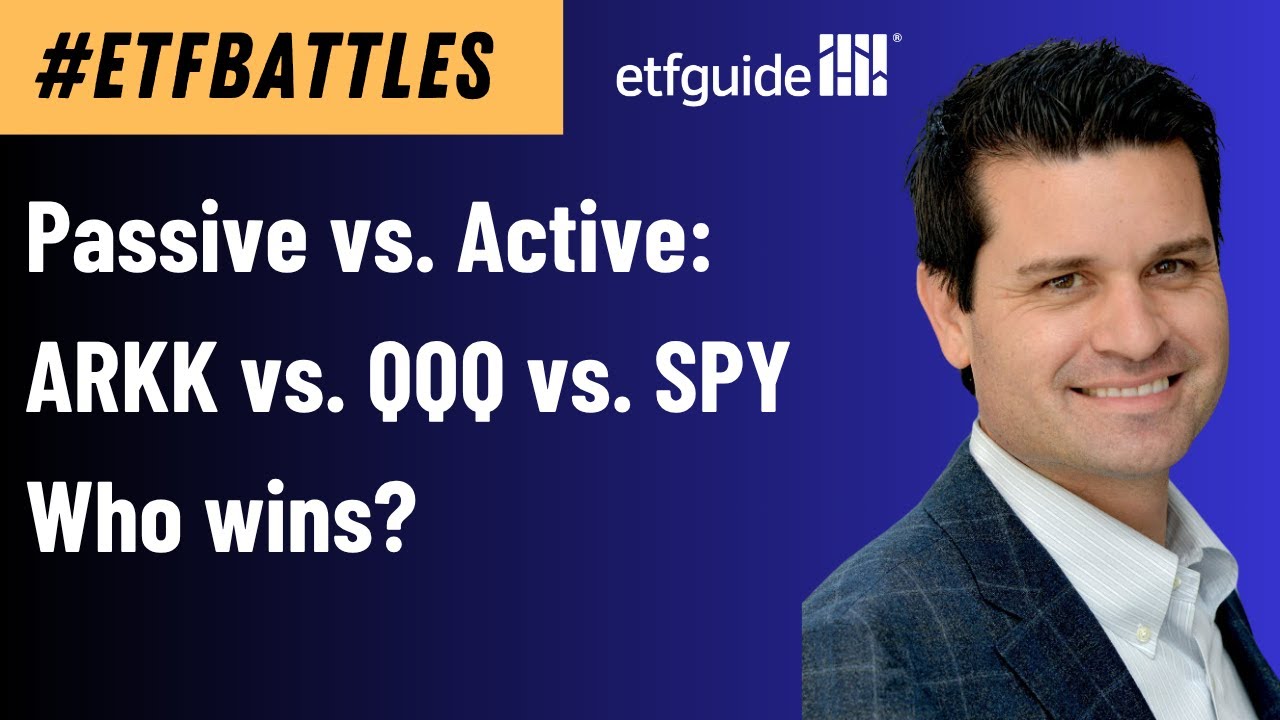
Well, the investing debate of active versus passive is one of those neverending arguments. It's like Republicans versus Democrats, Yankees versus Red Sox, Mozart versus Beethoven. I mean, it never ends. And for today's ETF battle, it's a triple header of an active versus passive.
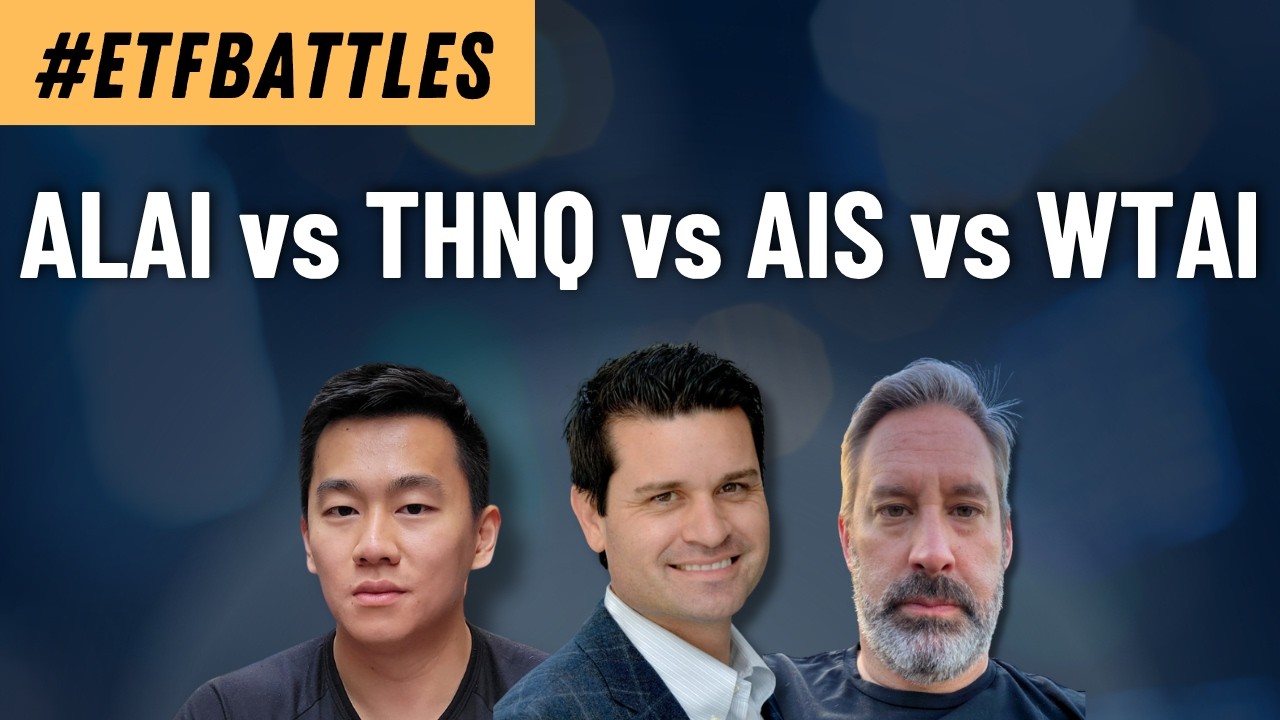
This time between the actively managed ARK Innovation ETF, that's ticker ARKK, overseen by Cathy Wood and the Triple Q's from Invesco and the Spider S&P 500 ETF from State Street Global Advisors. Now, once upon a time, ARKK was once the largest and best performing active ETF out there. And since then, it has struggled and is still looking to rediscover its mojo. Helping us to judge today's matchup is Dave Krenis at ETF Portfolio Management and David Durkin, an independent ETF analyst with a newsletter called ETF Focus. It's available at Substack.
Guys, great to have you back. We're going to go through our four battle categories and we're going to give each of you an opportunity to give us your analysis. We've got the cost category, we've got the performance along with the mystery category, and of course, exposure. And by the way, the mystery category is where you, our judges, can surprise us with that thing, that factor that you feel is crucial to today's matchup. It's completely up to our judges. You can also nominate wildcard ETFs. I have a feeling we'll get some of those.
You can also opt for split decisions if you feel that there is no clear winner. So keep in mind none of today's battle outcomes or analysis is ever known in advance by myself or our judges nor are they outcome is ever predetermined. So let's kick things off with the first category cost. David Durkin, please get us started. I think when you look at the absolute expense ratios on these funds, ARKK at 75 basis points obviously isn't going to win going up against funds like QQQ or SPY that are the biggest most liquid funds in the world.
But again, ARKK is actively managed. It looks into the high innovation areas of this economy. So you're going to pay for that. So I don't think 75 basis points is actually unreasonable for the strategy that you're buying with the fund. But on an absolute basis, SPY at 9 basis points is going to beat QQQ at 20 basis points. But I'm going to throw out a bunch of wild cards in this one. For QQQ, I prefer QQQM, which is the smaller, lighter version, if you want to call it at 15 basis points. So if you want to focus on that, I'd go with QQQM. It's cheaper.
And then, of course, SPY, you could go with VO, the Vanguard S&P 500 at three basis points, or you can go with SPLG, the SPDR Portfolio S&P 500 at two basis points if you really want to get dirt cheap on these things. So on a cost battle, I'm going to go with SPLG as the winner just because at two basis points, it's the cheapest of the bunch. Well, that's a solid start. Thank you, David. Dave Crrenis, you're up next on cost. How do you see it?
This is an important aggressive growth update. US equity has been the biggest long-term growth engine globally for quite some time now. And among these three battle ETFs, SPY has the lowest cost as Dave mentioned, although we do also prefer wildcard VO for even cheaper exposure to the S&P 500. And looking at cost on a value adjusted basis, QQQ and the lower cost QQQM have roughly double the systematic technology exposure through the NASDAQ 100. So on a value adjusted basis, I give the win on cost to wildcard QQQM.
All right, we got some agreement there among our judges. How does it look in the other categories? Well, let's go to exposure strategy. And Dave Crrenis, you're still up. So give us your analysis. For exposure, the S&P 500 and NASDAQ 100 both employ weighted passive indexing, while ARKK uses an active predictive strategy. And historically, the main evolution on Wall Street has been from predictive strategies to indexing. So I give the exposure win to QQQM for efficient technology exposure. And at our firm ETF PM, we do believe the NASDAQ 100 is the next generation S&P.
All right. Thank you, Dave. You're up next, David Durkin. What's your take? Yeah, I don't think we need to spend a lot of time on talking about what's in QQQ or SPY. I think everybody probably knows that already. ARKK is kind of I don't want to call it the wild card here, but it is unusual in how it's composed and it actually does provide a real good diversified add-on or satellite holding to one of the big index ETFs.
It's still mostly in large caps, so you're not differing a whole lot there. It gets a reputation as a tech ETF and it really isn't. Tech is about 20% of the fund and that's only the third largest sector holding. It's actually pretty well diversified between healthcare, you got communication stocks and the consumer discretionary sector is also big a big holding but that's mostly Tesla. That's the fund's top holding has been for a while. It's a little more concentrated. It's only got about 35 to 55 names. It's topheavy. You know Tesla at the top is more than 10% of the fund and then you got several more holdings that are at 7%.
So as far as a pure composition basis I kind of like ARKK on this one. You know the QQQ and SPY are great for long-term core holdings in a portfolio. I like how ARKK would fit in with these types of funds. It's very unique. There's not any overlap there. You really get some nice exposure to some of the nextgen tech exposure. So as far as exposure, I'm actually going to go with ARKK as the winner on this one.
All right, got you down for ARKK. That takes us next to performance. So, David Durkin, you're still up. Break it down for us. How do these funds compare? Yeah, the performance basis is really going to be dependent entirely on what time frame you're looking at. And you know, I don't need to tell anybody that ARKK has had some really high highs and some really low lows over the last few years. But if you go back over the last 10 years, ARKK, even with the volatility, has actually outperformed SPY by a narrow margin over the last 10 years.
But anytime between that, it's just been very hit and miss. It's up like over 60% over the last year, which is terrific. If you look at the annualized return over the last five years, it's only about 1%. It's almost break even just because of kind of where it's hitting those cycles. So if you're judging performance, I think you have to look longer term and the clear winner here is QQQ. I mean, it's vastly outperformed the indexes and almost any other ETF, any other growth ETF out there. So, I think QQQ or QQQM would be the clear winners here.
Dave Crrenis, you're up next. How do you see it when it comes to performance? On performance this past decade, the NASDAQ 100 strongly outperformed. ARKK and the S&P both delivered roughly two and a half times your money, while the NASDAQ 100 returned over four times. Adding leverage, the three times NASDAQ 100 wild card TQQQ delivered almost 16x and the three times technology tech returned 23x. This means tech gave you almost n times the return from ARKK and the S&P.
Still on a riskadjusted basis, I agree with my fellow Dave and I give the performance win to the more diversified NASDAQ 100 through either QQQM or TQQQ. All right. Well, that takes us next to our mystery battle category. This is where our judges can give us a single factor or multiple factors or a thing that they feel is crucial to today's contest. So Dave Crrenis, give us your mystery battle category. What is it and which of these ETFs wins it?
Ron, when it comes to portfolio management, I think all PMs will tell you that position size is critical. With regard to these battle ETFs, these two leading equity indexes could be over 100% of our active strategies when appropriate. While a satellite strategy like ARKK would typically be limited to a 10% position if we traded it at all, which we don't. So, I call the position size category a split decision between wild cards VO and QQQM.
All right. Thank you very much. David Durkin, you're up next. What is your mystery battle category and which of these ETFs wins it? Well, I don't even know what you'd call the category I'm talking about, but it's you kind of alluded to it earlier. Cathy Wood is pretty much a polarizing figure in the industry. Either you love her or hate her. And I kind of want to just explain why I like ARKK and I like what she does.
And I think it's really the fact that she has a very unique strategy with these funds and the other ARKK funds as well. But I have to respect the fact that throughout this entire cycle, she has stuck with the strategy on the fund, focusing on high growth, high innovation, high volatility, home run swings, and especially during the last few years when, you know, the Magnificent 7 has dominated the market. She resisted the urge to go into those stocks to chase performance. She really stuck with what she's known for and what this fund is targeting.
So, I think you kind of have to respect that. I think you have to appreciate the fund for what it's meant to be. And it's not meant to be a core holding. It's meant to be a satellite holding to build around core positions like QQQ or SPY. And I think it really does a good job of that. It's got a 90 90% plus active share, which means you have almost no overlap with the other big indexes. It's got relatively low turnover. So, she's kind of waiting for the stories of these stocks to play out.
But I think even when you look within the fund itself, some of the top holdings in there, I mean, it's got a lot of the popular stocks. It's got, you know, Palantir and Robin Hood and Coinbase and Circle was in there. That's been a real hot stock lately. So, if you look at some of the positions, you know, they're just the really popular stocks that are out there, the ones that are, you know, loved by the traders, they're used all the time, but when you put them in the ETF wrapper and you throw Cathy Wood's names on it, then all of a sudden people hate it. And I just don't really understand it. It's I think she's she's doing a good job. I like how this fund works. I like that she stick with the strategy. I like the objective of it. So, for that reason, I'm going to give her the category win in whatever this category is just because I like the fund and I like what it's about.
Very good. And that category, I figured it out what that is. It's called the Januz Qua, right? Perfect. The Qua, which for our French folks that I took French in school for eight years. Don't speak very much anymore, but I know that one. And that's used to capture an indescribable special distinguishing feature or to name some unnameable quality which I think very well describes the category that you're trying to hit. Perfect. We'll go with it. Excellent.
Well, we've reached the part of the program where we're going to give our judges a final opportunity to give us their overall winner. How will this go down? Active versus passive. David Durkin, give it to us. Yeah, I think it's kind of a challenge to put these three funds side to side and kind of measure them because they're really doing different things. QQQ and SPY obviously are sort of your big core portfolio holdings and ARKK is really meant to be kind of a satellite holding to build around that core.
So there's not a real good direct comparison, but I think I as far as if you're looking for something that's appropriate as the core of the portfolio, I'd go with SPLG as my winner just because it gives you that broad exposure. It costs next to nothing to own. Although I certainly couldn't make an argument with going with like QQQM as well. I think what for what you get, it's also very cheap. If you're looking for, you know, kind of building around that core of the portfolio, I'd call ARKK my winner just because I like the way it's constructed. I like what it does. It's going to again have high highs and low lows. You have to be prepared for that. You have to know what you're buying.
But I guess ultimately I'll call it a split decision based on, you know, what the investor's goal is with the investment, whether it's core or satellite, positioning. So, just so that I have this straight because I have to put this on my scorecard. Are you saying split decision between all three or split decision between your ETF nominations or wild? Yeah. I would call it officially a split decision between ARKK and SPLG is the ultra lowcost option. Okay. Just just so you know, that's what I had on my scorecard. I'm glad that I'm aligning with your thought process.
Dave Prince is your final chance to weigh in with your overall winner. Give it to us and don't be wishy-washy. I know you never are, but just give it to us. So, Ron, to recap this important aggressive growth US equity update, investors are reminded of the difficulty in outperforming the top indexes. This chart shows over the past 15 years, the NASDAQ 100 gave you 13x and TQQQ actually delivered 176x versus 6x for the S&P. So TQQQ delivered more than 27 times the S&P. And given the strong current trends in artificial intelligence, cryptocurrencies, and blockchain technology, I give the battle win to wild cards QQQM and TQQQ.
And all of that said, I should add that at ETFM, we do use leveraged ETFs and we liquidate or hedge positions when needed. We shifted defensively back in the crash of 2022 and again in the crash earlier this year. And over much of the past year, the market strongly favored gold and gold miners. There's just no way to accurately predict the timing and impact of geopolitical risk and market cycles. So investors must always be prepared for the unexpected and hedge risk as needed, especially when using leverage.
Well, thank you judges. And according to my final battle scorecard, this is a split decision four-way between ARKK SPLG, which was a nominated wild card from our judge David Durkin, and then from Dave Crrenis, he preferred the triple Q's via QQQM, and then of course the leverage version TQQQ as his choice with that focus on that heavier concentration and technology and AI and all of that stuff that is packaged inside the triple Q's and that certainly has delivered very strong performance historically and we'll have to see if that repeats or comes close if it does investors will be very happy and of course David Derky making his argument actually was quite surprising to hear his defense of Kathy Wood and it was a rational defense you got to you got at least respect the fact that despite some of the performance struggles that she's had over the past several years, it still controls a lot of assets under management. Six or seven billion. So that is a respectable amount.
And then some of those individual holdings within the portfolio have actually done been pretty good performers. So, we'll see if she can recapture her mojo. And of course, maybe the solution or one of the use cases for that type of ETF may not necessarily be one or the other, but maybe as as a complimentary piece of an overall portfolio, of course, complementing the passive portion. That's for those of you that are into active management. Could you imagine how much the street would love Kathy if she outperformed as much as TQQQ?
Well, yeah, definitely. I'd say that it's not just her. There's a lot of active managers that have been outperformed by TQQQ and just the unleveraged QES. It's been a very difficult yard stick to beat. And of course, SPY, S&P 500. I mean, that's that's a given. So, great points made by both of our judges. Thank you again, David and Dave, for sharing your insights with us. These are great, timely insights and keep up the good work.
Thanks, guys. Great to see you. Yeah, thanks for having me back again. And again, that was David Durkin with ETF Focus. Check that out at Substack and of course Dave Princes at ETF Portfolio Management. So, which ETF battle would you like to see on our next episode? Hit me up with your ETF ticker symbols in the comments section below or on our X feed at ETF guide. We could do double, triple, or quadruple headers. So, make it good.
One final thing, be sure to check out direction.com. That's our program guest. Lots of good ETF choices covering MAG 7, single stocks, including Nvidia, Palantir, and many others along with broad market indexes. So, again, check that out at direction.com. I'm Ry Legy. Thanks for watching. We'll see you on the next episode.