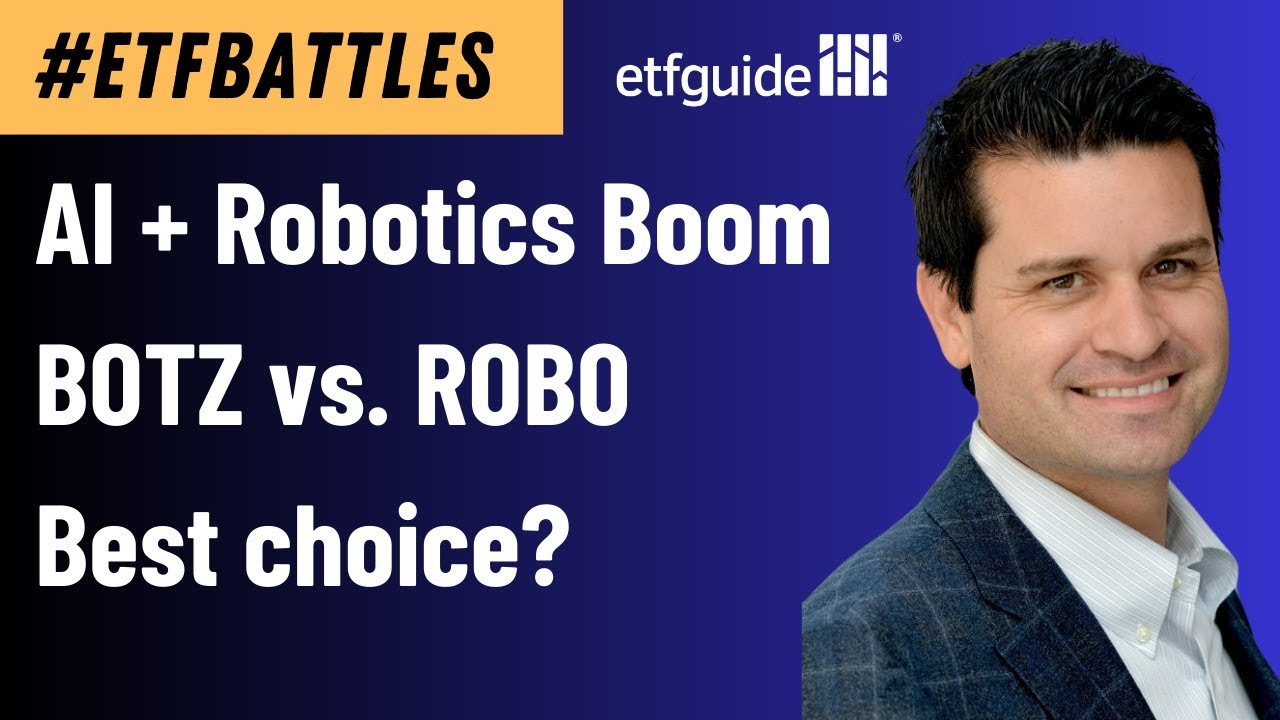
ETF Battles: BOTZ vs. ROBO- Robotics Rumble!
Well, today's ETF matchup is all about robotics. ETF A brings a diversified robotics ecosystem, the builders, the brains, the suppliers. Whereas ETFB swings back with a concentrated lineup of the biggest names in automation and AI. One spreads the risk, one bets on the Giants. Two ways to play the same mega trend, a rise in intelligent machines. So, which ETF is a better choice? We'll tell you the answer right after this.
Welcome to ETF Battles. I'm Ronda Legy. Yep, this is season 7 and we're analyzing and judging your excellent ETF battle requests. So, keep them coming. Hit us up in the comment section below with your ETF ticker symbols. Also, join our community by hitting the subscribe button. And be sure also in that description section below to jumpstart your financial future.
We've got smarter, safer, and robust strategies. Enroll today in ETF Guides free online courses. Whether you're looking to enhance your trading skills, improve the safety of your portfolio, or maybe you're planning for retirement, we got you covered. All courses available totally free to all of our viewers. Just hit the enrollment links in the description section below.
Today's ETF contest is a good one. It was requested by a viewer named Roger and it's between Robo from Robo Global and Bots from Global X. So which ETF is the better robotics play? Thank you Roger for today's ETF recommendation and suggestion. So, judging today's contest, we've got David Derkin, an independent ETF analyst and outside contributor at the Mly Fool, and Shaina Sisle from Banrian Capital. Two of the best in the business. Great to see both of you again. Welcome back.
So, our four battle categories are cost, exposure, strategy, performance, and mystery. Mystery is where you, our judges, can pick any factor or thing that you think is important to today's contest. Our judges can also nominate wildcard ETFs if they feel there's a better choice somewhere else or they can opt for a split decision. I've got the scorekeeping chores and at the end of the program we will declare an overall winner. Keep in mind none of the battle outcomes we ever do are predetermined or known in advance by myself or our judges. Let's start with the first category cost. Dave, please kick things off.
Yeah, neither one of these is going to compete with Vanguard anytime soon. This is kind of a battle of which is less bad as opposed to which is good. Here, bots is charging 68 basis points. Robo is at 95. So, high fees on both of these funds. Both of these have a lot of money in them. Liquidity is good. Trading is relatively tight. So, not much of a differentiator there. So, this is a pretty clear winner. Bots has a much lower expense ratio than robo.
Thank you very much, Dave. I got you down for bots. Shaina, you're up next. Tell us your viewpoint on cost. Yeah, I agree completely. These are fairly expensive ETFs with substantial asset basis. So, the fact they remain this high is interesting to me. Most ETFs will lower their fee at least a little bit as the assets get over a billion dollars. Both of these funds are over a billion dollars. So, it surprises me that they maintain these pretty high expense ratios. That said, we'll get into later why I think that is.
Bots is the clear winner. It's 68 basis points. It's substantially less expensive than robo. It has more assets. It has better tradability, better liquidity. So, bots is my winner. That takes us to our next category, exposure strategy. Shaina, you're still up. So, break it down for us. How do these two funds compare?
Yeah, so these funds are interesting. They are both based on indices. I'll save this for my wildcard category, but that to me is these are indexes that were created for these funds. So you know bots is really focused on the development production of whereas robo is more about the transformative aspects of robotics and AI. So they're both giving you exposure to robotics and AI but in very different ways. They generally have similar constraints and the guidelines in terms of you know whether or not they could a stock could be included are relatively similar.
Market cap minimums 200 million for robo 300 million for bots. You know market cap and concentration limits maximum size. They both have some information in here regarding IPOs and how they take into consideration that these tend to be IPO heavy industries and how do they bring IPOs into the mix. I will point out Robo has some ESG screens that they include which I think is really interesting and uses scores rather than other ways to market cap weight.
Instead of using pure play market crap cap Robo does a score and then it's weighted by the score divided by the sum of all the scores is how they weight. This is not market cap per se, but there is a market cap element to it. But the primary way is based on the score and pure play to the philosophy of the product. So, I think they're both really interesting. I do have a preference for bots. I do like that it's more in the production of the input. I'm sort of on the record that I like those types of names in environments. They tend to have less volatility and so on and so forth.
So I will point out Robo does have a volatility flag of 18%. So there's an 18% target ball score, which I do find interesting. But ultimately I think bots is a little more sustainable over a full market cycle because it's more of the inputs and less driven by consumer demand. So to me bots is the winner.
What do you mean by that volatility score? 18%. When I went and looked at the methodology for the underlying indices that each one of these ETFs uses it is in the index methodology that there is a robo target V score of 18%. meaning that they don't want the overall V of the portfolio to exceed 18% and so they actively monitor and manage the portfolio to ensure that it's not it doesn't exceed their V target.
I see. Thank you for that added detail. Dave, you're up next. Break it down for us on exposure strategy. Yeah, if you take a look at these two funds just from a high level, they look pretty similar. Their compositions are fairly similar. A lot of it as you'd expect is industrials and tech stocks. Both of them have a fairly heavy international exposure. So these are true global funds.
Bots is a little more large cap tilted. But for the most part, if you just look at a high level, you know, from a sector perspective or regional perspective, you think they look pretty different. And as Shaina mentioned, they've got some fairly different ways of constructing the portfolio. And you can see that in the portfolio overlap it's relatively low even though the highle composition of the fund looks similar.
So the big differentiator if you're looking at the numbers here bots has about 60% of its portfolio in the top 10 holdings. Nvidia is the top holding at about 10%. Robo only has about 17% in its top 10 holdings. So with bots you get a little more idiosyncratic risk in there. you get the robotics and AI theme, but you're a little more reliant on a smaller number of companies for success. Robo because it's a little more spread out and like Shaina said has that scored waiting methodology, you get your individual holdings spread out across a far far larger number of names.
So, really it comes down to whether you want concentrated or you want diversified. I personally prefer diversified. I think that's the way to go, especially in these thematic funds. So for me in this category, Robo is the winner. Well, that takes us next to performance. Dave, you're still up. So give us your analysis. How do these funds compare?
Well, over the long term, the performance of these two is pretty similar. If you go back to the bots's inception date of late 2016, the total returns are almost identical. I think it's like 180% to 170%. And I think that just speaks to the similar exposure to these themes that these two funds have. So if you want to look at the shorter term, Bots has done a little better over the last three years. Robo's done a little better recently. You're kind of picking hairs here a little bit, I think, on performance depending on the time frame. But I'm going to call this one a split decision. returns have been pretty similar historically for both.
Shaina, you're up next. How do you see performance? I agree with Dave, so I'm going to throw a wild card in here. For I take the risk of the viewers calling me a Kathy Wood stan, which is actually not true at all. I've never been a big fan of hers, but somehow she comes up every time I do a battle. I am going to throw in Arc Q to the mix as a wild card.
I believe that in thematic ETFs active managers tend to be the place you want to be especially when it is a fairly immature theme is tech robotics AI is actually a fairly new trend. It's fairly immature very early innings. You really want to have somebody who understands the disruptive nature and the innovation there. Robo has some of that. In fact, they actually tout the fact that they have four PhDs in robotics as advisers for the fund. But it's very clear to me that ARC Q, which is the ARC autonomous technology and robotics ETF, which is actively managed, focuses on disruptive innovation, similar theme, just absolutely crushes the other two in performance.
On a five-year number. The other two are roughly two and a halfish. You know, Robo slightly higher. RQ is up nine and a half% just over every single time period. RQ absolutely crushes these two. So, I think that speaks to the active management aspect of these types of strategies when they're concentrated like this where it makes sense. And so I'm gonna throw a wild card in there as my winner and put an RQ.
And no viewers, I am not a huge Kathy Wood fan. It's just hard to ignore when we keep getting these themes that are all about disruptive technology. It's hard to ignore that she is a leader in the space, like it or not. So Shaya, you're still up. We that moves us next to the mystery battle category where our judges could pick any factor or thing that they feel is crucial to today's matchup. So what is your mystery battle category? And what what which of these ETFs is your winner?
So I hinted at this in the beginning because I had noticed this in battles before but we've never really dived into it and that is the idea of what is passive? Like what really is passive? The bots ETF is looking to replicate the performance of the INDXX global robotics and AI thematic index. The robo ETF is looking to replicate the performance of the Robo Global Robotics and Automation India index. Why is this notable? Both of these indexes were created and both of these firms hired somebody to kind of third party manage an index that they created to manage these funds to.
So they've made up an index based on how they wanted to manage the fund and they're using that as their benchmark. In the robo case it's managed the index man is managed by veti in the bots sense it's managed by a firm called INDXX. But essentially what these firms do is you call them up and you say hey I have this idea for an ETF. I I'm not an active manager, but I have this idea. And so I'm going to give you all the attributes I want in this ETF index.
Every way I want you I'm going to create the guy. I'm going to do everything right. And then all I'm going to do is hire somebody to manage to set index and take into consideration, you know, a number of different factors and manage the cash flows. And so I ask, is that truly passive? Right? that it's passive in the sense that you're not making active trading decisions and waitings and you have very clear guidelines and rules. It's definitely rules-based, but I would argue it is a rules-based with an active tilt because these firms are creating these indices for their ideas. They're not
Is watching because this is what he was saying 20 years ago. Yeah. So, like I don't consider these true passive because to be truly passive, you're replicating an index that you have no influence over. Right. And these are completely influenced by the issuers of these ETFs. And so I think that this isn't truly passive. And I wanted to point this out as my wild card because I wanted to point out that these firms are actively creating the own benchmarks that they measure themselves to.
So, I don't know how to have a winner to that, but this gets back to my active management thing. I would rather just have somebody actively manage a portfolio and be honest with me about it. And so I'm going to throw RQ in there again. As a winner in this space because again, this is like like you set the rules of the game and you set the bogey and you make it so that you can meet the bogey and then you measure yourself to the bogey you created. And I don't know if I like that so much. But that's how a lot of ETFs work these days.
Yes. Yes. 100%. Shaina with her golf references there and also pointing out a very good point. I mean when indexes I mean this is a separate conversation for another episode probably not ETF battles but a really bigger viewpoint of the financial marketplace and how things have changed and evolved really when you think about it over the past hundred years. I mean, the first indexes that were ever launched were really geared as benchmarks or yard sticks for measuring measuring financial markets and securities. Whereas today, as Shaina pointed out, these indexes are being built for financial products that are investable.
I'd also like to point out that's also why both of these funds have higher expense ratios than you expect. They're paying to manage these indices. So, there's a cost to that. They hire these firms to do it for them and they have to pay those firms. And so for those reasons as well, it leads to a higher expense ratio. You're not managing to a passive benchmark. You created the damn benchmark and now you got to pay somebody to monitor and and have it at arms length, but it's your benchmark. You picked it. You should outperform it. Like you made it up.
Dave, you're up next. Give us your viewpoint. What is your mystery battle category and which of these two ETFs wins it? Yeah, I just wanted to kind of touch on the diversification topic a little more. Because if you again if you dig into these portfolios I mean you you you look at the name you go robotics and AI and you'd assume it's it's just a techheavy portfolio probably has a lot of the mag 7 names in it. In a sense you're sort of right. I mean it does have a lot of tech in it but it's got a lot of industrials in it as well a lot of the manufacturers and things like that.
If you dig down into the holdings of this fund, I mean again, bots has a 10% weight in Nvidia right at the top of the portfolio, but if you look at the top 30 holdings of both of these funds, there's not another mag 7 name to be found in there. So, in that sense, you're kind of getting the tech exposure without the without the heavy meggaap tilt that a lot of these tech funds and even the major indices have nowadays. So, and again, when you're investing in a theme like this that goes beyond just tech, you get the opportunity for outperformance.
And if you look at that year-to- date, the industrial allocation in both of these funds has helped has helped both funds outperform the tech sector by about five or 6% year to date so far as we're recording this. Now, that's just a very short time frame. You know, admittedly, we're kind of cherry-picking here a little bit, but again, it's kind of a it's kind of the point of you don't necessarily need to invest in all tech to get kind of a tech theme. You get something like this. It's a little more diversified. You kind of get away from some of the from some of the biases that are in some of the major indices nowadays.
So, this is kind of an interesting case where you can invest in a tech theme without the heavy tech exposure. So in that sense, I think both of these funds can be potential diversifiers while you're still participating in in some of the development of the AI economy and things like that. So, so just from, you know, just something I I noticed and and just worth pointing out that you know, sometimes you can look at a tech theme and find out once you dig under the hood a little bit, it's more than tech. And I think this is one of those examples. So I'll call it a split decision because it sort of applies to both of them equally. But diversification again looking under the hood very important with these thematic funds.
Great points. Thank you Dave. Now we've moved to the part of the program where our judges can give us their overall battle winner. How will this shake down? Dave, give us your winner. Well for this again for the thematic themes it comes down to for me which fund provides the better pure play exposure on the theme itself. And I think both of these do that fairly well within their own ways.
For me personally, I like the lack of concentration risk in Robo that that you get with bots. Again the 60% in the top 10 holdings of bots you'd certainly get that robotics exposure but you're getting heavy exposure to just the success again of just a handful of names where I think if you get something that's more diversified has much less concentration I think you're getting better exposure to the theme as opposed to the theme but a narrower set of companies. So I think both of these both of these funds do a good job of providing that robotics AI exposure. For me personally, Robo is the winner in this battle.
But definitely honorable mention to the issuers themselves. I mean they're charging high fees on multi-billion dollar portfolio. So they're just they're just jamming on the revenue that they're getting on these two funds. So from from their perspective, I'm sure they're quite happy with the situation. From an investor perspective, I I like Robo personally.
Shaina, your final chance to weigh in. What's your overall winner? Well, of the two in the battle, I agree with Dave. I do like Robo better. I do like that they have an advisory committee that is in that includes members of that have PhDs in robotics and engineering. I love that. I do like its great diversification. You know, when you look at time period performance, you know, over the three month, year-to- date, and one-year numbers, it's definitely a better performer. It is more diversified, but, you know, come at me viewers, tell me all the reasons why I'm a Kathy Wood Homer. RQ is my winner.
I actively went and screened robotics and AI themed actively managed funds because I believe in active management and semat thematic ETFs. And sadly or you know gladly whatever you want to look at it this is the fund that comes up and I know there's a she's very controversial. A lot of people either absolutely love her and worship her or absolutely despise her and hate her. But for better or worse, RQ in this theme has an excellent track record. It's an excellent fund. It's been around. It has like time periods. It like when I say it crushes, I mean on the one-year number, it's up almost 66% and robo outperforms bots, it's up 27. It's like so far ahead, it's not even funny.
It is more concentrated. But it it's got a reasonable expense ratio. It easy to trade. And lover or hater, Cassie Wood is good at what she does, which is doing a lot of this innovative disruptive investing. Sometimes she gets it really wrong and when she does, people like to like put her out there and remind everybody that. But at the end of the day, I screened for the actively managed robotics and AI themed ETFs and this is the one that comes out on top. And so yes, ARQ is my winner and, I fully expect all the viewers to give me the hate in the comments.
Well, our judges have spoken and according to my final battle score card, this is a split decision between Robo and ARK Q. A RQ was Shaina's wild card choice. What do you think about that, viewers? Post your thoughts below. She fully disclosed that she's not she's not a Kool-Aid drinker of Kathy Woods Kool-Aid, but she does recognize outperformance and in this case, active management has benefited this particular area. AI, robotics, thematic. I mean, RK, as she laid out, has delivered hands over way and above both of the ETFs in this original battle.
Dave mentioning Robo as his preferred choice, the more diversified play. Also pointing out too that that ETF has volatility screens just by the fact that also it's more diversified. Probably you're going to have less less concentration risk to have less less concentration risk by default and probably a little bit lower volatility compared to bots. So you've got very different ways as our judges laid out for playing this theme.
Do you want to go more concentrated? Then maybe bots is the answer. You want to be more diversified and catch every bit and piece and nook and cranny of this this AI robotics buildout, then Robo again was Dave's choice. But great job to both of our judges. Solid analysis as as usual. Well, hit me up in the comments section below with your ETF matchups. What would you like to see on our next episode? You can also find us on X. Hit us up at ETFG Guide. That's our X feed. Send me your ETF battle requests. Thank you for watching. We'll see you on the next episode. I'm Ronda Ley.