ETF Battles: COWG vs. QOWZ vs. QQQG - A Triple Header Cash Cows Duel!
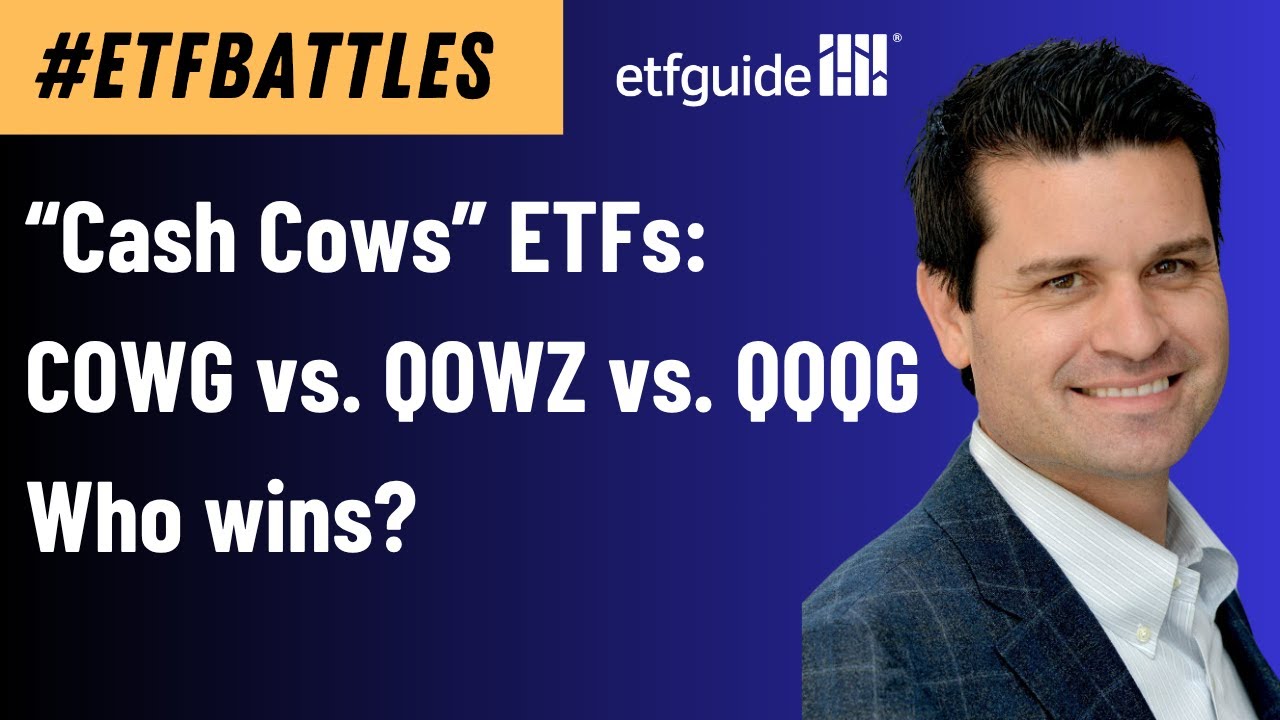
What are free cash flow stocks and what type of investment potential do they offer? On today's episode of ETF Battles, we're going to feature an audience requested triple header. This is a matchup between free cash flow ETFs from Pacer and Invesco. This is going to be good. Stick around.
You're watching ETF Battles and I'm Ronda Ley. It's great to have you with us. If it's your first time joining us, well, welcome aboard and be sure to hit that subscribe button to join our community. You can hit me up in the comment section below if there's an ETF battle that you'd like to see. Send me your exact ETF tickers. We could do double, triple, and quadruple headers.
You can also hit us up on our X feed at ETF guide. Also check out the video description section below for links to our program sponsor direction. Besides leverage and inverse choices on broad market indexes, there's lots of choices for ETFs linked to industry sectors along with MAG 7 and single stocks like Nvidia, Palunteer, and Tesla and many others. So be sure to visit direction.com.
Today's triple header is an ETF contest and it was requested by a viewer named Whippers Snapper 7. There's an old term that we almost never hear anymore, Whippers Snapper 7. This is a contest between a pair of cash flow ETFs, free cash flow ETFs from Pacer and Invesco Qoz from Invesco. Now, Whippers Snapper 7 also wanted us to include ticker symbol GFLW from Victory Shares.
We omitted that one in this contest because it's so new that it has very little data for analysis. So, got to give it a little bit more time, Whippers Snapper 7 to cook, maybe at least a year, and then check back with us. But again, thank you for your excellent battle suggestion. I'm looking forward to today's contest. So, let's welcome our judges. We've got Shaina Sisle with Banrian Capital Management and Mike Akins from ETF Action joining us. Great to have you back. >> Great being here, Ron. Thanks for having me. >> Thanks for having me back. >> Yeah.
Our four battle categories are going to be cost, exposure, strategy, performance, and yield, and then mystery. Mystery, of course, is where our judges can pick a factor or thing that they feel is pertinent and crucial to today's matchup. Judges can also nominate wildcard ETFs if they feel there's better choices somewhere else. I've got the scorekeeping duties and at the end of the program we will declare an overall winner. Keep in mind the battle outcomes are ever predetermined or known in advance by myself or our judges.
So the first categories cost. Let's kick things off with Mike. Mike, please get us started. >> Yeah. So pretty straightforward valley. We got 39 bips for QZ versus the triple QG at 49 and Kyoji at 49. So on an absolute basis, you know, you're 10 bases cheaper on that QZ. These are hard tickers. QZ and you've got from a kind of a liquidity perspective trading in and out of it. The largest product is COG and it's got a pretty significant advantage in terms of your cost to get in and out of the product. I think it more than makes up for that 10 basis point difference in the QZ. To that end I'm going to give Cai the largest, the oldest, the most liquid in the space, the winner from a cost total cost perspective.
Shaina, you're up next. How do you see it in terms of cost? >> I see it exactly the same way Mike does. The QQQG and QZ are tiny funds with like almost no liquidity. They don't even trade a million dollars of volume a day. And so even though QZ has a 10 basis points cheaper expense ratio, it is so much harder to trade. And so whatever advantage it has on the expense ratio goes away really fast for that reason. So I agree with Mike. It's COG.
All right. Well, that takes us next to exposure strategy. Shaina, you're still up. So how do these funds compare? >> I will start by saying that COG and QQQG are the exact same strategy just with a different indicy. So, Pacer has a series of funds that all kind of follow this cash cow idea that and they really on their website break it down why free cash flow matters and why they think it is a attribute of companies that will outperform and they do an excellent job on their website of doing that. But essentially what it says is that companies that have above average free cash flow positive free cash flow perform better over time and they tend to have higher growth rates as a result because they can maintain and invest at times where companies without free cash flow cannot.
As a matter of fact, when people talk about value stocks, they talk a lot about using PE as their valuation metrics to decide what to invest in. If you're looking at growth stocks, you want to look at price to free cash flow. And that is actually the valuation metric that you want to look at to determine the valuation comparability, discount, premium versus peers when you're looking at a growth stock. Everything that Pacer kind of lays out on their site is why they would want to use this metric as a key component for picking good growth stocks in the US large cap space.
Makes sense. The only difference between their two products is one uses the Russell 1000, narrows it down to the top 100 highest free cash flow margin companies and then uses price momentum to narrow that from the thousand to 100 and then uses price momentum in that 100. So it's 100 names. Whereas QQQG uses the NASDAQ 100. So it's only looking at a universe of 100 stocks versus a thousand and it's picking the top 50.
It's the top 50% of an index versus the other one where you're really looking at the creme to the creme because it's a much larger universe. QWZ is also using the NASDAQ, but not the NASDAQ 100. And it is using positive cash flow for each of the trailing 11 years. I actually like that methodology better because it speaks to the stability and consistency of those cash flows. So for me QZ is my winner because of that requirement to have that consistency over time.
So for that reason it's my winner. One caveat I do want to point out because of the nature of these stocks they all are super heavy in tech. There's more than 50% of the portfolio allocation by sector and all three of these products is technology. And like if you look at the top 10, I think two of them it's Palanteer and the other ones it's Nvidia. So it's AI, it's those names that everybody's running into it. It's a lot of AI exposure, a lot of tech exposure and if it's not tech, it's consumer, which again is another big growth area.
So with that in mind, this is not a particularly diversified product in terms of sector exposures. In fact, QZ excludes financials and real estate altogether. When you look at it though, they all kind of look the same in terms of their sector allocations, but QZ's insistence on the stability of that positive cash flow is what puts it over the top for me. So the QZ is my winner.
Mike, you're up next. How do you see it in terms of exposure strategy? >> I think Shaya laid it out pretty well on the methodologies. So if you just kind of look at these three products, they're large cap growth, right? They have different ways to screen. They're using free cash flow, which I think of as kind of a quality screen. So, they're adding quality to that growth metric. They all do a pretty good job of it.
I think if you're looking for maybe something alternative to pure beta large cap growth, like an IWF, the Russell 1000 growth or the S&P 500 growth or something. All three of these strategies kind of introduce a quality tilt to that. And I like I like that quality concept. If you're looking at from a long-term holding perspective, it could give you a little bit more consistency, a little bit more stable returns. In pure bit screening methodology, I just kind of like the starting universe of QZ a little bit better.
I kind of like the way that it approaches that from an exposure perspective, but they are concentrated. They look a lot like IWF, which is the Russell 1000. So I'm not sure you're getting huge differentiation here other than that kind of multi-step of quality, which in a down market, these I would expect to outperform just pure beta large cap growth because there is that construct of quality to it. Like all three strategies, but we're talking about a space that is dominated by market cap.
It's dominated by the biggest names in the industry. I'll get a little bit more of that in our mystery category. From this these three, I like them all. I think they all have done a good job building their products. The QZ is probably my favorite from Exposure. Though I think it needs to get a little more size to it before you get, you know, start allocating. It's pretty small. And, you know, it's going to need some, you have to be smart about allocating to it yet. I'll stop there.
Okay. And by size, Mike means aumum, assets under management, more money, more trading volume, all of that. Understood. Thank you, Mike. That takes us next to performance and yield. So, Mike, you're up. So, how do these ETFs compare in this category? >> So, I mean, if you look at performance, they're so new. Like, I don't even know what we're doing here. It's going to be hard for me to like really say there's a winner in performance other than to say that, you know, you look at Koji, it's done really well. It's been out the longest. It's up 27% over the one year.
Large growth is only up 13%. IWF's only up 13%. So, it's crushed that. I do think if you go to deconstruct those returns, couple things jump out at you. It didn't have as big a draw down when we had kind of our tariff scare, our liberation day scare in the market. And so that helped it seed those.
Also, if you just look under the under the hood, it got into Palunteer at the absolute right time and it's ridden that thing up significantly this year. So, I think that could change. it's such a short time period it's hard to really allocate there. I would expect these to be pretty highly correlated to large growth with a little less beta a little bit maybe protection on the draw down. So my performance winner is Kyo G just because you you can't argue with that one-year number.
It you know it's doubled up the large cap growth space in that time period. So that's awesome. But I think from a look forward perspective they'll all have similar results. just depending on different time of market we're in. But I'd expect those results to be kind of in directly in line with large cap growth with maybe a little bit when market really goes crazy, they might trail a little bit. When the market comes back, they might outperform a little bit. But I'll give my winner to cow because you can't you can't ignore that one-year number.
Shaina, you're up next. Performance and yield. How do you see it? Well, I was laughing kind of to myself when you were introducing this battle and you were saying that you excluded one because it didn't have a long enough track record and you wanted at least a year because QQQG doesn't have at least a year. >> That was an administrative error. >> Yes.
So with that in mind, as Mike pointed out, it's kind of hard. Cowg has the best performance over most time periods. I think that speaks to just having a larger universe and so the stocks that are coming out, even though it has a 100 names versus 50, it has a larger universe of which to select from and can be more selective within that universe, which I think even lends to higher quality in in that space and potentially having some quality names in sectors that are not well represented in NASDAQ indices. And that's likely to be the reason why it outperforms when you look at performance decomposition. So I have the same winner, COG, for the same reasons.
All right. Thank you, Shaina. And I think the Triple Q, whenever I see Triple Q's, that throws me off because I assume that it has a long performance history. So, I think that's what happened with Triple QG. So, apologies to Whippers Snapper 7 and the rest of our audience. They're probably going to nail me to the wall on this. So, this takes us next to our mystery battle category where our judges can pick a certain fact or thing that they feel is really important to today's contest.
So Shaya, what is your mystery battle category and which of these ETFs wins it? >> So one of the things I noted when I was talking about, you know, performance is that QQQG and QZ are fairly new funds. one being launched in December 23, so it just barely has a one-year number, and the other one doesn't even have a one-year number. And that speaks to this trend that we've seen in the last, I want to say, 24 months of everybody in their mother taking a strategy that they had either against the S&P or a larger Russell indicy and then applying an identical strategy to the NASDAQ.
That has to do with just Nvidia, the Nvidia effect, and all of those stocks that are super heavy in the NASDAQ that people want exposure to. So they're just reinventing a product that's been successful and applying it to a different index. So that is a trend, but I don't know that it's a trend that is a valuable trend if you're building portfolios. In essence, the screens that these products are using are kind of resulting in the same exposures.
I mean, even CowG has 54% of its portfolio in tech and has virtually an identical top 10 to the other two. So you're still getting the exposure you want, but I think over time when you know markets don't persist the same way forever, even though sometimes we feel like they do, there will be a point in time where Nvidia and some of those other high-flying AIdriven tech names are not the leaders of the market. And I know it sounds crazy, but if you look at the history of the market, there's always been one or two stocks that were like for decades right up at the top and then some of them don't even exist anymore. Point being is that trends change.
They do last a long time. What you do want is to have a portfolio that has a universe to choose from that's somewhat diversified. >> You mean companies like MCI, WorldCom, and AOL >> Like exactly like that. you can go back even further and you go back to like the 20s, 30s, and 40s and you're talking about oil companies that all merged into each other. So yes, that's exactly what I'm saying. And for that reason, I want a universe to choose from that's going to be more robust and diverse, and that's going to be COG.
Mike, give us your mystery battle category and which of these ETFs takes it. >> First off, I like all three ETFs. I I've gone through their methodologies. I think they're welldesigned. I think they start with good quality universes. I don't I think Shannon makes a good point with sticking to just 50 and what that does in terms of just starting with the QQQ versus having a larger universe. I think can set you up for a bad situation when the when the Q the Q phenomenon kind of dies down a little bit.
I like all three strategies. I think from a mystery perspective though, I always come back to this a lot in your shows, but I love factors. But you have to know how you're going to use factors. It all really comes down to this context of what am I doing here? Am I dealing a strategic portfolio and I like I want from a from a large cap growth perspective, I like having a quality overlay and I'm going to have it forever and it's going to be a a foundation of my portfolio to go with my large cap value.
Or are you investing tactically because you believe this particular type of strategy fits into that? None of these three ETFs are tactical factors. In my opinion, they are core strategic allocation strategies. So you're choosing between owning large cap growth, owning the market, or owning large cap growth with the quality tilt through this free cash flow screen. I like that.
I mean, I can see the the benefit of finding this. And then maybe, if you remember, three years ago, we were having conversations about free cash flow growth in the terms of value. And there's a lot of those out there, and I like those strategies, too. But, you know, we're not talking about them right now because they're value and they've significantly underperformed. So you kind of have to think about strategically pairing these strategies.
Are you just owning beta in large cap space? I actually think that's not a bad thing and you can do that. If you're going to do that, I think just own the market. But if you do like to pair a growth and a value, I like this quality overlay from a construct of having a dampener on draw downs and volatility. But these are not tactical strategies in the terms of like a pure beta or a deep value or a high momentum. There are markets if you're trying to kind of rotate across factors or certain factors the economic backdrop sets up well for them and you can get much more beta to those factors through some of the older factor strategies out there that are really concentrated 50 stock 75 stock portfolios.
So just that context, that's my mystery. My overall winner, it's tough. I'm going to go with COG just because it's got a longer track record. But I think QZ might be proved to be the winner over a full market cycle, but I like them. I like them all as long as you're know why you're using it and how you're using it overall to your portfolio.
Excellent. So, Mike gave us his final winner there with Cow G. And Shaina, we're going to give you an opportunity to weigh in with your final winner. Give it to us. >> Uh I have the same winner. >> Okay. >> For very similar reasons.
The reasons I laid out and when I was talking about the Misbury category in terms of just having that broader diversification opportunity, maybe not today, but the opportunity to to be in other sectors and have those options is greater when you are looking at the Russell 1000 versus the NASDAQ 100. For that reason, Cowg is my winner. It also is the strongest performer by like a lot. And so maybe, to Mike's point, QZ does outperform in the long term, but, at least as we have for a limited track record today, it is not anywhere close to performing to the same extent as, COG. I do like the idea of that quality bias though. So everything Mike said I think is this is the way that you do growth investing.
Well, our judges have spoken and according to my final battle scorecard, we had agreement on COG from both of our judges and our judges made some great points. Of course, Cow G being the most diversified ETF out of this group and our judges mentioning some great points. Mike, of course, some tips on how this might be used inside an overall diversified portfolio. I thought those were some great points. You know, we want to think about ETFs not just as individual bricks, but in terms of the overall application to how it might fit into your portfolio.
So, he raised some great points on that front. And then, for the most part, agreement across the board in all categories in favor of cow G and sorry to all on my administrative snafu by including triple QG in this contest. Of course, the fund does not have a one-year performance history, and our other ETF from Victory Shares was excluded because of that. So, we'll have to do another one of these ETF battles in the near future and include these two ETFs, Triple QG and also the Victory Shares. And we'll we'll take a look at this again in a future upcoming ETF battles.
I'm going to put it in my notes. And thank you for Whippers Snapper 7 for this excellent ETF battle contest. Hope hopefully you enjoyed it. Great job, Mike and Shaina. We appreciate your analysis. >> Thanks. >> Thank you so much for having me. I really appreciate it.
Well, be sure to visit the description section below. We've got links to both of our judges, Shaina and Mike, so get in touch. Also, we've got links to our program sponsor direction and keep your awesome ETF battle suggestions coming. You can hit me up in the comments section with your ETF tickers or on our X feed ETF guide. I'm Ronda Ley. Thanks for watching ETF Battles. We'll see you on the next episode.