ETF Battles: Dividend Safety? Watch SCHD vs. DIVB vs. SPDG!
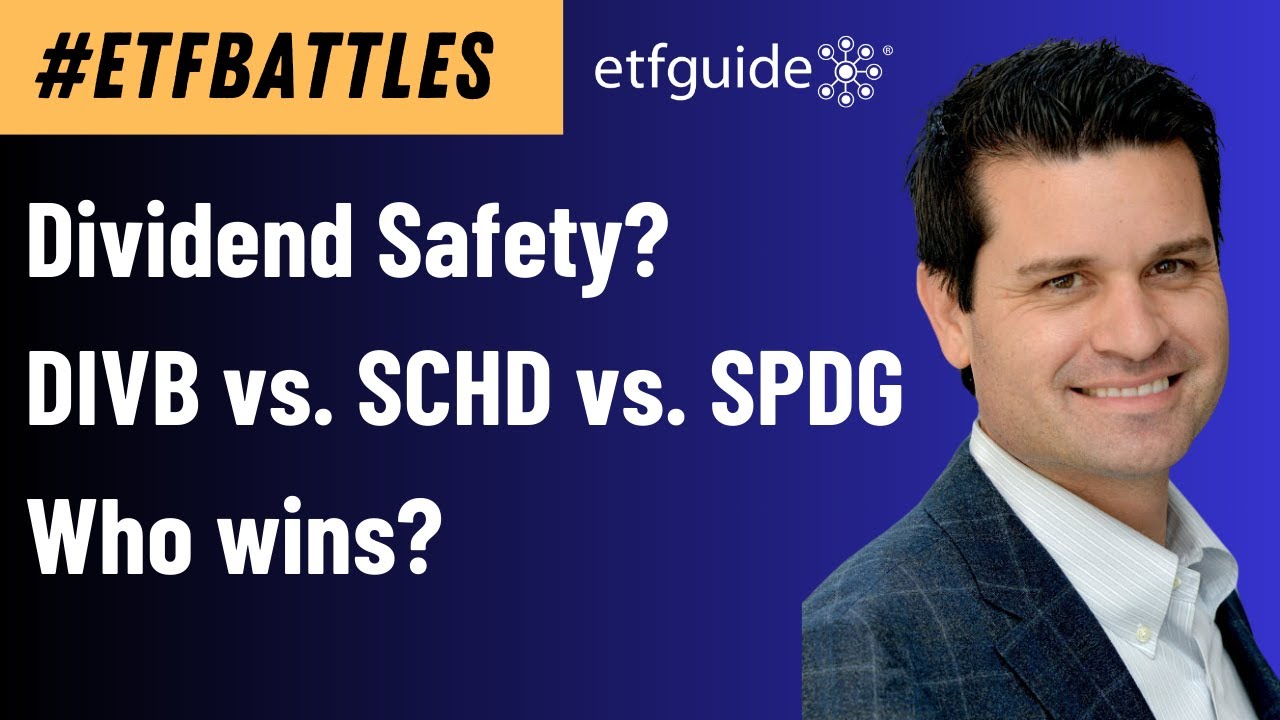
In the future, lower equity returns could be in the cards. That means the role of dividends will no doubt become an important component, maybe even a forgotten component that will be rediscovered in future returns. In the ETF market, funds focused on dividend income are still one of the largest categories by both assets and just sheer choice. Today's audience requested triple headers between dividend ETFs from BlackRock, Charles Schwab, and State Street Global Advisors. It's a heavyweight dividend ETF bout.
A cordial welcome to all. You're watching ETF Battles, and here we are in season six. I'm Ronda Legi, the chief culprit of this madness. If you'd like to send us an ETF battle request, I encourage you to do so in the comment section below. Send us your ETF ticker symbols. We could do double, triple, and quadruple headers. You can also hit us up on our X feed at ETFguide.
Be sure to check out our season six playlist to make sure that the ETF battle requests that you're making are for contests that we have not yet already done. Also, visit the description section below. I've got links to our program judges along with our program sponsor, Direction, so don't be a stranger. We've also got viewer resources with download links to free audio and ebooks and other goodies. Again, hit that description section below.
Today's heavyweight triple header dividend ETF bout was requested by a viewer named Sandip, and he submitted this to us on our X feed. It's between dividend ETFs from BlackRock, Charles Schwab, and State Street Global: DVY, SCHD, and SPDG. Boy, this looks like a good one. Thank you so much, Sandip, for this ETF request, helping us to sort through the clutter.
A duo extraordinaire has joined us. We've got Tony Dong with ETF Central joining us, as well as Mike Akins at ETF Action. Judges, great to see you again. Good to be back, Ron. Thanks for having me. Our four battle categories are cost, exposure strategy, performance and yield combined, and then we've got our mystery category where you judges can shock us with that factor or thing that you feel is crucial to today's contest. Our judges can also nominate Wild Card ETFs if they like something else somewhere else better. They can also opt for split decisions. It is entirely up to them. I've got the scorekeeping duties, and at the end of the program, we will declare an overall winner. Always keep in mind that none of the battle outcomes on this program are ever predetermined or known in advance by myself or our judges.
Let's kick things off with the first category: cost. Tony, please get us started. All three of these are low-cost index tracking products. They belong to for iShares, the core lineup, and for State Street, the portfolio lineup. Most Schwab ETFs are cheap. DVY and SPDG both charge five basis points, and SCHD charges six. In terms of spread, SCHD has the lowest one, with DVY in the middle and SPDG on the higher end. It's not as traded frequently even though the underlying is fairly liquid. When you put the two together, it's pretty much DVY that eeks out the others, but I want to stress that it's by a very, very slim margin, and all three of these are so cheap that unless you have like seven figures in them, I really wouldn't worry about expenses here.
Mike, you're up next. How do you see it when it comes to cost? Yeah, I'd even say eight figures. It's that close. I mean, we're talking nothing, five basis points and six basis points expense ratios. It's what makes me love the ETF marketplace, right? You're getting diversified exposure to a lot of great companies in a tax efficient way for almost nothing. It's fabulous. It's why the ETFs are taking over the world, and I love to see it. I don't really have much to add. Tony did a great job explaining it. Just keep in mind with SPDG, newer, a little bit less AUM, therefore a little less volume. Spreads are pretty tight, doesn't surprise me coming from a great provider like State Street, but you need to be a little bit careful trading that strategy because you could run into some liquidity issues, get a bad execution, and then of course your expense ratio, your total cost goes up quite a bit. That's all I got. A winner can't do it between DVY and SCHD. I'll just call it a toss up.
That takes us next to exposure strategy. Mike, you're still up, so break it down for us. Wow, so just exposure wise, these three products are incredibly close. They look a lot alike when you break it down by market capitalization, when you break it down by size and style, even sectors, pretty close across the board. Strategy wise, you really have three kind of unique ways to go about it. SPDG is going in there, and it's looking for yield on a sector by sector basis, and it's going to select companies that have a higher yield than the kind of mean yield of each sector, and then it's going to wait in a neutral component to the S&P 500.
What's great about that is a lot of times dividend strategies, you can get really overweight defensive, and as we know, the market itself is really overweight growth, whether it's tech or consumer discretionary. So that's going to give you a more market-like return with a little bit more yield. DVY is again, it's a very core product. They call it dividend core for a reason because it's market cap weighted. So they're going in there and looking for the yield products, but then market cap waiting it, which gets it to look a little bit more like the market.
Schwab is the one that's going to use the most fundamental here, and historically that's done really well for it up until this last year. We kind of had a roll over in some of those quality factors, and I'll get into that in performance, but Schwab's taking in a number of factors, thinking about quality of the balance sheet and then going after yield after that from a pure dividend play here, and thinking about why you use dividends. I think of dividends being used to provide mature companies that can provide a consistent dividend, have strong, you traditionally have strong balance sheets, and then that extra yield is going to reward an investor over time, kind of that value tilt. I give it to SCHD even though it's had a tough run here over the last year, but I like all three strategies, but my winner is SCHD because it's more of a fundamental choice approach to it, whereas SPDG and DVY are going to be a little bit more market cap centric. Solid analysis.
Thank you, Mike. Tony, you're up next. How do you see it between these two ETFs? It's really going to depend on your views for sectors. So if you're the kind of person that is going to panic or worry when your dividend ETF diverges markedly from the market due to, as Mike mentioned, severe sector imbalances, SPDG is probably the best one. The sector neutral strategy means that this one is going to have approximately the same sector allocations as S&P 500, so those overweights to financials, tech, communications, and of course, it's not just a pure yield play. They have a screen that ensures is at least seven consecutive years of dividend payments or increases.
DVY is a little more complex, and I say that because its index has changed quite frequently. The last time was in December 2022, and what they did was that Morningstar placed a higher weight on dividend, so 75%, and just 25% on buyback. It used to be more balanced as a composite measure of shareholder yield, but they've deemphasized buybacks, and in addition, they increased the UN for the highest yielding stocks to 50% instead of just from the top 90%. So what that did was that restricted a lot less to just, you know, the highest yielding ones. Another thing that they implemented that I do like is that they began excluding stocks with dividend yields in the top 5% of the market, and that's something that you see a lot of the top dividend ETFs do, and this just kind of gets rid of your yield traps very efficiently and simply.
SCHD, on the other hand, is one of these like very complex index ETFs that I like because they give you exposure to a very rigorous and systematically implemented strategy at a low cost. So, you know, there's the 10 years of consecutive dividend payment screen, and then it gets weighted on four fundamental factors: free cash flow to total debt, return on equity, indicated dividend yield, and five-year dividend growth rate. Then that gets parred down to 100 stocks. It reconstitutes every year. If I had to take a high level overview of all three of them, I'm still going to go with SCHD just because I believe the index methodology is very solid. It's been executed consistently, and unlike DVY, you know, there hasn't been like changes after the fact by the index provider. Then you can also go on their site and look at the methodology and the back test, and I think it's very sound even though it had that hiccup. One thing to note is that SCHD just reconstituted this year, and then we're seeing a lot higher waiting towards energy, and I think that's appropriate just given the high free cash flow yield of that sector, the high dividend yields, and also the lower valuations. So SCHD all the way from me.
Very good, and just explain to our audience real quick, when you said reconstituted, some of our audience members may not be familiar with that. What does that mean? So reconstitution event is when the index basically goes through its criteria every year or every quarter to add and drop companies. So rebalancing is when they don't add or drop anything, and they just reorganize what's in there according to the waiting methodology, but reconstitutions when you'll see new companies enter SCHD and old companies leave. If you're interested in seeing what the ETF has added and what it's kicked out, you can find that usually on their web page. There's a re annual reconstitution report, and there's a variety of other analysts that will go in detail about what's changed. This time we've seen that, you know, compared to what happened last year, SCHD is less heavy in financials, now more heavy in energy, and I think personally that's a much better tilt. Got it. Thank you for that added detail.
Tony, that takes us next to performance and yield, and we've got this combined. Of course, being a dividend bout, we had to include yield. Tony, you're still up. Break it down for us. How do these three ETFs compare? Yeah, so the back T is kind of limited by SPDG's newer inception, but from 2023 September to present, DVY's done the best at an annualized 19.78%. Drawdowns are all very similar too, and this is where you'll see the benefits of SPDG's approach when it comes to sector neutral. You're not making these big sector bets that can really derail like your thesis. Instead, it's going to be up to security selection within the sector, and if you're a fan of the dividend growth and the dividend yield above the median screen, that's going to do well for you.
Now, in terms of yield, DVY is going to be the lowest ever since they updated that methodology in 2022. The yields fallen just because the universe that they're selecting from isn't as high as yielding, and they got rid of that top 5%. On a 30-day SEC yield, you're getting 2.84 from DVY. SCHD's yield has always been excellent. Right now it's 3.71, but surprisingly SPDG isn't that bad. I don't have it up right now, but I remember it's somewhere north of 3%. So to put it all together, I would say that historically, yeah, SCHD has kind of been a dog recently, but for the future, I am very, very much confident that on a total return basis, SCHD will do very well and better than the large cap, large cap pure category average, and I think the yield is will continue to be good. It's actually increased significantly since this month last year. Excellent analysis.
Thank you, Tony. I also like the fact too that our judges when considering performance and yield aren't just looking at the backwards exclusively, but they're also thinking about what potentially could and might happen in the future. I think again, we need to do that as investors. We tend to be so focused on what happened in the past. So thank you, Tony, for doing that. Mike, you're up next. Break it down for us on performance and yield.
So yields going to be far in away SCHD. I mean, it's got the most targeted component to actually achieve that. As a result, it has a much higher yield. So if you're looking for that qualified dividend income and something you can just get that cash flow out of, SCHD is going to provide them a much higher yielding there too. They all yield nicely above the market though, so they all got a yield component. They've all got a great value tilt which, and I think of yield, I think value, it's generally one of your kind of your value factors in it. SCHD had a rough year last year, and it's kind of messed up its one, three, five year numbers. Historically, it's been a great strategy. I believe in it going forward just like Tony does, but it does highlight what can happen with only reconstituting a portfolio once a year. Market dynamics can change very quickly and cause your screens to be very different one month to another, and you might end up screening something very differently. You can really see it if you go and look at SCHD's rebalance. You can see it take huge haircut from tech on its last rebalance, a huge haircut and financials into a couple of other sectors. It may prove out to work out really well. The year's got a long ways to go.
So I still has great fundamental factors in there, but just something to keep in mind relative to like how these strategies work. You know, if it is passive, the timing of those rebalances can make a big deal. There's been a couple of great articles written about rebalancing luck when you do your rebalance, was it the right time to do it and how it can affect performance with these passive strategies. All said and done, looking forward, I still like SCHD though. I will tell you if you're looking for a core position, you want a core position maybe with a little lower volatility, a little higher yield, the SPDG even though it's new, I would expect it's going to provide very closer returns to the S&P 500 because of that the way it weights around the sectors and get you a little bit more yield, a little bit more maybe quality/value component, so growth at a reasonable price. So I like that it's too young for me to really know what's happening there, so I'm going to stick with SCHD, and then DVY is a great strategy, but I don't like the market cap waiting component of how they they manage that strategy.
All right, well that takes us next to the mystery battle category where our judges can pick a single or multiple factors that they think are important to today's contest. So Mike, what is your mystery B category and which of these three ETFs wins it? So let's talk little active passive. My mystery here is I think we have to recognize that I think as an industry embrace the fact that some of the largest, most well-sourced investment firms out there like TROW, Price, John Hancock are coming to market and embracing ETFs. Finally took them a while to get there, but they're coming in and they're embracing the lower cost structure, not as low as what you'd get from a pure passive strategy, but under 50 basis points and you know, if you apply a tax efficient active strategy with a lower expense ratio, I do believe it can provide consistency.
Using that SCHD example, you have the ability to kind of massage your strategy based on macro environments, but you can't you really can't do that with a pure passive strategy. So I would encourage investors if you're looking at for core allocations, don't you know, completely shy away from the active front because there are a lot of great managers coming to market here and providing very interesting strategies, very well researched strategies, you know, for a very in my opinion a reasonable price and you're getting it in the great ETF rappers. So that's my mystery category, not going to throw out a bunch of tickers, but it's not too hard to find them out there and take a look at that.
Well, I think that's the first time we've had active dividend ETFs chosen as a wild card, just the entire group. So great, great analysis, Mike, and you're right, we're getting more more choices in the active dividend ETF space. This may even prompt some of our viewers to send us some ticker symbols for a future and potential ETF battle episode. So great job. Tony, you're up next. Your mystery battle category, what is it and which of these ETFs wins it?
This is a term I coined myself called continuity. It's just like, you know, can I rely on this ETF still delivering exposure to the same strategy later on? On the active side, this is a risk you got to look out for called style drift. You look at Fidelity Contra fund, it started out as a contrarian fund, but it turned into large cap growth to great effect. I might add William Danov has absolutely killed it, but you know, you look at you look at the name of the Strate Contra fund, it was originally supposed to be a contran fund. So back to this, SCHD is the only one I feel comfortable holding for 10 years partially because it's so massive. It's just got 70 billion in assets, and that's a lot of licensing fees being paid to S&P Global for the Dow Jones US dividend 100. They're not going to change that index from them. They're going to keep using that, and that is the index that I want to be invested in if I'm owning this ETF.
SPDG, I love the sector neutral approach. We've seen this to great effect with even ESG ETFs like SNP where they've managed to outperform the S&P 500 without those big sector deviations, but like, you know, it's been around since September 2023 and it's it's tiny in size. I think it has like 9.85 million in AUM, so it's well below that 50 million death zone, and I honestly don't know how long this ETF's going to stay open for like the next strategic review at SSGA, they might just ask this thing because it's likely not turning a Prof, especially with an expense ratio that low. As for DVY, just the constant changes to the index that it uses by Morningstar is just something that I'm just not a fan of. Like I know that they're just trying to optimize it, but in my opinion the whole point of an index ETF is to just really set it and forget it, and if I have to worry about how they're going to change the reconstitution criteria, the selection criteria, The Waiting criteria, you might as well just go active at that point, right? You know, DVY isn't that either at at less than a billion assets under management. It's not in danger of closing down, but you know the iShares ETF lineup, and this is more of a meta thing, the iShares ETF lineup is freaking massive right now. They have so many funds and a lot of them are redundant. You already have two other core dividend ETFs, DG and HDV. I could definitely see a scenario one day where someone there takes a look at these three and decides DVY can get a and merge into the other two, and we've seen it happen before with other funds. They change their names, the share classes get merged, different funds get merged.
Again, like just from a peace of mind perspective, I'm going to take SCHD for La Ron. Well, we've had some great analysis up until this point. Now we're going to give our judges a final opportunity with their final say. Tony, give it to us. SCHD is one of those few dividend ETFs that I really like from both a total return and a factor perspective. The index methodology is multifaceted, it is rigorous, it is sound, and you're getting this for six basis points, which is an absolute steer steel, not steer, it's an absolute steel. Then one thing for those of you concerned about tax efficiency is that SCHD's index also excludes Real Estate Investment Trust, so the majority of the dividends are going to be qualified. You don't have that ordinary income to worry about unlike some dividend ETFs where you know you because they don't exclude Real Estate Investment Trust, you get a big dose of them because a lot of those have high yields. If I had to pick a dividend ETF to stick to and understanding that I like total returns better, I would not mind owning this one.
Mike, your final chance to win with your overall winner, give it to us. Yeah, I think we're going to think we're going to get an agreement today. It's unheard of. I feel like the last several of these I've been on, we've had split decisions, but SCHD is my winner, and I'll give you three reasons why. It is incredibly cheap and efficient to get access to these products. It has a as Tony has done a much better job than I will try to repeat, so save everybody some time, a very fundamental sound process to it, but number three and I I got to be honest, it's truly the true dividend product of this battle. It's actually going after yield. It's a dividend strategy. The other two don't me wrong, they're there they're they're not not dividend products, but this one is a legitimate yielder, you know, yielding almost 4% on a weighted average basis the underlying. Hey, this is a dividend battle, so let's give it to the dividend ETF SCHD.
Well, our judges have spoken, and according to my final battle scorecard, SCHD is the winner. To quote retired B basketball player Rashed Wallace, ball don't lie, and in this contest, the ball bounced in favor of SCHD overwhelmingly. Our judges agreed on exposure strategy, performance and yield, mystery, the overall battle winner, and they made some great points. I think one that stuck out to me is SCHD among this trio has the most fundamental screens, and for just six basis points annually, that's quite the bargain for dividend focused ETF investors. Great job to both of our judges. Active dividend ETFs Mike mentioned that as a something that our audience should watch for. I don't know, maybe we'll get some future requests for active dividend ETFs. Audience, do your homework and get back to me. Great job to both of our judges. We couldn't have done it without you. Awesome. Thanks, Ron. My pleasure.
Be sure to visit the description section below. We've got links to both of our judges to get in touch. We've also got a link to our program sponsor, Direction, who has been expanding their ETF lineup. We've also got lots of choices Beyond industry sector ETFs, leveraged and adverse. We've also got single stock ETF long and short, so be sure to check that out as well as lots of freebies, free ebooks, and other goodies. One final thing before we take off, which ETF battle would you like to see on our next episode? Hit me up in the comment section below or on our X feed at etfguide. Send me your ETF tickers and make it good. I'm Ronda Legi. Thanks for watching today's contest. This is ETF Battles. We'll see you next time.