ETF Battles: GPIQ vs. QQA vs. JEPQ vs. QQQI- Covered Call Cashflow Clash!
Looking for income in today's market? Well, covered call ETFs might be the ticket. They take stocks you already know inside the S&P 500 and NASDAQ, and they layer on an options strategy that generates cash flow. Today's audience requested ETF battle is a quadruple header between covered call ETFs from Goldman Sachs, JP Morgan, Invesco, and Neos. So, who wins the battle? Find out right after this.
This is ETF Battles and I'm Ronda Ley. It's great to see you again. If it's your first time watching, we're glad to have you with us and we're glad you found us. Welcome aboard. Be sure to hit the subscribe button and of course the like button if you've been enjoying our content. If there's a certain ETF battle you would like to see, be sure to send us your ETF ticker symbols in the comment section below or on our XFE at ETF guide.
Also, be sure to check out our season 6 ETF playlist to make sure that your desired matchup has not already been done. Also, be sure to check out our free online courses. We now have three with habits of the investing great along with safety, a guide for investors and retire securely. All these courses are available totally free to all of our viewers. Just hit the enrollment link in the description section below. Also in that same area, you'll find links to our program sponsor direction.
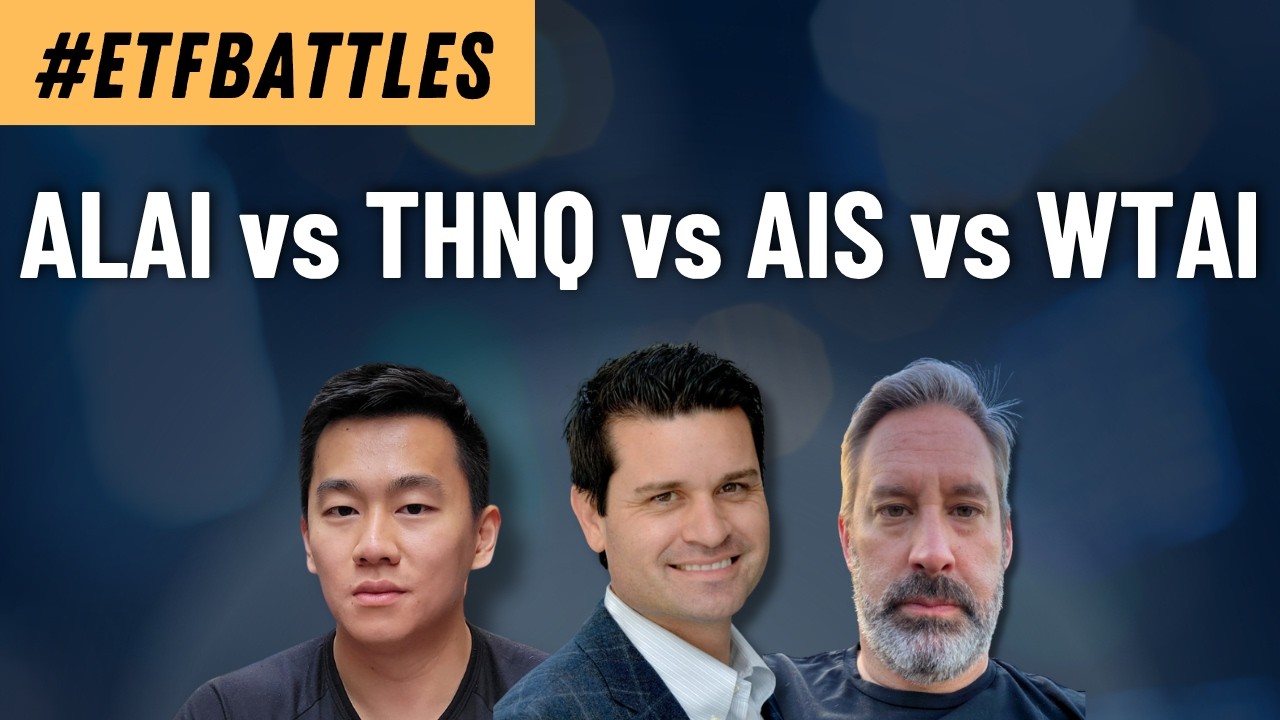
Besides leverage and inverse choices on broad market indexes, there's lots of choices on ETFs linked to industry sectors along with MAG7 and single stocks like Nvidia, Palunteer, Tesla, and many others. So be sure to visit direction.com or hit the description section. Now, today's ETF battle was suggested to us by a viewer named Garrison Paul. It's between four covered call ETFs. These funds are from Goldman Sachs, JP Morgan, and Neos along with the Vesco.
Interesting matchup. There's been a lot of interest in covered call income generating ETFs. And judging today's contest, we've got a duo extraordinaire, David Durking, an independent ETF analyst with the Street.com, and Aan Ferris with Bloomberg. Guys, welcome back. So great to see you again.
So, we got our four battle categories, cost, exposure, strategy, performance, and yield are combined. And then we add our mystery category where you, our judges, can choose any factor or thing that you think is pertinent and crucial to today's contest. Our judges can also nominate wildcard ETFs if they feel there's better choices somewhere else, or they can opt for split decisions. None of the battles that we do on this program are ever predetermined or known in advance by myself or our judges. The first category is cost. Let's start with Aan. Please give us your analysis.
Great picks because there's so much involved which we'll get into in a little bit. But let's just look at headline cost. So expense ratio. So you have gold the golden product GPIQ 29 basis points. Jeep Q, which is the first one ever launched of this series, that's 35. Neos QQQI is 68 more expensive and QQA, which is the newest entrant from Invesco, that's 29. It's deliberate. It matches the Goldman product.
So issuers are very kind of clever in how they price things. Now, I just mentioned they're all really popular because even though the smallest one has half a billion dollars, Jeb Q has 32 billion. They trade a lot. They're they've got sizable assets. So, I think for this one, we're just going to have to go it's a tie really because between GBIQ and QQA just because it's 29 basis points. Again, we'll talk about why that's not necessarily why you need to be picking it, but I think just because of how involved these are, let's just go with the cheapest one. So, I think it's a tie between Goldman and Invesco.
Thank you very much, Aan. That's a strong start. You're up next. David, give us your analysis.
Yeah, I see it pretty much the same way. You know, the 29 basis points for QA and GPIQ are again the lowest. I'm going to use trading spreads as the tiebreaker here, though, because QQA has a larger trading spread. It's got a smaller asset base, so it's going to cost a little more to trade. GPIQ again has that larger asset base, so trading spreads are pretty thin on it. It does have a six basis point advantage over Jeep Q. So, I'm going to call GPIQ the winner in this one.
Thank you, David. That takes us next to Exposure Strategy. And you're up, Dave. So, give us your take.
Yeah, at a 30,000 ft view, all of these funds look the same. They're all based on the NASDAQ 100. They all used some sort of derivative income strategy. They all pay monthly income. So at that level, they all look pretty similar, but it's really a function of the mechanics of it really how it overlays that covered call strategy and kind of how much how much options exposure it's going to use.
So Jeep Q and QQA use ELNs to get their exposure. So there's some counterparty strategy and and the banks that issue those notes. So that's a little bit of a unique twist on it. GPIQ uses more of a traditional covered call strategy and it's only overlaying about 25 to 75% of the portfolio. So it can actually sort of change according to conditions. It can add exposure, take away exposure depending on how the managers feel. So, because it doesn't go sort of full boore 100%. It actually has more upside than the other ones. So, based on that, I think I'm going to go with GPIQ again as the winner in this category.
I think it's just a nice straightforward strategy. It doesn't get into, you know, some of the other things like using ELNs or other things like that to overlay its strategy. It's just sort of a cleaner way to do it. I like that it has a little more upside potential. So, I'm going to go with GPIQ in this one.
Got it. Thank you, Dave. And if you can just give us that acronym ELN, what does that stand for?
That is exchange linked notes.
Got it. So, that's it's basically just a product where they roll the the underlying security and the option into just a single security as opposed to buying the stock separate and then writing covered calls separately. So it's just kind of a twoin one package.
Got it. It's a derivative. Correct.
It's a derivative where it packages the underlying the underlying stocks or the index like the NASDAQ 100 and then has the the written option strategy built in. So, it's like one security, you get the whole the whole covered call strategy.
Perfect. Thank you for the explanation on that and added details. Aan, you're up next. How do you see exposure strategy in this battle?
Yeah, I thought that was really great. And I think to he was spot on in that what's great about the industry by the way is okay, Jebq was first. They were using lens and you have all these different versions to sort of try to make it maybe more efficient or take a different spin on taxes. But overall, like you said, they're all kind of doing the same thing. I think it's sort of just looking personally what kind of scenario you is this in a taxable account or qualified account are you looking for more income? Are you looking for more upside? So you have those kind of choices across all of these.
So one thing that I I do like about GPIQ that he mentioned that it's dynamic. So they're not keeping a consistent hedge. They're sort of just seeing what the market conditions are and they might change that. So you do have the potential for more equity participation with GBIQ. Jeb Q was the first. It's the largest, but like he was mentioning these ELNs, they tend to be less tax efficient. That's one that's so they're they're taxed more as ordinary income. So that can impact your tax situation if that's what you're using.
QQQI from NEOS actually came out after Jeb Q to alleviate that issue. So they're not using as much ELN. They're using index options which are more tax efficient. So really it's kind of the same thing but just more tax efficient with QQQI. QQQA like you was mentioning is very similar to GPIQ. It's newer. It's a little bit cheaper.
With QQQI, the NEOS one, it tends to be a little bit steadier in its payouts. Jeb Q can sometimes be a little bit more sporadic just based on what the market is doing. So again, they're all try more or less trying to do the same thing, but I agree with David. I like the dynamic aspect of the Goldman GPIQ product. That's the only one sort of doing that. So, I like the ability that they can maybe just sort of tailor that to get you a little bit more upside. So, it's close. They're all sort of there. Some of the differences are negligible. Some are bigger differences, but I think I'm going to go with the Goldman U GPIQ product.
Got it. That takes us next to performance and yield. And of course, in an income battle, we got to look at yield. So, give us your take, Aan. How do these ETFs look in this particular category?
So, I would say overall when you're buying these, I think one thing you need to look at when you plot this against its underlying index, the Q's, the NASDAQ 100 just because over time it tends to go up. You're going to lag the market. That's just something you you're going to lag. Just something to keep in mind. It's maybe not why you're buying this product. You're buying it because you want steadier income or a little bit more downside protection. So, obviously going into that, all of these are going to lag the market as it goes. You know, there are scenarios obviously when the market goes down that these will do better, but just keep that in your, you know, in the back of your mind.
QQQA is pretty new, so there's not a whole lot of data. More or less, the performance is maybe within four to 5% of each other. So, they're all sort of kind of doing the same thing. I think where you need to focus on here is the yield, obviously, because they're income products. So, you get yield ranges anywhere from 9 to 13%. Now, the NEO's product has actually has the highest yield just because of how they're generating some of that income with their their option strategy. So, they pay about a 13% yield. The other ones are about 9 to 10, which I think is really good cuz I don't want to get too offbeat here, but I know a lot of people get sucked into or investors get sucked into these high income products like Micro Strategy or and they they're promising these really excessive yields, 50% 60% yield. Be wary of that.
You want you want a product that also has a reasonable yield, right? So, sort of something to think about in the back of your mind is making sure that the yield is consistent with sort of the overall growth of the market when it starts when the yield is too high in the stock where the index can't keep up with that growth. That's where you start to get things like nav erosion, right? So, essentially just you're eating your principle to pay out that income. What I like about all these performance-wise, the price return is also up, right? Even though you're making a lot in total return, you also have the price of the index going up, which I like means it's not really eroding. It's not I know that's a long- winded answer, but these are complex products. So, it's really important to sort of know these different these different aspects.
That said, even with the higher yield, GPIQ and NEO tend to be really, really close. Again, I like the dynamic aspect. I think that it's nice to also have that upside participation. So, I'm going to give the yield, even though it's not the highest, I think you're going to get a little bit better pull of return in the long term with the Goldman product if the market keeps going up. So, I'm going to give this one also to Goldman GPIQ.
Perfect. GPIQ, I got you down. Thank you very much, Ethan. And, you're up next. Give us your take, David, on performance and yield.
Yeah, this battle is really kind of a case study in how you shouldn't just look at the yield on some of these products. You if you're an income seeker, you know, going with QQQI, which has, you know, again, like a 13% yield. You may look at that and say that's the one to go with. But this category specifically is a good one that should emphasize the idea. You really need to look at what you're investing in and look at how these funds operate to really see whether, you know, one has an advantage over the other.
In this case, like we said with the Goldman product, that has a dynamic overlay. It can have, you know, higher or lower depending on what the conditions are. QQQI is really more geared specifically to maximize income. One of the things that it does is it writes its options at the money instead of out of the money, which is, you know, something a lot of these other funds will do. When you write your options at the money, that tends to maximize your current income and it'll maximize the yield, but it also gives away a lot more of the upside potential if the index were to rally.
So, and you can you can kind of see that in the yields where QA and GPIQ have yields in the 9.5% range, but G JQ, sorry, is at about 11 12% and again, QQQI is at 13. So the higher the yield, the more focus on on income, but it give tends to give away a little more of the upside. So you can see that in the current returns GPIQ is is the best performing out of the group and that's mostly because it has less of an options overlay. It has more upside exposure. We've seen the NASDAQ 100 do great this year. So obviously its total returns are going to do a little better.
So, you know, and I agree with Aan for all the reasons he said why I would go with GPIQ as well. I like the long-term potential. I think over the long term, it's going to probably outperform the other ones. Again, your mileage may vary as to whether you're looking for total return versus income, but for for me personally, I think GPIQ is the winner.
Well, that takes us next to the mystery battle category. This is where our judges can give us that certain factor or thing that they feel is crucial to today's contest. So, David, lost my breath there. What is your what is your mystery battle category and which of these ETFs wins it?
Well, I kind of alluded to this earlier. My category, I'm just going to call it cleanliness. And that's just alluding to the fact of again how some of these structures can be really complex as far as how you're overlaying the option strategy and some of the nuances that can go along with it. So, you know, ELN's again, there's nothing wrong with using those to overlay a covered call strategy. You expose yourself to a little counterparty risk in case the note issuer something happens to them. It's probably unlikely, but it's something that could be considered.
You've got QQQI, which uses a special type of contract in order to again improve some of the tax efficiencies on it. So, it's just these little factors that kind of distinguish one fund from another. But, the Goldman fund, the GPIQ, that uses more of just like a traditional covered call strategy that I think a lot of people are familiar with. It just buys the stocks at the index. It writes options and, you know, there's there's really just not much that's fancy or unusual about it. So, in that sense, I think it's just kind of a cleaner way to play the covered call strategy overall.
Again, the dynamic approach allows for some upside capture. So, I like that it's, you know, more of a truly actively managed strategy. Again, I'm just going to go with GPIQ in the in the category of just having the the cleanest strategy of the bunch.
All right, got you down for JPIQ. Thank you, David. Now, we shift to Aan. What is your mystery battle category and which of these four ETFs stands out?
I think just cuz with the importance of income, you have to acknowledge taxes, right? And just keep in mind if this is a taxable account, these distributions, you're paying tax on them. So I can't possibly know what you're after tax return is. But with something with QQQI, just because of the way it's doing it, they're they have something called return of capital, right? So when you're getting these distributions, they're essentially deferring your taxes. So ultimately you're going to pay taxes on all of this. It's just a matter of when.
So if tax deferral is really important to you, QQQI that will just all that does is reduce your tax basis, your cost basis, and you'll pay that tax later. So you'll have some more tax deferred growth. So just because of the the tax efficiency with it, I'm going to give this one to QQQI. I just like that they're able to be a little bit more tax efficient and something that's frankly really hard to be because there's just no way to dodge taxes on income unless it's in an IRA. So they just cuz they're they've sort of improved on this over the Jeep Q products.
So just from I know obviously keep taxes in mind, but I think QQI if that is what is most important to you that might be a better choice than some of the other ones. So I'll give that tax edge to the NEOS product.
Solid take. And yes, we need to pay attention where we decide to own these ETFs. It will impact your bottom line. Thank you for mentioning that, Aan. So, now we've moved to the part of the program where our judges are going to give us their overall battle winner. How will this go down? I think I know, but let's give our judges a final say. Ethan, you're up.
Yeah. Sorry it didn't surprise you, but I think some stuff David was saying GPIQ is a really great sort of middle ground product. It's it's the cheapest. It's clean. It's got decent income. You also get the upside if you sort of have a bullish bias towards the market. But again, you have to take in every scenario that you're that's most important to you. But I think overall this is a really really strong product from the bunch. Again, all kind of doing the same thing. So my overall winner will be the Goldman GTIQ product.
Dave, your final chance to weigh in with your final overall winner.
Yeah, I I've gone with GPIQ in every category, so I have no reason to change anything now. For all the reasons that Aan said, I like it's the cheapest. It's straightforward. It's got the dynamically managed active strategy. It's still got a a good 9 or 10% yield. So, you're so the amount of yield you're giving up compared to something like QQQI still isn't huge. You got the income component. It's clean, it's straightforward. I don't think I need to go on repeating what's already been said here. So yeah, the Goldman product GPIQ is my winner.
Well, our judges have spoken and according to my final battle scorecard, it is GPIQ from Goldman Sachs. That's the ETF that won today's battle. And our judges agreed across the board with the exception minor exception of the mystery battle category where Aan referred to triple QI he mentioned taxes but pretty much you know everything our judges mentioned was spoton lower fees which means obviously you're going to be able to get more yield right potential yield and then the other thing too is the the simplicity of the strategy clean or cleanliness being a category mystery battle category That was our first time we've ever had cleanliness as a as a mystery category and it's also dynamic in nature so the fund can have that flexibility to adjust to market conditions.
Great points across the board by both of our judges and also thank you to our viewer Paul Paul for an excellent ETF battle suggestion. Keep them coming and we really appreciate that. Aan and David really great work. Thanks for being on today's program.
Yeah, thanks guys. Good to see you.
Yeah, this was a great pick. So, I had fun doing this one.
Yeah, be sure to hit the description section below. Besides links to our program sponsor, we've also got links to our program judges. So, don't be a stranger. Get in touch and then keep your ETF battle request coming. Hit me up in the description section below with your ETF ticker symbols. And you can also find us on X at ETF guide. I'm Ronda Ley. Thanks for watching ETF Battles. We'll see you on the next episode.