ETF Battles: GRID vs. DTCR- Infrastructure Investment Smackdown!
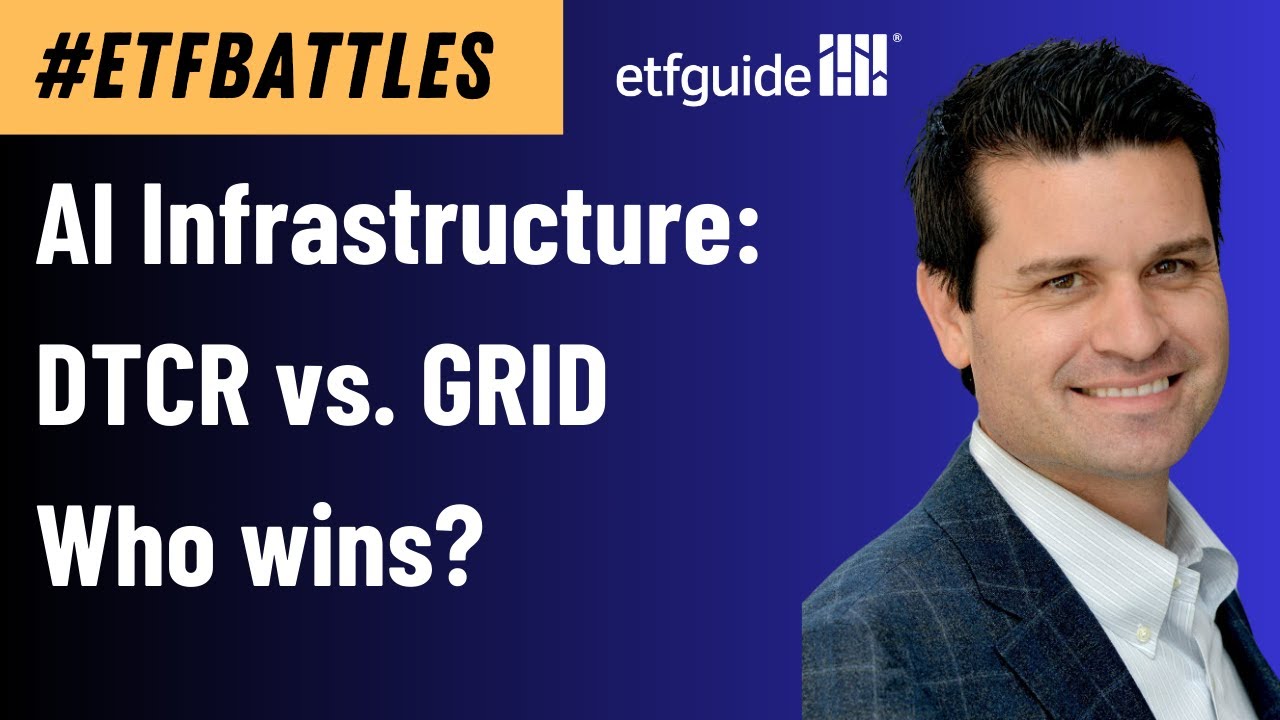
We keep hearing the word infrastructure, but that word now means two very different things. On one end, there's the physical backbone of the modern economy, the smart grid, which includes electrification and the hardware that keeps power on. On the other hand, there's the digital backbone, the data centers, the cloud infrastructures, and the REITs and the hardware firms powering AI and the internet.
Today's ETF battle is a head-to-head contest between two ETFs right in the thick of both trends. So, which is the better choice? Stick around for the answer.
You're watching ETF Battles and I'm Ronda Ley. Great to see you again. Welcome to a brand new year for ETF Battles, an original series which kicks off season 7. Can you believe it? We've been doing this program for seven years, and I'm so thankful to all of our viewers, our judges, our sponsors, and everybody who makes this show possible. Thank you, thank you, thank you. Be sure to join our community by hitting the subscribe button and send me your ETF battle request in the comment section below. We'll consider it for our upcoming matchup on the next episode.
Jumpstart your financial future with a smarter, safer, and robust strategy. Be sure to enroll in our ETF guide, free online courses. Whether you're looking to enhance your trading skills, improve the safety of your portfolio, or planning for retirement, we got you covered. All courses are available totally free to all of our viewers. Just hit the enrollment link in the description section below.
So, for today's ETF contest, we got one from a viewer named Rue Burger, and it's a good one. It's between Grid from First Trust and DTCR from Global X. Which ETF is the better play on this massive AI digital infrastructure buildout? Thank you, Rue Berger, for today's ETF contest.
Judging today's matchup, we've got a duo extraordinaire, time-tested veterans, David Derkin, an independent ETF analyst and outside contributor at the Mly Fool, and Shaina Sisle with Banrian Capital. Judges, great to see both of you. Welcome back.
>> Happy New Year, Ron. It's great to be back. >> Yeah, great to see you guys again. So, our four battle categories are cost, exposure, strategy, performance, and mystery. For mystery, that's where you, our judges, can choose any factor or criterion that you think is crucial to today's contest. You can also nominate wild card ETFs if you feel there's better choices elsewhere. I've got the scorekeeping chores, and at the end of the program, we will declare an overall winner. Keep in mind, none of the battle outcomes are ever predetermined or known in advance by myself or our judges. So the first category is costs and we're going to start with you Shaina. Please get us started.
>> So this is really interesting. Both ETFs have reasonable expense ratios. DTCR at 50 basis points and Grid at 56. Grid actually trades a little better than DTCR. The spread is slightly better, but not so much that it makes up for the six extra basis points of expense ratio. Although it is a substantially larger fund with more holdings which suggests to me potentially better liquidity and trading volume. So this was a really hard one for me. On the surface if you just look at the numbers DTCR is the winner. But when you look about average daily trading volume and just ease of of trading, grid is a bit better. So, I consider this a tie if I'm being honest. There's not one that I think is substantially better on an expense ratio and and trading basis. They both have their pros and cons.
>> Solid start. Thank you, Shaina. Dave, you're up next. How do you see it when it comes to cost? >> I came to pretty much the same conclusion. Expense ratios, neither one of them is particularly low. They're not terribly high either. They're just sort of in the middle, but they're close enough that I don't think there's a material difference with either one. And like Shaina said, I like the liquidity of grid a little bit, too. That should keep trading spreads down, but you look at that whole picture combined on the total cost of ownership, it it's kind of a tossup. I agree. So, I'll call it a split decision as well.
Well, that takes us to our next category, exposure strategy. Dave, you're still up, so break it down for us. >> Yeah, even though these both fall under the infrastructure category, you've got two really different portfolios here on grid. You've got mostly industrials and utilities. So, you've got the companies that are producing the hardware, the meters, the the networks, and things like that. So, you got a little bit more of a cycl, cyclally sensitive portfolio on DTCR. You've got about half tech and half REITs, data center REITs. So, you've got all the big names there, American Tower and Crown Castle. So, all the big familiar names. So, I think when it comes down to it, you really have to decide kind of which angle you want to play here. Personally, I like grid a little more. it's cap weighted but it does focus more on pure plays within the infrastructure space. It's got dedicates about 80% of its portfolio to companies that generate more than half of their revenue from from this. So I think you probably get a little more of a pure play. I kind of like that focusing on the industrial and and the manufacturing side of things. Although I think it really comes down to kind of which which angle you you want to tackle in order to get your infrastructure exposure. For me personally, I'm going to call Grid the winner. that's just my personal preference.
>> Shaina, you're up next. How do you see it when it comes to exposure strategy? >> Yeah, I agree with Dave. These are two really different funds giving you exposure to very different things. I was kind of surprised with DTCR having such a huge chunk of it and REITs. I expect it to have a a better yield than it does. I'd hoped that it'd have a better yield considering the read exposure, but it it doesn't. They basically have the same yield. I it really does come down to personal preference. I actually am going to take the opposite view of Dave on this. Well, I think that the need for the type of infrastructure improvements and buildout that grid is exposed to is higher. I just don't think that is the place where the dollars are flowing. So, I am inclined to prefer DTCR's exposure where I think there's a lot of focus, a lot of money going into that space. most of the largest players in the major indices are playing in the space where there's the need for this. So the actual funds to allocate to the development of this infrastructure is much more robust and not as reliant on government spending where I think grid is much more reliant on government contributions to that buildout. So, while both of them are excellent funds and as Dave pointed out, grid is probably more of a pure play, I think just ultimately where the trends are and where the money is and where the flows are going, I think that DTCR is the exposure that I would want. And my only caveat being is that I wish it had had a better yield profile considering its read exposure.
>> Well, that takes us next to performance. So, how do these two funds compare? Shaina, you're up. >> Well, this gets back to what I was saying, where the funds are, where the money's going. DTCR absolutely blows grid out of the water performance-wise with the sole exception being the five-year number, which makes sense to me because if you go back five years, the focus on data center and AI just didn't exist. And there was a much larger focus on the grid and you know, you had the Texas grid failures and things of that nature. they were hot topics at the time, but they kind of came and went. Whereas the broader themes and the money and the flows and truly the infrastructure buildouts happening more in the digital data center and digital infrastructure side and you clearly see that in performance it's not even close for these two funds in the last 18 months or so. Even the three-year DTCR outperforms it's just the fiveyear where there's a differential. But overall I think the trends support GTCR so it is my winner. I will note that in these types of thematic areas active management tends to do well. So I really wanted to try to find a wild card. But what I found was it's not really an area where there's a lot of assets. So, while there's quite a few active managers in the space that have substantially better performance than either one of these and a more robust underlying universe, meaning that you gain exposures to all kinds of different clean energy and data center development and things of that nature, the vast majority of the actively managed funds with the broader universes have very small asset bases. Fact, when I was doing my my screen to see what kind of came up, the ones that were coming up at the top were all being delisted because they were not attracting assets, which I found very interesting. So, as much as I tried to find a good wild card for this because I do think that active management does better in themes in these thematic plays, I was unable to really identify one. So, ultimately, DTCR is my winner. Even though the active managers I did find did have better performance, they just don't have asset base, so they can't be sustained.
>> Thank you very much for those excellent notes and points. Dave, you're up next. How do you see it when it comes to performance? >> Yeah, which like Shaina said, it depends on kind of what your time frame is you're looking at to see who's outperforming who, whether you prefer short-term performance or long-term performance, you can, you know, you can get a different answer. I agree with the yield problem on DTCR. I mean, for a portfolio that's half reads, I agree. I'd like to see something closer to 3 4% or higher, even though it's just half of the portfolio, but it's only around 1%. So, yield really isn't a differentiator in this battle. So, because of the back and forth with the returns, just depending on what time frame you look at, I I'll call this one a split decision. But, I'll piggy back off of what Shane has said. Yeah, I I agree that, the the interest is really more on the data center side and that's, where the flows are probably going to be going as investors want exposure to that side of things. So, perhaps a little tailwind on that side, but at this point right now, I'll just call it a split decision.
That takes us next to our mystery battle category. This is where our judges can give us that single factor or maybe multiple factors that they feel make a difference. So Dave, what is your mystery battle category and which of these two ETFs wins it? >> Well, I just wanted to talk about the rate sensitivity of these two portfolios just a little bit because if you believe what the market is saying right now, they're looking for about two rate cuts in 2026. I'm not sure personally they're going to get there with GDP running at about 4% annualized over the last quarter or two. I'm just not sure the Fed's going to have that much room. So in an interest rate sensitive portfolio that has a lot of REITs in it, you think that might get a tailwind if rates are heading lower, you kind of see that in the overall volatility of the portfolio. DTCR is just a little more volatile than grid. I think my winner in this category is just narrowly going to be grid because it's got a little bit a little bit less interest rate sensitivity, but you're going to get a little more of the cycllically sensitive side of things. So, it's going to be dependent on growth in the sector and spending in the sector. But, again, it kind of depends on where you feel rates are going. If you feel rates are going a lot lower, then DTCR and its heavy read exposure might be the better play. I'm just not sure it's going to get there right now. So, I'm going to give the narrow win to grid on interest rate sensitivity.
>> Shaina, you're up next. Your mystery battle category, what is it and which of these two two ETFs wins it? >> So I'm going to talk a little bit about how exposure to a regulated industry impacts potential return outcomes. Grid is playing in more of the electric grid, electric energy renewables space which is a regulated framework. It's utilities for all intents and purposes. And so that can be somewhat of a constraint on potential upside opportunities there. Whereas GTCR is less involved in that space. And as I mentioned when I was talking about kind of performance and the like one is much more heavily related on government spend than the other. and I am inclined to stay away from anything where a government is too involved and that regulatory pressures can really change the thesis of this you know in the case of electric infrastructure and things of that nature renewables clean energy you know who's in the White House can matter in terms of you know the expenditures in that space the the subsidies and so on and so forth and those things are all kind of out of the control of the companies that are in the space. And so I'm I do prefer GTCR because it has a little less regulatory oversight and it's less impacted by, you know, government spending and subsidies. So I am going in the opposite direction. I can see where this battle is going. It's a clear preference on either side for different reasons, but my my winner is DTCR because I prefer more of a free market framework versus something that's highly regulated and particularly sensitive to government spending and subsidies.
>> Shaina and Dave, the odd couple, at least for this particular battle. So, now we've moved to the part of the program where our judges are going to give us their overall pick. So, Shaina, you're still up. Give it to us. >> Yeah, I guess it's pretty obvious at this point and I I I absolutely know where Dave's going to. DTCR is my winner here. this shouldn't surprise anyone. I am the person who loves Nvidia. I talk about AI and infrastructure. A lot of my favorite stocks when I go on and I talk on CNBC or Fox or whatever are always in this space. And there's a reason. It's because that's where the long-term trends are. I think that, you know, we're very early innings of a massive technological upgrade and it's all driven by what's going on in DTCR. There's a lot more money in this space. There's a lot less regulatory pressure in this space and I think that the actual focus and likelihood that the spending will happen in that side is higher. The again the one caveat is I really hate seeing a product that has 50% of its holdings and REITs with such poor yield. And if there's any down negative of this particular fund, it's that it's disappointing to see. But for lack of being able to find a better alternative, it has to be TC DTCR. when I look at the two in the battle,
>> Dave, your final chance to weigh in with your overall winner. >> Well, I would say it doesn't have to be DTCR. I I would go with grid. Obviously that's going to be my pick in this one. Again, as as I said up on top, I think it really comes down to how you want your exposure to look. I certainly don't have any issue with someone who wants to focus more on the REIT side and go with DTCR. Certainly a very defensible pick. Me personally, I just like the in infrastructure side, the electrification side of things. you know, companies that are going to work on the modernization of of some of our power systems out there. I I do like that. I think it's a bit more of a pure play. It's going to be driven on revenues and things like that. So, again, mainly personal preference, but I think it it, kind of underscores the fact that in these thematic funds, you really want to dig down into the composition and how they're investing and where they're investing because even though at a high level, these are both infrastructure funds, they're obviously doing very different things and you're going to see very different returns and different behaviors in the two funds. So, for me personally, grid is the winner. Again, personal preference.
Well, our judges have spoken and according to my final battle scorecard, today's winner is a split decision. And we had Dave for grid, he made his argument very clear. He favored that particular ETF. He likes to play on the energy, the industrials. And of course, even though past performance hasn't really been as hot as DTCR, you know, we need to look at things from a forwardgoing perspective. So, we'll see if Grid can respond and deliver performance that rivals DTCR in the future.
Now, as far as DTCR, that was Shaina's pick. She emphasized that she likes the the tech exposure. Obviously, it's also got some exposure to REITs, but hey, where's the beef? Where's the yield? That was sort of something that she highlighted as as not really a concern, but kind of like make your head scratch. And then as far as AUM and this theme assets under management, I was kind of actually surprised. It was an interesting factoid that Shaina pointed out, not a lot of assets allocated in terms of funds to this particular theme. Uh but active managers, as she had pointed out, have had a tendency to do pretty well and outperform. So active managers watching, maybe you want to bring an ETF or fund to market that delivers some good results and brings in some assets. So, so maybe we can have some wild cards on an upcoming episode.
So, great job to both of our judges. Well done. We appreciate your excellent insights. Be sure to hit the description section below. We've got links to both Shaina and Dave. Check out their research and some of the the things that they're up to. You can also hit our description section below. We've got links to our free online courses. And that does it for today's episode. Hit me up on our X feed at ETFG guide or in the comment section. Which ETF battle would you like to see on the next episode? Give me your ticker symbols and we'll see if uh if we can get them on the next show. Thanks for watching. I'm Ronda Legy. This has been another episode of ETF Battles. We'll see you on the next program. Take care.