ETF Battles: JEPI vs. ISPY vs. GPIX - A Covered Call Income ETF Rumble!
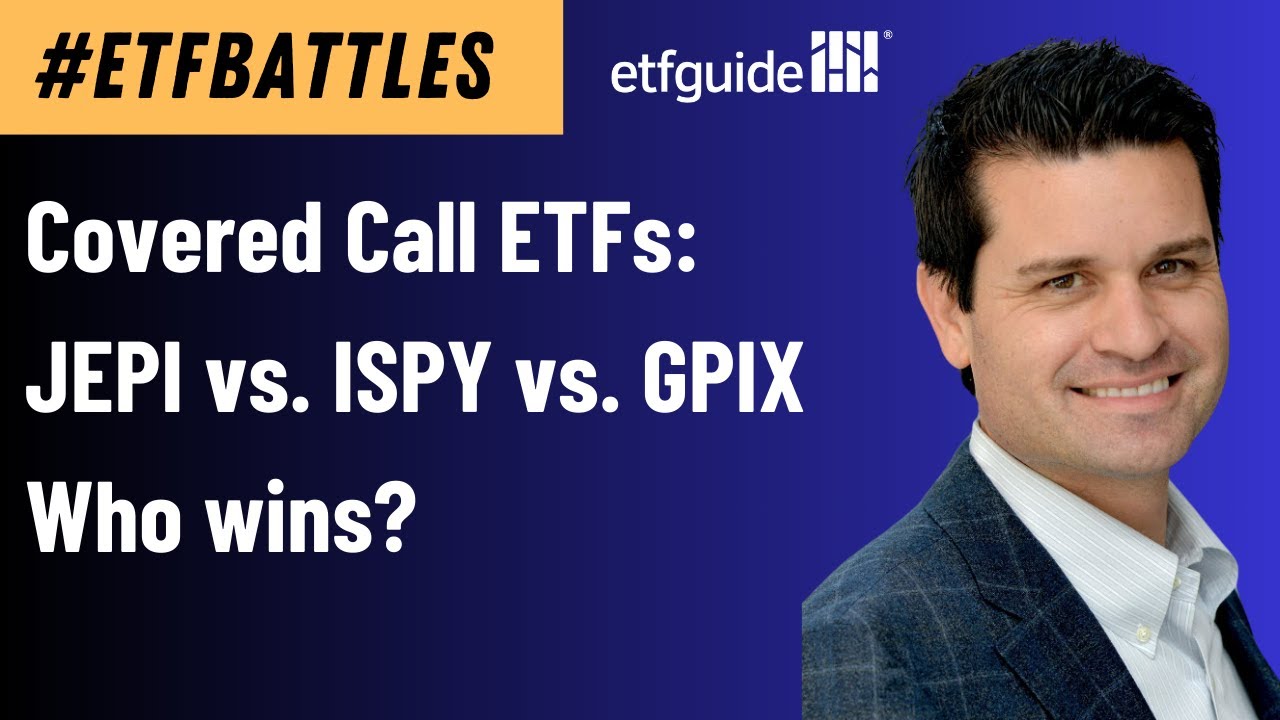
There's no shortage of novel strategies for extracting income from greedy financial markets, and the ETF industry is hellbent on helping you squeeze out every single dollar down to the last millisecond. Today's audience requested a triple header between income ETFs focused on US large cap stocks. It's Goldman Sachs versus JP Morgan versus ProShares. This is going to be fun.
Stick around. I'm Ronda Legy and you're watching ETF Battles. This is an original series program that's now in season 6 and we're so glad to have you here. If it's your first time, be sure to hit that subscribe button and join our community. Our goal, of course, is to help you make better investment choices.
So, if you need help analyzing any specific ETFs and you're not sure how they stack up versus each other, send us your ETF ticker symbols in the comment section below or on our X feed at ETF guide. We could do double, triple, and quadruple headers. Also, be sure to visit the description section below. We've got program links to our program sponsor, Direction.
Be sure to go to direction.com to learn more about their leverage and inverse ETFs on not just broad indexes but single stocks. Again, direction.com. We've also got links to our program judges Shaina and Dave. So, get in touch with them and also other resources. So, again, hit that description section below. Today's triple header ETF contest is between ETFs.
These are high income focused ETFs from JP Morgan, Goldman Sachs, and ProShares. And this was sent to us by a viewer named CP. Thank you so much, CP, for this excellent suggestion. Who wins the battle? Well, we're going to find out helping us to sort through this mecca of madness. We've got Shaina Sisle with Bandrian Capital and David Durkin with the Street.com. Judges, so great to see you again.
Good to be here. Thanks for having us back. So, we're going to go through these four battle categories can give you each an opportunity to weigh in with your analysis for the mystery battle category. That's where our judges have the freedom to choose any factor or thing that they feel is crucial to today's matchup. Our judges can also nominate wild card ETFs if they feel that there's something you should know about that's better. And so, watch for that.
I've got the scorekeeping chores. Keep in mind that none of the battle outcomes on this program are ever known in advance by myself or our judges or nor are they ever predetermined. So, let's kick things off with the first category. That's cost. And it's always sisters before misters. So, Shaina, please get us started.
All right. So, this is a fun battle. These are quasi alt funds. And when we get into it, and the queen of alts, no less, is talking about this. So this is your wheelhouse, Sheena. Yeah, but I call them quas alt funds because they're the vast majority of them, and we'll get into it later, I don't think really are providing any sort of alternative exposure here.
But when you look at expenses, you know, just on the surface, GPIX, the Goldman Sachs product, has the lowest expense ratio, but nobody has better liquidity than Jeepy. And that's because Jeeppy is by far and away the largest product, and it's not even close. It's at $38.2 billion. And it's a really popular fund. So, even though Jeepy's expense ratio is 35 basis points, it just has substantially more liquidity, way easier to trade than the other two. And so, for that reason, it's my winner. Yeah, it's just as simple as that.
Thank you, Shaya. Dave, you're up next. How do you see it in terms of cost? Well, I'm not even going to need my full 30 seconds on this one because Shaya said everything I was going to say. Yeah, Jeep is my winner on total cost as well. The liquidity is just great on this fund and the other funds are both less than a billion dollars. They're, you know, they're not too bad on cost considering the strategies behind it. But yeah, Jeeppy is my winner, too.
All right. Well, let's dig into the details and look at the exposure strategy. That's our next category. Dave, you're up. Break it down for us. Yeah, at their core, all of these are covered call funds using some type of highinccome option overlay strategy. So, Jeppy obviously is the most popular one that everybody knows about that centers on lowvall large cap stocks that use slightly out of the money options.
They invest in ex ELNs, which is ex exchange link notes. I'm sorry, I'm equity link notes. Sorry, I'm, you know, getting my acronyms mixed up here. But, you know, there's so many acronyms on Wall Street. We lost track, too. So, we we joined the club of lost acronym tracking. Yeah. But those are essentially just the stock and the options bundled together in a single security.
So, same strategy. GPIX is the S&P 500 with a dynamic option overlay. So that can fluctuate between high option coverage and low option coverage depending on where they see market conditions heading. So it's an actively managed product. And then ISPY, you've got the zero data expiration daily call strategy on top of the S&P 500 as well.
So that's going to have a different risk return profile. You're going to get the much higher yield on that. But you're going to see some volatility and it's really going to cap the upside. So, you got to make sure that that's kind of in line with what you're looking for. Overall, I would go with GPIX on this one. I like that. You know, starting with the S&P 500, it's not terribly exciting, but I think it works for this.
The flexibility in the overlay strategy typically goes between 25 and 75% coverage. So, I like that it can kind of pivot with conditions at the time. I think it's just a nice balance between all three of these products. So, I'm going to go with GPIX on this one. Shaina, you're up next. How do you see it in terms of exposure strategy between these three ETFs?
Yeah. So, Dave mentioned a lot of the things I was going to mention. You know, I said it in the beginning, but these are quasi alt strategies. Jeff is the only one that's trying to provide some diversification benefit. The other two are really it's it's just about giving you S&P exposure with option premium to kind of sweeten the pot. Whereas Jeepy is actually looking to be lower involved and there's benefits to that.
Zepy also Jeepy also includes an ESG ESG overlay which I think is interesting but as was pointed out it's somewhat actively managed. It's investing in large cap stocks. It's using the S&P 500 as its universe. It's not replicating the S&P per se. It is using equity linked notes. The problem with equity linked notes is it brings in counterparty risk because they're issued by a bank.
And if you paid attention during the financial crisis or if you read anything about the financial crisis, you'll know that a lot of the problems that happened during the financial crisis was counterparty risks. So ELN's bring in some risk to the portfolio that doesn't exist in the other two. I spy is trying to do something I think kind of interesting which is to find exploit an opportunity in the markets where most covered call funds use monthly option contracts and base it on you know expiring in 30 days and they sell and it's out of the money.
But by doing that, sometimes it could be out of the money when you sell it, but market volatility can change that really quick and we're in kind of a volatile market. Whereas I spy is you using a daily approach. So it's based on the expiration is in a day. Which actually can reduce some of the the risk that volatility inherently brings to option markets both good and bad.
Obviously when volatility is high the option premiums go up but if you have already shorted something you don't necessarily get the benefit of being able to sell the option contracts at a higher premium. So overall when I look at these I don't love the ESG component of Jeepy to be honest and I don't love bringing in counterparty risk with the equity link nodes. The Goldman fund is really interesting in that it's actively managed and that it's a it's a dynamic option overlay.
So, it can be up to 25 to 75% of the portfolio at any given moment. But I prefer I spy. I think they're doing something interesting where they're trying to exploit something inherent in the market which I I think it would be quite interesting. Honestly the performance of these funds is not demonstrating to me that JPEX is active approach is adding tons of alpha. So but then again none of these funds have really long track record so it's hard to really tell but for the reasons I just mentioned I spy is my winner.
So that takes us next to performance and yield. And Shaina you're still up so break it down for us. These strategies are interesting in that inherent in what they're trying to do is to have strong monthly income distributions. It's ironic to me because Jeeppy is the most popular fund in this battle and it's not even close with like none of the other funds are even at a billion dollars. Jeffy's at 38.2 billion. Everybody knows Jeppy.
But on the surface, it's actually not a better product performance-wise, yield-wise. It's not really accomplishing its goal of having lower V. Like, if I if I think about the day we're recording this, and obviously this comes out in a couple weeks, but the day we're recording this is the last day of April, and April has been a crazy month for the markets. So you would want a strategy that is looking to do low ball and have this covered call overlay to do, you know, perform better than the other two funds in the battle, but that's not been the case. JPX, GPIX has actually done better.
And Jeffy has has has kind of not done great in the last month, but it's done better on the threemonth and and and then you know we can look at all the different time periods, but it's kind of all over the place with JPEGs having like the best common period return by far on the one-year number. Now, I'm going to introduce a wild card here, but I'm gonna caveat it by saying the fund I'm going to introduce as a wild card is not focused on monthly distributions and creating income. And if that's why you're owning these products, then this is probably not the fund for you.
But I look at these products as a way to manage risk in a portfolio. So, I'm not really worried about the distributions. So, the fund I'm introducing can have really good distribution yield but sometimes has none like now which is MRSK which is a fund that we've had in battles in the past. It's the TAZ Agility Shares u managed risk blueprint ETF.
This fund actually brings in something that the none of the battle funds have which is the put protection. So it it is doing a covered call strategy. It is selling out of the money calls, but it is also doing some call put spread in here and using puts to protect on the downside. And it's done that effectively in this volatile environment.
And so it's bringing something to the table that I think the three in the battle don't bring. So MRSK is actually going to be my winner. Of the battle funds, it's really hard to choose because their their performance is GPIX has a one-year number that is substantially different than the other funds. But it's common period performance over all other time periods is worse.
And so I it's just really hard to pick a winner in the category because it's it's all over the place. So, I'm going to have MRSK as my winner. I do like that it's using foot call spreads here and it's having protective puts in the portfolio to protect when the markets are all over the place and it is outperforming the three in the battle substantially 200 basis points right now and so I I just like that better if I'm I'm looking at a strategy like the three of these where I'm looking to manage risk in a portfolio.
Thank you for that wild card Shaina. And that takes us to Dave. You're up next. Give it to us in terms of performance and yield. How do you see it? You know, Shaya brought up a really good point of Jeeppy and its success. Sometimes it's just a matter of the right strategy hitting at the right time. And you know, the market goes nuts with it.
It's like, you know, 2021 and 2022, it did fantastic. It outperformed. It had a five-star rating. And since then it's it's really been pretty average I think compared to some of the other funds in its category but investors love it. It you know much success to it but yeah Shaina made a lot of the points that I was going to make. You know over performance is kind of all over the place and and GPEX and I spy have only been around for a year to a year and a half.
So there's not really a long track record to look at. If you look at yields Jeeppy I think is at 8.2 GPIX is at 8.8 and Ice obviously has the highest yield of all at around 11% because of the zero DTE strategy. And I think that's a good point she brought up too that in high volatility markets like the one we're in now the option premiums on these are going to go up too. So you can get a yield boost in these kind of markets that you may not get in a in a low vol environment.
So I think each of these is producing a yield at least that's kind of reasonable with their underlying strategy. Performance is I don't know kind of kind of mixed I guess I'll call it. So I'm going to cop out on this one and I'm just going to call it a three-way tie. think they're all sort of delivering at least on the yield front kind of what would be expected of them.
Very good. And what about and this is just out of left field. What about NAV decay? We've been hearing more about that like with these types of high yielding types of ETFs where investors are just enamored with the yield, but they're not really looking at the decay, the total return of the actual product. I mean, are you guys seeing that as a something investors should be aware of?
Yeah, I mean if you look at this battle category, the highest yielding on a distribution rate is I spy, but if you look at like the time period right now, it is substantially the worst performer. So from a total return perspective, you know, I think people do get too enamored with yield. That's why I brought in MRSK because I don't look at these products as where I want my income.
I'm sorry, but if I'm an income investor, I'm I'm doing fixed income where I can have that like coupon and get that. Whereas, if you're doing it with options or you're doing it with dividends, you're going to have volatility in your income. So, it really is going to be at the end of the day about total return, right? So, no matter what your dividend is, because it's going to fluctuate all of the time, you want to make sure that you're getting good total returns because it's not going to be a stable income component.
Same is true with these option contracts. And if you look at these, the higher the yield, the the more decay there is in the NAV. The total return is not as good. And and that's exactly what you see here. It's exactly what you see here. And again, if I'm an income investor, I'm not using this as my income.
It's not stable and you can't really count on it. So if you're doing this, you're hoping to get enhanced total return with an because of the income component and you're not seeing that here. Absolutely. Go ahead, jump in, Dave. Yeah, I'll just jump in real quick and and add that it's kind of why I'm not a fan of these zero DTE products to begin with because you see some of these products out there, they're based on, you know, Tesla and Nvidia and Coinbase and all these funds.
They're really wretch and you got playing the option income off of that high volatility. So you get those 50, 60, 70, 100% yields on those. And I I I get really worried that some of these folks that don't really understand how these products work, they're just jumping in, say, "Hey, 70% return, I'll take it." And they don't realize that these things have very little upside potential as far as the share price and a lot of downside potential.
So you look at total return and, you know, there are some of them that are still negative over the last 12 months even with the yield. So it it's just another argument for investor education. Some of these products you really have to understand how they work so you know what you're getting. Yeah, I I agree with Dave. These are the types of products I'm going to look at as essential ways to manage risk in a portfolio.
I'm not looking at them for income. And the three battle category funds in here actually aren't great risk management tools. So, they're bringing in complexity. They're bringing in derivative exposure. They're bringing in all this stuff that's hard for the average investor to understand sometimes. And and they're really selling the product on the yield component. And I think that's a disservice because like I just don't think that this is where you come if you're looking for income.
Well, let's go to our mystery battle category. And I believe Dave, you're up. So, just give us real quick what is your mystery battle category? We may have already covered it since we're having such an extensive conversation, but it's it's you're up Dave. Yeah, I was actually going to touch on a riskrelated topic here.
I I was going to look at draw down risk and you know this isn't really draw down risk in in the typical sense of you know how you're protecting your downside just more to bring up the point that you know these covered call ETFs you're you're still almost entirely exposed to the downside risk of the underlying security. So really what you're getting is you're you know the high yield is offsetting some of that downside but you're still getting a lot of downside exposure. So, since their April peak, Ice Spy and GPIX are both down about 17% and Jeepy a little less at 13%.
But, you know, the numbers aren't quite as important as the fact that I think investors need to be cognizant of the fact that there's still a lot of downside risk. If the market corrects, you're still going to experience a lot of downside with these funds. I think Jeeppy at least you know with its smaller draw down in the recent market I think is a product of the fact that it that it invests in low volatility large cap so it's got a little bit of a lower risk profile on the underlying here.
I overall I I'll just call this a split decision just more or less to point out the fact that investors need to understand that there's still substantial downside risk if there's a market correction. Shaina, your mystery battle category, what is it and which of these ETFs wins it, if any. Yeah. So, similar to what Dave is saying, you know, I'm going to get on my high horse again.
I I don't love these products that are introducing complexity and risk and they're selling it as you know potential for protection on the downside or for income and they're not really providing much good total return andor they should have better downside protection and and these funds generally do protect on the downside but the market goes up 75% of the time so like I want something that's going to give me downside protection but also upside participation. And, I don't know that these products really provide the risk management tools or that asymmetrical return profile that I would look for if I'm going to bring in complexity.
I'm going to throw a wild card in that I wasn't planning on, but as we were getting into discussion and I was thinking about, you know, what would I want if I wanted a product to provide me downside protection with upside participation? You know, this is a product that actually is doing something completely different than these but providing that hedge and that's CBLS which is the cloud e hedged equity ETF. It's an actively managed long short fund.
So, it's not doing option contracts to get downside protection and potential yield, but that this fund is actively actively choosing stocks to go long based on potential for outperformance and shorting things that they think are going to underperform. And this is actually a product that has done just that. It's it's delivered on what it says it's going to do. So, you know, in the the recent market volp 500, which is what you would expect it to do, but it's also participated and in some cases even beat the S&P 500 even with the short book.
And I think that speaks to manager skill and as a risk management tool where I'm looking for a product that's going to bring me upside participation and downside protection. I like that long short hedged equity approach where it's you're actively going long certain stocks and short certain stocks and making a directional bet versus this option contract complexity because really the selling point of these is the distribution yield but people pay too much attention to that not total return and I just think that these products need to provide me some downside protection and I would like upside participation which Jeffy is clear that it's looking to do lowvall, but the other two are trying to give you the returns of the S&P 500 and they don't necessarily do that. And they're not providing enough downside protection.
So, really on a total return basis, you get this distribution, but you're really not getting what is to be expected even with the distribution yield. So, I'm going to bring in CBLS into the mix. Again, it's a long short hedged equity product. It's more like a hedge fund in that respect than these products which are using options to get that kind of downside protection and potential upside participation. But I I do think it's a little bit easier, I think, for investors to understand.
You're you're you're paying a little extra for manager skill, but the manager's proven its skill and it is a good risk management tool. So, I'm going to throw that fund in there. All right. Well, our judges have made some great points on today's program and hopefully this has enlightened you and educated you about some of the ETFs in today's contest.
Give me a turn, Ron. Yeah. Oh, yes. Well, that's right. I'm sorry. We we've been the banter has gone on so much. So, let me give you your You didn't even ask for who the overall winner of the battles are. We were just still on completely lost track. My right now I'm scrambled eggs and sloppy joe's.
So, uh, Dave, go ahead with your, uh, fi your your final point, uh, before we, uh, give you a chance to name your overall winner. Yeah, I'll just, uh, I'll just keep it quick here. Out of these three ETFs, I would go with GPICS on this one. I just think it between these three, it provides kind of a nice middle ground.
I do like the flexible option overlay on it so that the managers can sort of pivot and, uh, position itself based on conditions. So, there is some added potential there. Again, I'm not a fan of the zero DTE funds, so I spy isn't really for me personally. Jeffy's got a long history. It hasn't done quite as well recently, but uh based on strategy and uh the overall objective of the fund, I like GPEX.
Okay. Is that going to be your final overall battle winner also? Yep, that'll be mine. All right. Very good. Shannon, your final chance to weigh in with your overall winner. Yeah. So like Dave, I don't really love these types of strategies.
I agree is the one that probably has the most opportunity to participate on the upside, which is why I think it's one-year number is so much better because if you look at the trailing 12 months of the market and we're still generally positive and so it's it's showing that it it actually is the outlier in that respect and that it substantially outperforms the other two on the one-year number. But all of that being said, I don't like I don't really know how to tell somebody how to use these products in a portfolio because they don't really fit. They're they're definitely equity.
They're probably a potential alternative to like a pure S&P 500 because with a yield component, but then again, they're not giving you the same diversification or even return profile as the S&P 500 and bringing in potentially some inherent risk. So, I am actually going to keep my wild cards and say that CBLS and MRSK I think are better products which can actually provide some diversification benefit and alpha to a portfolio in a way that the three in the battle just really can't because they're not trying to do anything. And it's hard for me to make the case that these are better solutions than like a pure S&P 500 fund.
You know, I I just don't believe in in these types of products. And I say this as somebody who used to run a covered call strategy. But it was an actively managed one. And so I I was still selecting stocks and looking at the option market and I didn't always have to cover the position I had in the equity. So I I had a lot more freedom.
So, I just don't love these products. I'll probably get crushed in the comments for saying that. I tend to get crushed a lot in the comments. Maybe I'm too sensitive, but I will say that I I get crushed, too. Bring it on. Bring it on, audience.
Hit us up in the description. Hit us up with your comments and crush us, please, because we'll crush you back. Right. I just don't love this ETF battles. They're really not providing much in in return for the risk and the higher expense that they have. And so, for that reason, I don't like any of them.
And CBLS and MRSK are my winners of this battle. All right. Well, the Queen of Alts has spoken and so has Dave. And according to my final battle scorecard, this is going to be a split decision between GPICS, which was Dave's choice. And um Shaina's two wild card choices, MRSK and CBLS.
And each of our judges made some strong points. And I'm not going to elaborate on all of their points. I think they spoke for themselves. But let's just say that pay attention to to more than just the yield. I know that a lot of investors have unfortunately been enamored and caught captive by just the yield and they don't look at the other aspects like what our judges mentioned on today's show.
The NAV that's that that could possibly decay as well as the overall or total return of the fund. And also too, to Shaina's point, how does this fit in to your overall portfolio? Does it even fit into the framework? And so that was something that she really questioned about all three of these ETFs.
Again, I think our judges did a great job. They gave us at at the very least something to really think about before you hit that buy button. Shaya and Dave, great job. Thank you for having me again. Thanks, Ron. Be sure to visit the description section below.
Also, one last thing, visit direction.com. That's our program sponsor and be sure to get in touch. Lots of good educational resources for ETF investors and traders. Again, direction.com. Well, I hope you've enjoyed today's episode.
Hit us up with your ETF battle requests. Keep them coming. I want to see some good ticker symbols and some good suggestions in the comment section below. I'm Ronda Legy. Thanks for watching. We'll see you next time.