ETF Battles: QQQM vs. MQQQ vs. SPYQ vs. QLD - Leverage Mania!
Well, in this episode, we're diving into the high octane world of leveraged ETFs and another audience requested matchup. This time between four leveraged ETFs with different reset frequencies, but on indexes that you're probably familiar with. So whether you're chasing momentum or hedging tactically, these are tools that can supercharge your strategy if you know how to use them, stick around. We're going to get to the bottom of this matchup.
Well, this is ETF Battles and I'm Ronda Ley and a warm welcome to all. Hit that like button if you've been enjoying our program and do join our community by subscribing. We're almost at 60,000 subscribers and a big thanks to all of our loyal fans. We could not have done it without you. Tell your 10 million friends and in no time we'll be above 100,000.
Visit this comment section below if you'd like to send us an ETF battle request. Send me your ETF ticker symbols. We can do double, triple, and quadruple headers. You can also find us on X. Our feed is ETF guide. Also be sure to check our double or double check our season 6 ETF playlist to make sure that we're not doing any battle matchups or requesting any matchups that we've already done.
Also the video description section below has links to our program sponsor direction. Lots of choices beyond broad market indexes. They've got ETFs linked to industry sectors along with MAG 7 and single stocks like Nvidia, Planter, Tesla, and many others. So, be sure to hit that description section below. You can also visit direction.com.
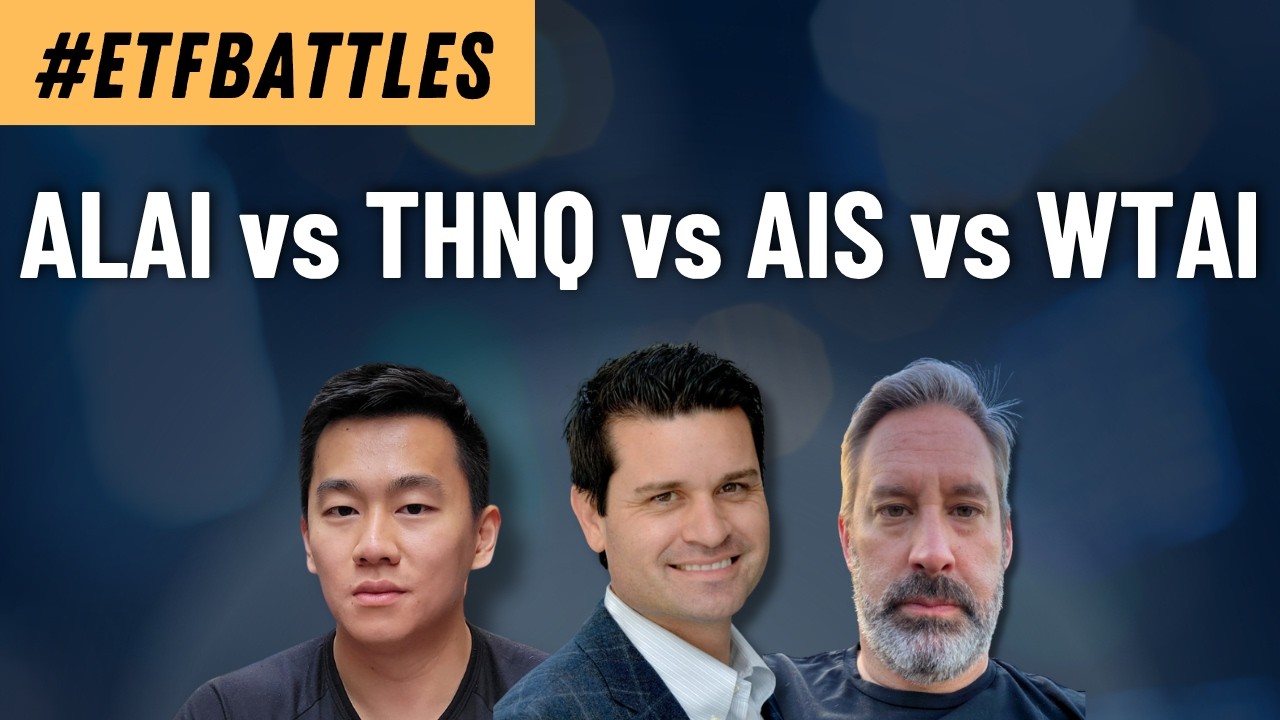
So today's ETF battle was sent to us by a viewer named Gladstone, a loyal viewer who's been chasing us, following me, hunting me down, making sure that we're going to do today's matchup and specifically requesting this particular judging pair of Shaina and Dave, which we'll introduce them in a second. We've got ETFs from Trader and ProShares and it's QLD versus MQQ versus QQQP versus SPYQ. Lots of Q's. And judging today's ETF contest, we got the queen of alts, Shaina Sisle with Bandrian Capital and Dave Crinces with ETF Portfolio Management. Judges, thank you both for being here.
>> Hey guys, let's battle. >> I am very excited about this battle and I fear that Dave may not like me after it. All right. Well, let's see. This might turn out to be a battle of philosophies beyond a battle of ETFs. We've got our four categories of cost, exposure, strategy, performance. And then we've got, of course, our mystery battle category, which is where our judges can pick a certain factor, a thing that they think is pertinent and crucial to today's contest.
Judges can also nominate wild card ETFs if they feel there's a better choice elsewhere. They can also opt for split decisions, pass. I'm pretty liberal. So they can pretty much do with whatever they want except use foul language. I've got the scorekeeping chores. At the end of the program, we will declare an overall winner. Keep in mind, none of the battle outcomes are ever predetermined or known in advance by myself or our judges. The first category is cost. So, let's get started with Dave.
>> Ron. I don't know how Shaina could say that because I love everybody, but you know, big thanks to our viewer Gladstone for requesting this battle. This is a very interesting leveraged ETF rebalancing matchup. Now, I have said many times on previous battles that levered ETFs are the future of investing and investors now have a wide range to choose from. Among these battle ETFs, QLD is the cheapest, although we do prefer wildcard TQQQ for even cheaper exposure to the NASDAQ 100 with three times leverage. So on a value adjusted basis, I give the win on cost to wildcard TQQQ and then to QLD second. >> Wild card so early in this episode. An epic battle, but we'll take it. Thank you very much, Dave, for that excellent analysis. Taking us next is cost. Shaina, please give us your breakdown.
>> So, the reason I think Dave's going to dislike me after this battle is I actually completely disagree. I think these are awful products. I hope they're not the future. I think leverage is the future, but not this way. We'll go there as we get into other categories, but I do agree with Dave in QLD being the winner of this battle. The other three are much more expensive. And as much as I tried, I was unable to find a lot of information on their trading liquidity, and my assumption behind that is they're very small funds that don't really trade. So there isn't really much data of which to take from in order to get much information about liquidity and that in of itself is a red flag about the liquidity of the funds. >> Yeah, good point. And the AUM on these trader ETFs is very low obviously contributing to that lack of what you call trading volume and certainly that's something that investors need to be aware of. Thank you for bringing that up Shaina. Next up is exposure strategy. And Shaina, you're still up. So, break it down for us. How do you see it?
>> So, I want to start by saying that these are not funds that are meant for long-term holds. Especially not QLD. In fact, there is a major disclaimer on the landing page for that fund saying this is not meant for being held for more than a day. We'll get into the the trader funds and how they're a little bit different. I'm sure but from the status of the exposure strategy all four of these funds are two times levered to a respective index QLD MQ and QQQP to the NASDAQ 100 and SPY to the S&P 500.
Levered funds are using derivatives to gather their leverage and they are levered not just on upside but on downside. So you have to have really high conviction in the outperformance of this particular index if you're going to invest in these especially QLD. It's a trading fund. It is not meant to be held for more than a day. It resets daily. But the aspect of this that is worth noting is that if you go up 100% that's great, but if you go down 100% you got to go up 200% to get your money back. So it magnifies the risk.
And so volatility in these markets can be high and volatility is not your friend when you're looking at levered ETFs because you have to get double the return of the downside to match, you know, the potential upside. So you really got to get it right. And that's why I don't typically suggest using these products at all unless you are an active trader and you're looking to hedge or really convey a high conviction and in something to happen in a very short time period. So, for as far as exposure strategy goes, like I said, they're all two time levered. They do reset at different times, which makes the ones that reset monthly and quarterly a little less volatile and maybe not as risky, but I'm going to also throw in a wild card here early.
I'm a big believer in the use of leverage for smart reasons, as a way to manage risk, not as a way to magnify risk. In this case, leverage is being used to magnify potential risk, but also magnify outperformance. More risk, more return. That's the whole name of the game. But I'm a big fan of using leverage as a way to manage risk. So and long short is using leverage because you can have more long exposure and manage risk by your short exposure.
And then there's a new type of theme use of leverage which is this idea of return stacking. Corey Hoffstein is sort of the person the mastermind behind the idea of return stacking which is actually stacking and using leverage to gain equal exposure. So if you have for example they do this a lot with alts you want to get a 100% exposure to your 6040 but you want to have alts as a diversifier. So you might leverage part of your 6040 so that you can get 100% exposure and then use that leverage to get your alt exposure so that you'll be able to get the benefit of both things without sacrificing on returns. And that's that concept of return stacking.
And there's products out there that do that. One that stands out to me is RSBA, which is Corey's return stacked bonds and stock portfolio. And he has others as well. And Wisdom Tree also has some products in this space in this concept of return stacking. >> Got it. Thank you, Shaya. And also for explaining a little bit about return stacking. Very interesting. Dave, you're up next. How do you see it when it comes to exposure strategy?
>> For exposure, we have four levered index ETFs, each with two times exposure. And three of the ETFs, as Shaina mentioned, are for NASDAQ 100 index and one is for the S&P 500. Among the three NASDAQ 100 versions, they rebalance over different time frames. We have daily, monthly, and quarterly. Now, in general, we favor the higher exposure to tech in the NASDAQ 100 long term. And as for rebalancing frequency, different types of volatility may favor each of these different ETFs at times. So for exposure, I give the win to wildcard TQQQ for the extra leverage. And in its absence, I call it a split decision between the the three NASDAQ 100 two times funds. >> All right, thank you very much. And now we move to performance. And Dave, you're up. So break it down for us. How do these ETFs look? And I know that the trader ETFs, as you you'll probably allude to and point out, do have a very short performance history. So anyway, I won't steal any thunder for you. Break it down for us
>> on performance. QLD is the only battle ETF here with more than 11 months of actual trading. And this data chart shows over the past 11 months, the NASDAQ 100 outperformed the S&P and quarterly rebalancing in QQQP was best with that fund up 27%. However, in this graph of the past decade, we see that the three times wild card TQQQ returned more than one and a half times QLD. TQQQ gave you almost 22x versus 13x for QLD. That said, past performance can never guarantee future returns or even positive returns. And investors must be prepared to hedge when needed. In the crash of 22, QLD fell by 61% and TQQQ was down 79%. So on a riskadjusted basis, I give the performance win to wildcard TQQQ. And among the battle ETFs, I'll call the performance category a split decision between all three of these two times NASDAQ 100 funds. >> All right. And Shaina, you're up next. Performance, how do you see it?
>> So, I didn't do my homework on this because I don't think the returns matter. These are not products that are meant to be held for that long. So, I don't care what it did over three years or five years because you shouldn't hold any of these for that long. It's just you know you're looking at a linear experience not the actual experience and so you know you got to look at the compounding effect you got to look at you know what happens when there's ma massive draw downs and the resetting function matters here so I didn't even look at performance because when you're investing in these types of levered funds the longest you should hold one is a quarter and Mo, I wouldn't even suggest that.
And you really have to understand how these things work. They are not meant to be held for long periods of time. So, I really don't care what the long-term performance is because that's not why you would own something like this. So, there's no winner. But, I will again point out the return stacking ETFs do have some attractive returns. Two that I will add into the mix for wild card is RSST and GDE. Wisdom Tree is GDE. It's using leverage to get extra gold exposure versus a traditional US equity exposure. And then RSST is my favorite because it's doing the what I talk about all the time. It's using leverage to manage risk of US equities by incorporating managed futures into the portfolio.
So I like leverage. I don't like this leverage. And I have no winner from the battle categories cuz I didn't even bother looking at returns cuz they don't matter. And I'm throwing in those wild cards instead. >> I love the attitude, Shana. Keep it up. Keep it up. And she's so defiant. But she can defend that defiance and that makes all the difference. That takes us next to the mystery battle category. This is where judges can pick a certain factor or thing that they think matters. And so Shaina, what is your mystery battle category and how do these ETFs compare?
>> So I'm going to take this opportunity to get up on my high horse like I like to do on this show and talk about leverage. Good leverage, bad leverage, and everything in between. So leverage can often be seen as a dirty word, but we use leverage in our lives every day. When we buy something on a credit card, when we buy a house with a mortgage, you're using leverage, right? So, you have less money and you're borrowing on top of that to buy an asset that's going to hopefully grow in value or that you need. And ultimately the use of leverage can be very helpful. I've certainly helped investors use leverage where they take a loan out on their traditional portfolio at a lower interest rate than our expected market returns and we leverage up our equity exposure.
Leverage is also very commonly used when you are investing in alternatives. So if you are investing in PE you know we talk about buyouts and you know we had all these kind of things in the 80s where the use of leverage was a big deal. The reason a lot of PE and VC and all these other types of products did really well in a low interest rate environment is because it was really cheap leverage and so they could magnify the returns and invest borrow at a low rate and invest with a higher expected return and therefore get you more return and more juice in your portfolios. Using leverage to include and manage risk can also be really helpful.
I talked about long short funds. When you go long a stock and then you short, you're using leverage to short. And so the short can be your risk management in many ways so that you can put more money in the stocks that you have high conviction of. Return stacking is the same idea. And so I like to use leverage as a way to have cheap borrowing and take what I'm borrowing and put it into a higher expected return opportunity. This is not that. This is I just want as much exposure as possible and I want to juice it up. And there is no actual risk management here. This is actually increasing your risk and your exposure substantially. So you got to be really really right.
And the average person who is watching this battle is probably I'm not even somebody who can feel confident making that bet and I'm you know been doing this for a long time and I'm pretty experienced in this space. Most people are not going to trade these correctly and so more likely than not you will end up getting burned. So unless you're using a professional like Dave to manage your portfolio or somebody who is an active trader and understands the nuances and the risks associated with this and will be able to very quickly trade in and out of these things, you should not touch them. So I want to just talk and say to the viewers, leverage is not a bad thing.
Leverage can be a lot of things though. And when you use leverage as a way to mitigate risk or to potentially amplify returns because the cost of your leverage is low, that makes sense to me. Levering for the sake of levering, which is what these products are doing, is very risky. And if you are wrong or there's any volatility, you can lose everything really quick. And so you need to monitor these things like by the second. And I don't think that the average investor wants to or should do that. And so if you really want to do these leverage thing, then you need to talk to Dave and have Dave manage a portfolio for you. You should not be doing this yourself. >> Well, thank you very much. Some great points that you raised and especially I think helping us understand that how we use leverage in everyday life. I think sometimes we forget about that. I mean how many people are have a mortgage? Well, if you have a mortgage on your home, which is what more than half the US population, they're using leverage, you know. So, so in the investment universe, there is leverage and certainly as you explained there so eloquently, the kind of leverage that you prefer to use. And Dave, you're up next. Thank you, Shaya. How do you see it in terms of your mystery battle category? What is it? And which of these ETFs stands out, if at all?
Well, first thank you Shaina. I do agree that these are very complicated products and investors should proceed with extreme caution or access professionals who have comfort with them. When it comes to the mystery category, you know, I think Shaina would agree that all investors gradually learn that position size matters a lot. And with regards to these battle ETFs, all of these equity index instruments could be over 100% of our strategies when appropriate. So I call the position size category a four-way split decision. However, we do generally favor the NASDAQ 100 over the S&P. And we often say the NASDAQ 100 is the next generation S&P.
And we say this, Gladstone, because the top 10 holdings of the two indexes are mostly the same, although the NASDAQ 100 has far more exposure. And if you are a CEO launching the next Nvidia or Google, you absolutely want your stock to be on the NASDAQ so you can get allocation flows from both the S&P and the NASDAQ 100 indexes. So at ETFPM, we do believe the NASDAQ 100 is the next generation S&P. Now, we've moved to the part of the program where our judges can give us their overall winner. And my battle scorecard is looking very empty. It's barren. Will it get filled up during this last segment of the show? Well, let's see. Dave, your mystery B or your not your I'm still on mystery. Um, what is your final battle winner for this quadruple header?
Well, levered ETFs can be complicated, so be sure to read our book, Investable Benchmarks. And to recap this levered ETF rebalancing battle, investors should know that market volatility could favor different rebalancing frequency at different times. There's no way to know for sure which rebalancing frequency will be best or when. And in general, we do still favor daily rebalancing of the NASDAQ 100. And in this chart, we show that over this past 15-year period, the three times NASDAQ 100 TQQQ delivered 233x. TQQQ actually delivered almost 33 times the S&P return of 7X. So, I give this levered equity index ETF battle win to TQQQ. And among these battle funds, I give the win to QLD. >> Shaina, your final chance to weigh in with your overall winner. Give it to us.
>> So, since we're going to talk about leverage, I'm going to give you a fund that uses leverage, but it's nothing like the funds in this battle. So, I have two winners. They're kind of different, but I think they're worth noting. We talked about the return stacking. So any of Cororey Offstain's return stacked ETFs can make sense. He has number of different flavors. And I like them all depending on how you're using them. But I am going to go on my Queen of Alts throne and talk about what kind of leverage. I do like leverage that can give you really outsized returns but also manage risk. And that means I'm going to talk about begs.
This is a newer ETF by one of Bon's part partners, Rare View Capital. It's a two times levered cryptocurrency precious metals fund. And it is tactically le using leverage to gain exposure to one or both of those categories at any given time. that mix is actually really good for risk management in that the precious metals tend to be more defensive and bitcoin and cryptocurrencies tend to be more risk on kind of trades. The products has done quite well since it launched in May. It doesn't have a long track record. a similar fund by our friends over and Newfound have one called BTGD similar except it's just Bitcoin and gold whereas the rare view one is all cryptocurrencies and all precious metals. But the the one BTG has some really impressive performance over the last six months. It's up 47% year to date up over 40.
And that's the kind of leverage I like. Leverage that makes sense. Again, both of the products, whether it be Begs or BTGD, are using leverage, but using it to amplify the returns of two areas of the market that are complimentary. And and that actually manage the risk of the other. So, I like both of those portfolio, those ETFs. I love this return stacking concept. I think it has a lot of value. I personally have been doing a lot of work with Wisdomree about this to be able to use some of the, alternative products that we have and that we manage at Bonrian in ways to their return stacking portfolio models. So, there's lots of different ways. I love the concept of return stacking. I love the idea of using leverage to have risk mitigation.
And so, for that reason, I'm throwing those wild cards in there. And I can I would happily throw all the battle category funds in the trash. >> All right. So BTGd just to confirm that ticker correct? >> BT GD and begs as in beg for mercy. It stands for Bitcoin ether silver and gold or gold and silver. Begs. >> Got it. And BTGd what is what is in that portfolio again? >> That is just Bitcoin and gold. Whereas the begs one is ETH, Bitcoin, silver, gold, and also other precious metals. >> Got it. Okay, makes sense. And that BTG, just to confirm, also uses 2x daily level. >> Two times. Yep. They're both levered two times. >> All right. Well, our judges have spoken. And according to our final battle scorecard, today's winner is a split decision between TQQQ from Dave. that was his choice pretty much across the board. He preferred that ETF. Of course, it does have a much longer history than any of the ETFs in today's battle. Actually, QLD, it might have the same history, but close close, but it does use 3x daily leverage on the NASDAQ 100, which which he has many times said he believes is the S&P 500 of the future.
And you look at the performance of the NASDAQ 100, it's hard to argue with that. Shaina's choice was Begs and BTGD. Those were her two wild card choices. Some interesting alternatives. Well, would we expect any less from the queen of alts? And these two ETFs offer 2x exposure to cryptocurrencies and precious metals, of course, with a little bit of variation there. So check those out. Begs BEGS and BTGD. And what a great battle. What a great showdown. I was not expecting today's episode to end the way it did. So many great points. Using leverage to mitigate risk. Using leverage for cheap borrowing, right? And arbitrageing, right? The difference between what you're borrowing at versus your expected rate of return. And if there's an advantage there with your expected rate of return, well then leverage can make sense in that scenario. So some really awesome points and of course we couldn't have done it without you both of you. Much appreciated your excellent insights Dave and Shaina. Well done. >> Thanks for having me and thanks for the battle Gladstone. I hope I didn't completely disappoint. >> Well, thank you Ron. Thanks Shaina. Remember protect principle when needed people. >> Yes. And thank you again to both of our judges as well as Gladstone for this outstanding ETF battle suggestion. Boy, a lot to digest in today's episode. Hit us up in the comments section below. What did you think of some of these wild card choices that our judges mentioned, some great points all the way around. Again, hit us up in the comment section below. And if there's a certain ETF contest or battle you'd like to see, send me your ETF ticker symbols again in that comment section below. And thanks again for watching ETF Battles. Hit the subscribe button, join our community, and also check out the description section for our program sponsor direction. Thanks for watching. I'm Ronda Ley. We'll see you on the next episode of ETF Battles.