ETF Battles: TOPT vs. CNEQ vs. BKCG – High Conviction Showdown!
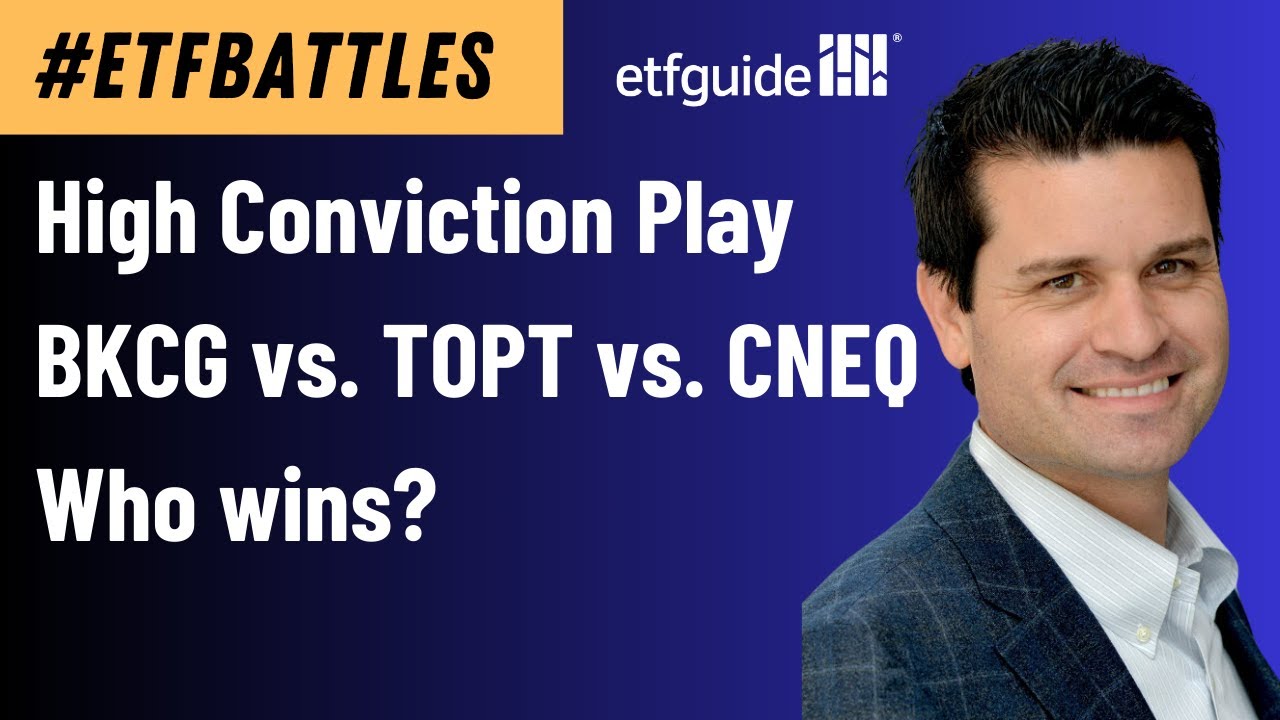
Forget broad market exposure. How about we examine ETFs that are swinging for the fences? Sounds like a delightful exercise to me. Today's ETF matchup is an audience requested battle between three high conviction, highly concentrated plays where every holding is handpicked and every move is deliberate. Or so you think.
But conviction cuts both ways when you really think about it. Are you getting genius or are you getting group think? Well, today's ETF face off, we're going to dissect these managers that are trying to express their boldest ideas and we're going to see whether it's a smart bet or just a gimmick. Let's find out. This is ETF Battles. Stick around.
Good to see you again. I'm Ronda Leg. You're watching ETF Battles. Be sure to hit that subscribe button if it's your first time watching. And keep your excellent ETF matchup requests coming. Hit us up with your ETF ticker symbols in the comment section below. And then also be sure to watch our season 6 ETF battles playlist. It's also posted in that same area in the description section. Check to make sure that whatever ETF matchup you want to see has not already been done.
Also, be sure to check out the description section. We've got our program sponsor direction links to them and they've got lots of choices in terms of leveraged and inverse ETFs on broad market indexes. You've also got ETFs linked to industry sectors along with MAG 7 along with single stocks like Tesla, Palanteer, Nvidia, and many others. So be sure again to hit that description section below and visit direction.com.
Today's ETF contest was sent to us by a viewer named Demoy. And yes, that's a soft X as they do in France. And this looks to me like another super intriguing matchup this time between high conviction, highly concentrated equity portfolios, ETFs tracking those strategies from Alger, BNY Melon, and Black Rock. We've got adrenaline versus adrenaline versus adrenaline. Thank you, De Moy, for your ETF battle request. slicing it up and helping us to make sense of it. We've got Shaina Siso with Banrian Capital and Tony Dong, an independent ETF analyst. Great to see both of you. Welcome back.
So, we got cost, exposure, strategy, performance, mystery. Those are our four categories. Mystery is where our judges can pick any factor or thing that they think is crucial to today's contest. And who knows, that may be the deciding factor for today's matchup. Also, our judges can nominate wildcard ETFs or they can opt for split decisions. I've got the scorekeeping chores. None of the outcomes or analysis that we do on this program are ever known in advance by myself or the judges, or are they ever predetermined. So, let's get right to it. Cost is the first category. Shaina, break it down for us. How do these ETFs compare?
So, this is pretty easy winner. CNEQ and BKCG are more actively managed and their expense ratio reflects that. TT is passively managed, and its expense ratio reflects that at 20 basis points. It's also very liquid and easy to trade, has the most assets of the three. For that reason, TT is my winner.
Thank you, Shaina. top t is her choice when it comes to cost. Tony, how do you see it? You know, there was a time where 50 to 55 basis points for an actively managed fund would be considered extremely competitive. That would be during the days of mutual funds, but in ETFs now, we're seeing active management on both the equity and the fixed income sides come down. And unfortunately, BKCG and CEQ are no longer as competitive. TPT in this case is just significantly cheaper, less than half, 20 bips versus 50 and 55. I am still not too keen on paying 20 bits for what amounts to 20 stocks. I think that with brokerages like M1 Finance where you could just make a pie or like even with zero commission brokerages, you could just buy a lot of these constituents yourself following the top 20 of the S&P 500. So, if I had to pick one, it would be TOPT, cheapest by far.
That takes us next to exposure strategy. Tony, you already kind of alluded to it. So, break it down for us. How do these three ETFs in their portfolios look? Mega Cap US growth tilt, but achieved in different ways. Top is pretty simple. Top 20 stocks in the S&P 500 in between rebalances. You're going to get all the mag seven up there and a few odds and ends like JP Morgan Chase, Birkshshire Hathaway. It looks very similar to the NASDAQ 100 but for the financials and the inclusion of NIC NYSC listed stocks. Again I don't like it because it's just you can do this on your own. If they charge 10 pips for it maybe 20 is a little pushing it.
CQ is a black box in how they actually select their holdings. We know it's a concentrated portfolio. We know that is skewed towards mega cap tech stocks with a much higher average market capitalization and more significant tech concentration. But beyond that, the process of how Alger actually picks the holdings is unknown. Fortunately, on the website, you can see which sectors and individual equities contributed or detracted to return. So, I do appreciate that. But one thing to note is that the active share of this fund is actually pretty low. It's at 48%. Generally, I would say anything below 50 to 60% would be closet indexing. And that the top holdings are going to be very similar to whatever benchmark they're going against.
So, if we look at the top holdings for this alge fund, it's the usual suspects. It's the Mag 7, Nvidia, Microsoft, Amazon, it's not until you get some active holdings like Apploving, Taiwan Semiconductor Manufacturing, Nebios Group that you begin to see some differentiation. So, when I see something like this, I'm asking myself, is the alpha actually from security selection or did you just double triple down on beta, right? With the same holdings as everything else.
As for BKCG, it's pretty much the same story. BNY, you know, elaborates a little bit on their criteria for selecting companies. They say, okay, it's those whose revenue is likely based on our fundamental research that grow faster than US economic growth. And they measure that by GDP for some reason. and that have the potential for growth in long-term earnings or cash flow per share. Basically, again, trust us, but we're going to tell you a little bit. We're seeing again a concentrated portfolio, 25 to 35 companies. They claim that there's a low annual portfolio turnover. I can't really find the stats for that, but I'm sure Morning Star has it. But again, like the active share of this is not that great. If you look at the top holdings, it is the same stuff again. Nvidia, Amazon, Microsoft, Alphabet. The first out of benchmark holding I see is ASML, right? So, if I had to put it down to what exposure I'm going to want, I'm going to go with TOPT again because at least I know what how they're picking this stuff. Yeah, they take the top 20 of the S&P 500 and go. That's a natural momentum tilt. However inefficient it is, you're getting that factor exposure. But for these two, it really is just trust me, bro. And I don't like black boxes. I think they go against everything ETFs are. I don't like semi-transparent ETFs. you might as well be semi-transparent if you're not going to tell us how you're managing it, you know. And again, I don't buy the whole argument that, oh, someone's going to frontr run us. Like, come on. This is like nobody's heard of this ETF yet. No one is front running you. So, that's my take on it. Top again for exposure.
Shaina, you're up next. Break it down for us. Thank you, Tony, for the analysis. I agree with a lot of what Tony said. I the two funds here that are actively managed CNQ and BKCG offer absolutely no information about how they select their names. And then they output looks a lot like you know the top 20 30 names in the index with a heavy tilt towards tech. Look I've been in manager research for most of my career 20 years of the 25 that I've been in and in this business. And you can tell me stuff without telling me stuff. Like when you sit down your investment committee and you screen some you have a screen and you have factors you screen for and it gives you a universe, right? You're going to select from that universe using certain expertise, but you can at least tell me what you're screening for and these don't.
In fact, at least BKCG gave me something like some general idea. I actually wrote down they have like a list of things that they look for industry leadership a global prominence strength of management strength of financials and then growth expectations based on their proprietary model of how they calculate that for CNQ I watched every video on that website on the website for ALGA I read through the statement of additional information I read through the I know nothing about how this the manager selects stocks I know literally nothing other than we want to be invested in the names of the future. Like how that's defined, what they look for, how they select, how they nothing. I got no idea how they pick their names. And for that reason, it's really hard to like take that leap to, as Tony said, pay 55 basis points for active management when you don't have any information about how the manager is generating alpha and and no ability to actually check if what they say matches the output, right? Because there's a lot of reasons why you want to know these things is because you're trying to set return expectations so you kind of understand how this might behave over a market cycle. In order to do that, you often times take the information they tell you and then say, "Okay, if I did like a plain vanilla version of this, would it move?" Maybe not get you the same returns, but at least give you movements in the same direction so that you can understand if I did this plain vanilla versus how they're doing it. Are they adding some level of skill that I can't get? Right. But I can't do that cuz I have no idea what they're doing.
And to Tony's point, you want to see high active share in a concentrated portfolio. That's why you buy a concentrated portfolio for the active share. If you don't have high active share, and by high active share, Tony said over 50. It should be in the 70s, if not higher. If you're going to do a concentrated portfolio and take that kind of risk, if you don't get that, then you're paying up for closet indexing. You're not actually getting a concentrated portfolio that's an alpha generator. You're getting a concentrated portfolio that's doubling down in the biggest momentum names of an index. So for me, I don't like any of these, but as Tony pointed out, TOPT, at least in that case, you know, it's passive. you know exactly what it's buying and why and it has some cap so that you're not overly focused on one or two names. So, you know, yeah, and and you're still playing the momentum game because the names go up in market cap based on the momentum of the price performance.
I wanted to go and see what else was out there in the concentrated equity space for ETFs, but when I started going to some of the screening tools, it was really hard cuz none of them really screen on concentration. You can screen on a lot of things, but concentration isn't really one of them. But I while I'm not the biggest fan of Ark, I will say at least with Ark, Kathy Wood is very transparent about what she's doing. And you're buying Kathy Wood's skill. And if you think she's got talent, then you buy the fund. And if you don't, then you don't. But at least you have an idea of what you're buying and who you're betting the horse on. And so I'm going to throw ARC out there as a potential of somebody who's looking for concentrated equity instead of any of these.
I also want to point out the most important thing here when you're dealing with concentrated positionings, whether it's mega cap, large cap, or whatever. And there's a reason you see mostly concentrated portfolios in the largest cap names, especially in ETFs. You cannot close an ETF. So, you got to play in the largest, most liquid spaces because you can't close it if you get, you know, if you hit a home run and all of a sudden you start seeing like massive inflows. You need to have the liquidity to be able to put that money to work. And so, you tend to see in ETF land because they're daily liquid and they trade during market hours and all of that good stuff, you tend to see it stay in the large cap universe because of that. But I actually think where you get the best bang for your buck and concentrated equity is in the spaces where the universe is really large. So small cap and midcap is where I would be want to be more concentrated versus large cap because as we're seeing here, it's really just a momentum game where you're just doing like the biggest players. But again, if you're going to do concentrated equity, at least bet on a horse that you think might have some talent. So I'm going to throw arc in as a wild card. Don't love it, you know. So, I I think but I think Kathy has talent and I I respect the fact that she's completely transparent about how she goes about selecting her names and she gives you a lot of color around why she owns every position in the portfolio and I respect that. So, if you're going to go this route, I would buy ARC. I wouldn't touch these.
All right. Well, that takes us next to performance and you're still up, Shaina. Um, and I know some of these ETFs have a limited performance history, but what were you able to deduce? I wanted to get more color on BKCG. So for your background of our audience, BKCG, if you go to like an independent site like ETF.com or VTE ETF database to try to do the analysis on this, there's no history because the fund converted from a mutual fund to an ETF in March of 25. So we got nothing to work with here. And if you go to BNY Melon's website, they actually do give you the historic performance of the eyesshares of the mutual fund that they converted. But the problem is they only do it through the end of the month of September. They haven't updated through October yet. And so I don't have like. So, I I don't have much color other than the performance in September wasn't overly impressive. And if I kind of just deduce that it probably is just going to be similar in October, I wasn't it has the poorest performance of the the funds. Oh, uh, CN EQ has some decent performance over time, which suggests that there is some skill in the selection, especially over the slightly longer time periods. Again, doesn't have a long track record. Um, but ultimately, there really isn't a great winner of this battle. I'll give it to um to uh CNQ just because it does actually have better performance over most of the common time periods, but again, I don't know that it's substantially better than if you just picked the top 10 or 20 names of the NASDAQ and just called it a day.
Tony, how do you see it when it comes to performance? Yeah. Uh from a the longest back test I could get by excluding BKCG was just over a year for CNQ and TPT and CNQ has like significantly outperform. So and with only higher moderately higher betas. So based on my back test here uh we're looking at a beta 1.35 for CEQ and TPT is 1.1. S&P 500 is obviously one but their performance their uh keer over this time was actually 50% versus 26 for TPT. So there there was some contributors to performance and if you look at their attribution report uh you look at some of the holdings that have done particularly well for them in their top contributors it's been apploving Nvidia and a Nebus group too is the hyperscaler that was one that was you know a rare out of benchmark exposure for them uh but a lot of this was make no mistake you know the video propping it up so you can ask you you can say yeah well manager skills selecting a video but I can also go to TPT and say, "Well, if I just bought the biggest companies, it would naturally be there anyways and it would have caught most of the runup." Um, but numbers are numbers and they're pretty objective here. Uh, CNQ is the winner in terms of, uh, overall performance.
Now, we shift to our mystery battle category where our judges could give us a single factor or multiple factors that are they feel are crucial to today's contest. Tony, what is your mystery battle category and which of these ETFs wins it? I'm going to go back to fees again. It's one of like the most basic ones here, but like none of these are priced very attractively for me. The one that I'm going to go to is a wild card. It's from Principal Asset Management called USMC. It's their mechap ETF. It's only got 25 stocks and the active share isn't that much better at 50%, but it only cost 12 basis points. So you're getting a concentrated portfolio, make no mistake, of 25 meggaap companies for 12 bips. that's eight lower than TPT. It's not entirely I would say it's kind of like a quasi active. So what they do is they take the top 50% of the S&P 500 by market cap and they screen that into the portfolio. From that top 50% the five largest stocks or the top 10% are held at market cap weight. So that comprises the most of your beta exposure. And then the remaining stocks in the top half that were screened in are ranked and weighed on principles proprietary financial strength score. And that's where the black block comes in. They don't really tell you what goes into that, but this entire process here is laid out for you very clearly in a chart that shows you all the different steps by which stocks are screened in and out, which I appreciate. And uh did I mention it's only 12 bips and it's outperformed the S&P 500? So, if I was to go concentrated, assuming that I just don't go out there and assemble my own basket for whatever reason, I'd be willing to pay this, but not, you know, 20 for TOP and certainly not 50 and 55 for the other two. So, that's my mystery battle category. And going back to cost and I'd like to introduce USMC as my winner.
That's some big league analysis and a reminder of how important cost is. Well done. Thank you, Tony. Shaina, how about you? what what is your mystery battle category and which of these ETFs uh wins it for you? As I mentioned, I've been doing manager selection, manager research for the vast majority of my career, 20 plus years at this point. Probably met with thousands of managers in all kinds of different asset classes, emerging markets, growth, value, you name it. And the one thing that I've always done is kind of we we would always be meeting with a lot of managers because we were doing manager research for variety of different usages. And so, we were always looking for certain qualities and we only have so much time in the day. So, we had easy ways to eliminate folks and whether or not we even wanted to bother diving into anything. And one of the main things is like, tell me what you're doing, right? If you can't tell me how you're generating alpha and why I should be interested in your product, then I'm not wasting my time. You're wasting mine. Because I got to set performance expectations. At the end of the day, the number one thing that I was looking to achieve anytime I evaluated a manager was how are they achieving the returns that they achieve? How will that behave over a full market cycle? And what are the returns I should expect? because nine times out of 10 I only get mad if your performance doesn't match my expectations.
And so I need to understand how to set those expectations. And a lot of times that comes from you telling me what you own. Cuz sometimes the manager can't articulate why they outperform. But they can tell me how they select names. And then I can back into that by just doing, you know, a number of different analytical kind of back tests and and build out my own um, you know, uh, mathematical um, regression um, using different factors. But, you know, they might think that they're adding value by doing something, but then you just find out that they're closing indexes or they're just really like, you know, momentum or whatever. But what I need is I need you to tell me what you're doing because I can't make a decision and set return expectations if I have no idea how you're achieving what you're achieving. And the problem I have with the two actively managed funds in this battle is they don't tell me anything. And so for me, I'm not wasting my time. I don't care what your numbers are. If I can't understand what's driving them, then it's all well and good when you're doing awesome. But when you're not doing awesome, then we have a problem. And there's going to be a point where it doesn't work and you're going to want to know why. And if you don't know how to do it intuitively, that's a problem.
I also think that's a reflection of somebody not being a good partner. And so I would not use CN EQ or BKCG for those reasons. I should be able to know at least a little bit about your approach so that I can understand and set return expectations. COPD, at least I know exactly what they're doing. Now, to Tony's point, I probably replicate it and it would cost me less, but at least it's clear. Um, I don't have a wild card. I mentioned ARC. ARC is expensive. To Tony's point, you know, really expensive compared to like what I would expect to see at 75 basis points. There's another ETF that I I like that I talk about a lot, IPO, which is a renaissance fund that lives in the midcap world, which I think can be really interesting for outperformance. But ultimately, I don't necessarily think that concentrated portfolios add a lot of value unless you really have a lot of conviction in the manager itself. Um, you know, over time, I've seen a lot of managers who don't run concentrated portfolios that outperform concentrated portfolios. The other thing is concentrated portfolios only work in a vacuum because in as soon as you start putting them in and building them into another portfolio like your portfolio sort of removes the benefit of the concentration um on its own I did an exercise years ago where we were looking to only invest in concentrated managers but we needed five of them and the second we did five concentrated managers all the active share went away. And so it was a it was an exercise not worth doing. And then it told us that like this is not worth the time. Let's just pick the best managers and forget about active share because it goes away um really quickly when you start combining things.
Remember the Janice 20 fund? Yep. But that's another perfect example of what I'm talking about. But at least with Janice 20, you knew what they were doing. Like you had some transparency into how they selected their names. I think anytime you work in concentrated stocks, you have to bet on the horse. Or I'm sorry, the jockey, not the horse. And I don't these managers have not provided me with anything that makes me feel like they're a jockey worth betting on. And so I don't like any of them and I don't have a winner.
All right. Now, we've moved to the part of the program where our judges can give us their overall battle winner. How will this go down? I don't know. Well, let's give our judges a final opportunity. Shaina, which of these ETFs or perhaps your wild card is is your your final choice? I hate all of them. And I'm going to say these funds are all investing in heavy tech. Just by the cues. Just by the cues. That's where I'm at. I think the only thing that makes sense here is if you want that kind of exposure and that kind of return, um, you want to know what the manager is doing. Kathy Wood ARC, she'll tell you, but that's an expensive fund. I think if you want to get juiced exposure of the next big innovations, just buy the cues.
Tony, your final chance to weigh in with your overall winner. Give it to us. It's going to be my wild card USMC. The first two actively managed funds, uh, my first reaction upon seeing them is, "Oh, great. another large cap growth concentrated equity that I have no idea how they screen in their stocks and it's the same names with an active share of less than 50%. It's just hard not to instinctively dismiss them and the the the product categories get incredibly saturated and I'm not sure why issuers keep launching more and more concentrated stuff and moving towards less transparency and even trying to fold in private assets but that's a conversation for another day. TPT is one of those things where I'm like, I I get the rationale for it, but who asked for this? You know, it's not hard for anybody nowadays, especially with commission free brokerages, to just assemble your own basket of the top names. Direct indexing exists, and this is one of those ETFs that direct indexing proponents are going to point to and say, "This is stupid. We can do this at a lower cost." So, I'm going to go with my wild card, USMC. I really think for 12 bips getting a concentrated portfolio like 25 stocks where they explain precisely how they screen in and weigh their names and you know the active share is not great but I can't complain for 12 bibs if I need a tax loss harvesting partner for the Q's or for SPY or for the even like S&P 100 USMC is perfect. It's doesn't track the same benchmark portfolio is differentiated enough so you're not going to run a foul the wash sale rule and the the historical performance is lined up and did I mention the fee is only 12 bips that's not a lot of drag there um
yeah 20 times yeah 20 I really want to emphasize that because it's one of those hidden gems that people just ignore I've only seen it used by raas not a lot of retail knows about it but the other the other takeaway I give to retail is that if you're going to look for concentration Shaina mentioned it you're not going to find a lot of alpha in the mega capat space. Everybody allocates to these, but then if you move into the small cap space and you package it into an ETF, you run into issues where the fund grows so large that they end up comprising a significant portion of the volume from these small cap names. The ARC funds have had that issue with some of their smaller, more speculative biotech holdings. So, this is one of those places where if you're going to go small, like look into like an SMA or something or even some of those older weirder CES. I don't really like them because of the high fees and the use of leverage, but there's a few decent ones out there if you look closely. Um, yeah, the we we got the
ETF for our audience. Closeed funds. I would say that's a place where go look at a mutual fund. I know everybody hates mutual funds these days, but like they work in certain places and that would be one of them.
That's exactly it. We don't need to ETF everything. Um, I've said this before in other places, but not everything needs to be ETFed. So to sum it up, USMC wild card all the way.
All right, on that note, uh we're going to shift to our final battle scorecard and our judges have spoken and they have some they had some strong opinions on today's program and they were good opinions. Uh it's a split decision between the Triple Q's, which was Shaina's choice, and USMC from Tony. That was his choice. He mentioned like 3,000 times that it only charges 12 basis points. 012% which was great. 25 meggaap stocks is what you get. It's quasi active. And the most important part I think the real big takeaway here is it's transparent. They're telling you what they're doing. And so if there's an investment out there, I think this is a big lesson for everyone watching today. I if you don't know exactly what that manager is doing, how they're picking or or the the security selection, if there's a lack of transparency, there's a black box, I'd say run and run away fast. And I think our our judges made that point very strongly. Uh great great points. It also introduces a whole bunch of other potential problems like style drift and potential over diversification and lots of other issues. So you want to avoid all of that. and uh our judges I think uh you know prepared us for that so that we can avoid those pitfalls ahead of time. So great job, great analysis to both of our judges, Shaina and Tony. We couldn't have done it without you. Well done.
Thanks so much for having us. I always like doing these. Always happy to be here, Ron.
Yeah. Excellent. Excellent. Well, we we uh we appreciate the analysis and you know, there's always uh we never know how what twists and turns each particular ETF battle is going to take, but I tell you today's contest took some unexpected turns. And it was delightful. It was delightful and also it uplifts all of us analysis wise. Iron sharpens iron and we're all better investors for it. So, great analysis. Uh be sure to hit the description section below. We've got links to both of our judges. Uh, reach out and get in touch. And then, of course, we got links to our program sponsor, Direction. Go to direction.com. And then, of course, hit us up with your ETF battle request. What would you like to see on the next episode? Give us your ticker symbols. Do that in the comment section below. We could do double, triple, and quadruple headers. I'm Ronda Ley. Thanks for watching ETF Battles. We'll see you on the next episode.