ETF Battles: Watch Nasdaq QQQ Covered Call ETFs, it's QQQI vs. QDTE!
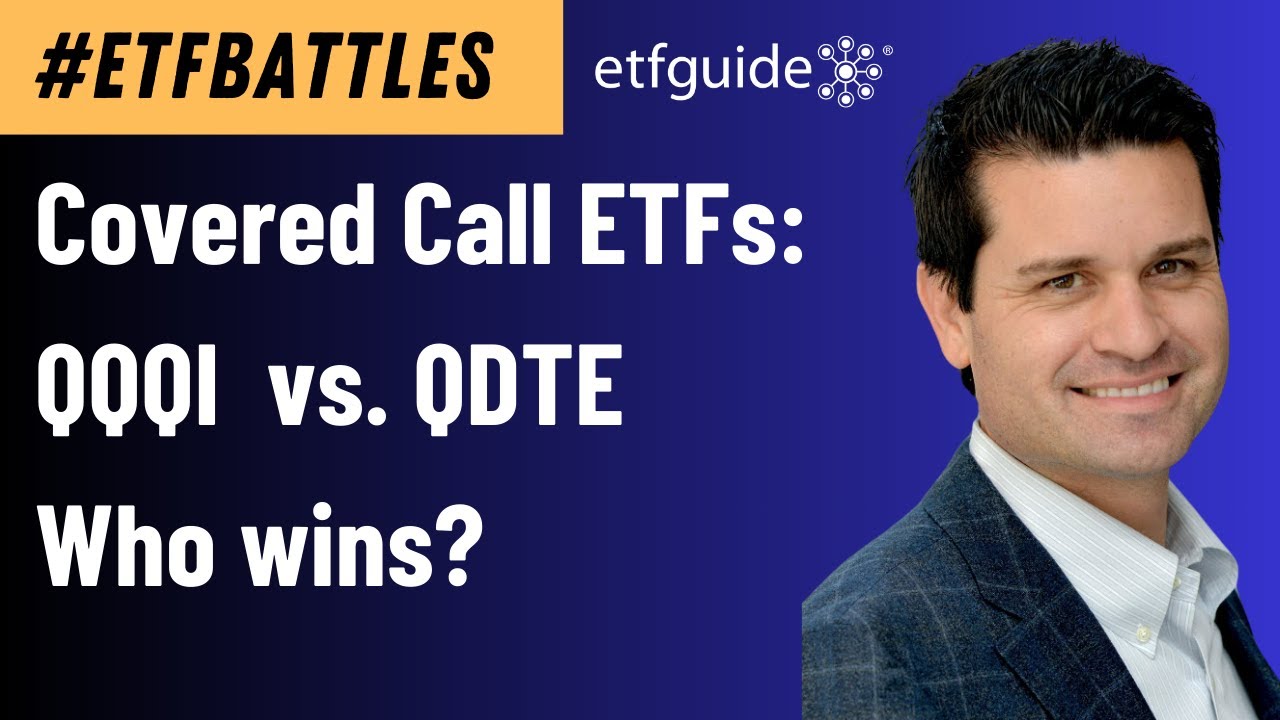
ETFs that use synthetic income derived from call options have exploded in popularity, and today's ETF battle is a head-to-head matchup between covered call ETFs from NEOS and Roundhill. Who wins the battle? Find out right after this.
Cordial welcome to all you're watching ETF Battles. I'm Ronda Lee. If you're new to the show, welcome aboard. We're in season six, so hit that subscribe button and join our community. If you've got an ETF battle suggestion, hit us up in the comment section below with your ETF ticker symbols. We can do double, triple, and quadruple headers. You can also send us your requests on our X feed at etfguide.
Don't forget to visit the description section below. I've got links to our program judges and links to our program sponsor, Direction, who has been expanding their leverage ETF lineup. They've got a mess of single stock ETFs, which they have been increasing that menu, so lots of choices. They recently just added leverage ETFs on Palantir Technologies and Berkshire Hathaway, so be sure to check out direction.com. There's other goodies down there in the description section, so don't miss that.
Today's ETF bout was requested by a viewer named Brian Morrison, and it's between QQQI from NEOS and QQQD from Roundhill. These are both high income ETFs focused on the underlying index as NASDAQ, and so we're going to take a look at these income funds and compare them. Remember, they're using what's called synthetic income, which is from specialized option strategies. That's a lot different than, let's say, dividend income from a corporate payout from a company. Our judges are going to probably elaborate on that.
Judging today's contest is a duo extraordinaire. We've got Dave Kines with ETF portfolio management and Athan Fers with Bloomberg. Judges, welcome back, great to see you. Our four battle categories are cost, exposure strategy, performance and yield combined, and then mystery is the category where our judges can pick a certain factor or thing that they think is crucial to today's contest. I've got the scorekeeping duties. At the end of the program, we will declare an overall winner. None of the battle outcomes we do on this program are ever predetermined or known in advance by myself or our judges.
The first category is cost. Let's start with Athan, please get us started. You have QQQI, which is from NEOS, and you have QQQD, which is from Roundhill. That one is 95 basis points. The one from NEOS is 68, so it's a pretty significant difference. We'll get into the yield that they pay out, and that's much different, but they've both been pretty successful in a very short amount of time. They're pretty new products. They both have over $600 million in them. They both trade quite a bit. Obviously, this is a really popular category. Synthetic income has taken hold very, very quickly, but the difference in the expense ratios is meaningful enough that I would just give this to QQQI. It's 68 versus 95, so that's a pretty big difference. Notice they are more expensive than a typical, you know, kind of Vanguard type ETF, but I will give this one to the NEOS QQQI. That's a strong start.
Thank you, Athan. Dave, you're up next. How do you see it when it comes to cost? Ron, you know how much I love leverage ETFs, and I've been begging you for a leverage single stock ETF battle for quite a while, and what do you give me, Ron? Covered calls. Okay, well, you know, I'm a team player, so let's do it. QQQI is almost 30 basis points lower cost than QQQD, and in this space, that may be material, so I agree with Athan and give the cost win to QQQI. You are correct, but the underlying index is the triple Q's, which refresh my memory. That's your area of expertise. You're a triple Q NASDAQ 100 proponent, so that's why I pulled you in on to this, but thank you very much for that analysis.
That takes us next to the performance. I'm sorry, not performance, exposure strategy. I'm jumping ahead, so let's take a look at exposure. Dave, you're up, give it to us for exposure. These funds are both focused on growth through the NASDAQ 100 with extra income and somewhat lower risk profile than passive equity indexing, and at etfm for this type of exposure, we typically employ the incoming growth investable benchmark portfolio, which is a balanced mix of stocks and bonds with a dash of the top cryptocurrencies. We also do not allocate to covered call strategies because our focus is on maximizing investor upside with risk control. Often we prefer to use leading leveraged ETFs with an active position rotation process to both control risk and to allow for income. For exposure in these covered call battle funds, I call it a split decision.
Athan, you're up next. How do you see it when it comes to exposure between these two ETFs? They're both the same but different, and what I mean by that is they're obviously both tracking the cues, right? They're writing out of the money call options on the cues, but it's with a you're going to get a little bit more downside protection, and you're going to miss out on a little of the upside, right? That's sort of the cost because clients always ask, or they don't understand, well, yes, you'll get this yield from it. What's the cost of getting that yield? That is giving up some of the upside.
The main differences between these two is the Neo's product will do monthly option writing, and the Roundhill will do daily, so because of that, they're able to punch out a much higher yield. Just something to keep in mind that the scheduling is different. You could potentially give up more upside with the Roundhill product. I'm going to have to go with what David said, too. I think it's a split decision. I think you're getting the same exposure, just like what preference you want. Also, Roundhill pays out weekly, too, so the income is paid out weekly versus monthly for NEOS, so it's just more of a matter of preference. It's too close to call. I'll probably also do a split decision on the exposure strategy.
All right, well, that takes us next to the next category, which is performance and yield, and Athan, you're still up, so break it down for us. Let's start first with yield, right? I was mentioning because Roundhill does it on a uses daily options, they're able to punch a much higher yield, so they have a yield of about 30% annualized. QQQI uses monthly, they have about half of that, right? Only about 14% yield. This is also going back to the expense ratio. You do find that the ones that are able to generate a higher yield do charge more, so just something to think about. Yes, the Roundhill product was 95 basis points, but it pays a much higher yield.
Performance, they're both pretty new, so if since they launched, and just because the cues have been a little choppy, they pretty much just match the performance of the cues. If you wanted to get a long-term look how this strategy would have done, just look at JEPQ, which is a JP Morgan covered car product. It's been out there a little bit longer just to give you an idea of how this would perform over the long term. If you still believe the Q's are going to go up and the market's going to go up, you're going to lag on the upside. You have to keep that in mind with these types of strategies, but because this is going towards an income oriented investor and someone who, you know, is going to be focused on that, Roundhill just punches so much yield from that product, and that's really attractive to somebody. Because of that yield kicker and they're doing it on a daily basis, I'll give the performance and the yield winner to QQQD.
Dave, you're up next. How do you see it when it comes to performance and yield? On performance, these two funds are relatively new, as Athan mentions, so this data chart shows over the past four years, JEPI, and XYLD, two older covered call funds, both materially underperformed the S&P 500. However, JEPI was successful in significantly reducing risk in the crash of 2022, so for performance here, I call it a split decision, and note in this trailing four-year period, SPXL strongly outperformed TQQQ. So as much as we do typically use TQQQ, which is three times NASDAQ 100 exposure, there are times when we prefer SPXL for three times S&P 500 instead.
That takes us to the mystery battle category. This is where our judges can name a certain factor or thing that they think is crucial to today's contest. Dave, what is your mystery battle category and which of these ETFs wins it? Well, my mystery category is always position size, and when it comes to covered call funds, my position size is zero. Now, given the asset flow, there is certain value and opportunity for some investors in covered call strategies. However, at etfm, we prefer to reduce risk and to allow for income through active risk controls on leading leveraged ETFs, so I call the position size category for these battle funds a split decision.
Athan, you're up next. How do you see it when it comes to your mystery battle category? What is it, and which of these ETFs wins it? One of my favorite categories is taxes, the tax man, and investors have to be cognitive of price return versus total return, right? Essentially, if you look at both QQQI and QQTD over the common inception date, they almost performed exactly the same. They're at about 20%, but QQTD, most of that return came from income versus QTI, which was balance between price and income.
Assuming you're not in an IRA, just something to keep in mind because it's all income, you're paying taxes on that, right? Versus some versus price return, you won't pay that until you sell it. You can't avoid that with income, so just keep in mind that from a performance perspective, QQTE was down on price, but it was up in total return, which means all of that came from income. You're paying tax and all that income, so just be in mind of these super yielders. They're very they not the most tax efficient funds. It's just something to keep in mind that where your return is coming from, price or to return or income, you're going to be hit with a tax bill that's unavoidable, whether it's an ETF or any type of fund structure. Because of that, QQQI is more efficient because it it doesn't quite necessarily only rely on the income portion of it, so I will just taxes and the contracts they're using the more tax efficient in QQQI, so just from a tax edge, the winner would be that mystery batter category. I'd give it to QQQI.
Great point, thank you so much, Athan, and it really depends, too, how you're using these products, right? If you're using it again, as Athan said, in a tax deferred or tax-free retirement account, then the taxes aren't so much a concern, right? Because you're either deferring or eliminating those taxes if it's like a Roth IRA or Roth 401k, but then again, taxes are a big deal if you're using these products in a taxable brokerage account, then you have to really think about that, so great point, Athan.
That brings us to the part of our program where our judges can give us their overall battle winner, and Athan, you're up, so give it to us. It's a really close one, and I don't want to cop out by saying it's a split decision, but there there's they're both the same, but they're so different just because of what is more important factor to you. If it's income and you just want to punch out the most possible, it's QQQD, but QQQI, which also is a little bit more tax efficient, they do give you some downside protection. It's really close. I don't know if I could pick one. I'm going to have to go with a split decision here and just clarify real quick, Athan, the payouts on these, what is it? What is the frequency of the distributions? Is it both the same on these? They're a little bit different. QQQD, the Roundhill one will be on a weekly basis. QQQI will be on a monthly basis, so again, if that's important to you, frequency of the distribution, you know, just something to look at, and we're noticing more of the new ETFs that are coming out are going to a weekly payout, so people seem to want the income much faster, whether they want to reinvest it or do something with it much quicker, so they do have different payout schedules. All right, thank you for that clarification.
Dave, you're up with your final chance to weigh in with your overall battle winner. Give it to us, Ron. To recap this covered call snoozer, we don't allocate snoozer. What are you talking about? I'm still up, and so is Athan, and we haven't even had our third capuccino. We don't allocate to covered call strategies at etfm. We prefer to employ active risk controls on leading leveraged ETF, and over the past 15 years, this chart shows SPXL returned 53 times your money, which was eight times the return of the S&P, and since SPXL did fall by 57% in 2022, active risk controls may be critical, so for somewhat lower risk equity exposure, I give the win to the balanced incoming growth investable benchmark portfolio or to wildcard ETF SPXL with ETF PM's active risk controls for added safety, and in the absence of those options here, I give this covered call battle a Ronnie D favorite split decision.
All right, well, our judges have weighed in, and according to my final battle scorecard, this is a split decision between QQQI and QQQD, and of course, we had a wild card combination with SPXL from Dave, and each of our judges made their arguments. Of course, Dave favoring leverage with risk controls as his favorite way of approaching this sort of investing. Of course, that's, you know, with his philosophy of investing, and he does have a benchmark income, what did you call it, Dave? The income and growth investable benchmark, right, exactly, which it has ETFs that are con underlying constituents of that benchmark. Athan making his point, and I think he raised some great points. Be aware of taxes. How are you using these two ETFs? They are not the most tax efficient in a taxable account, so if you're using them in that setting, well, you're going to pay a load of taxes because these are heavy on the income, and then also, too, the as mentioned, QQQI is paying out monthly income, whereas QQQD is paying out weekly just because of the fact that both both funds while using a similar strategy, the frequency of those distributions and the frequency of the underlying options is different, so you'll have more frequency or higher frequency of payments the Weekly's with QQQD and monthly with QQQI, so that could be a consideration for some of you income investors that want to get your money as soon as possible, right? That's again something else to keep it mind.
Great job to both of our judges for breaking down today's high income high steroid tech ETF contest. We couldn't have done it without you. This is great. Thanks, Ron. Thanks, Athan. Happy trading, everyone. Well, be sure to visit description section below for links to our program judges. Also, we've got a link to our program sponsor Direction and lots of good stuff down there. Thanks to Brian for this episode's ETF battle suggestion. Very good. What about you? Which ETF matchups would you like to see on the next episode? Send me your ticker symbols in the comment section below or on our X feed at ETF guide. I'm Ronda Legi. Thanks for watching ETF battles. We'll see you on the next episode.