The Ultimate AI ETF Battle: ARTY vs. AIQ vs. CHAT vs. ROBT - Which Fund Wins?
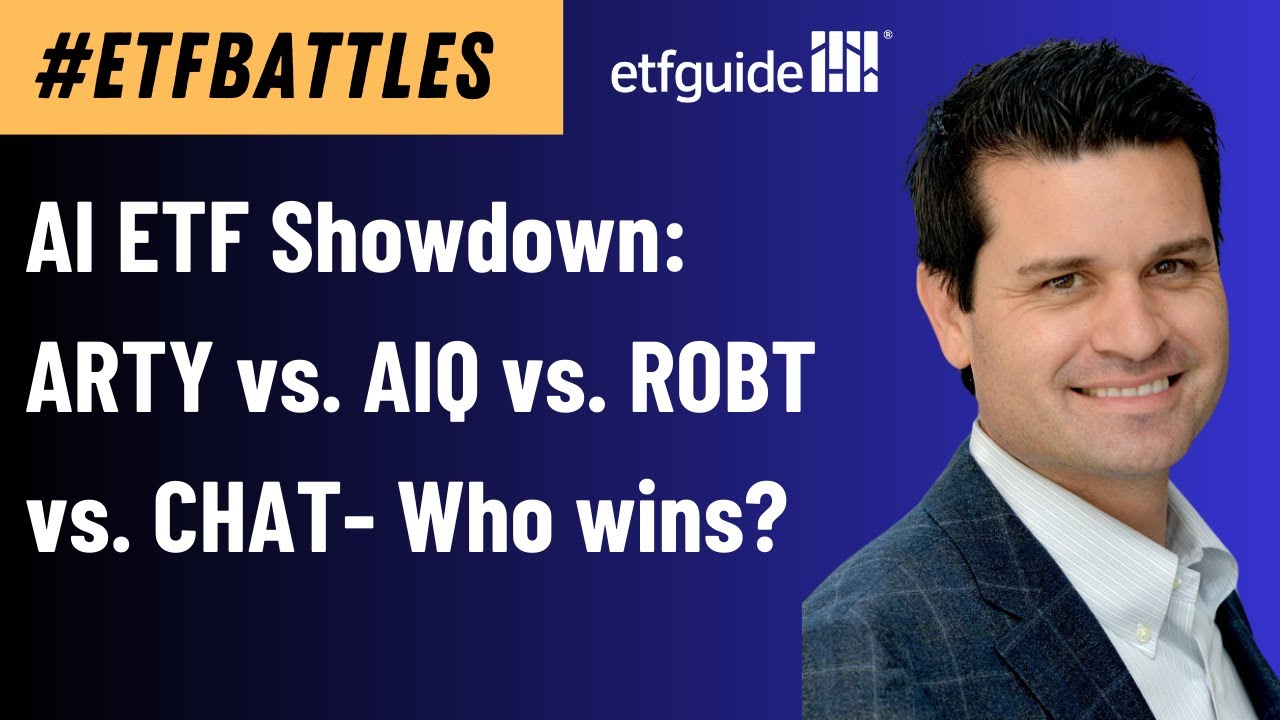
From self-driving cars to predictive algorithms, artificial intelligence is reshaping all industries and investors are taking notice. But how do you tap into this revolution without picking individual stocks? Well, today's ETF battle is an audience requested quadruple header between four AI focused ETFs. This is going to be fun.
Stick around. You're watching ETF Battles and I'm Ronda Leggy. It's great to see you again. If it's your first time watching, welcome aboard and be sure to hit that subscribe button to join our community. Visit the comment section below if there's an ETF battle that you'd like to see, just send me your ETF ticker symbols. You can also do so on our XF feed at ETF guide.
Be sure to check out our season 6 playlist for ETF Battles just to make sure that you're not requesting a matchup that we've already done. Also, check out the video description section below for links to our program sponsor direction. Besides leveraged and inverse choices on broad market indexes, there's lots of choices for ETFs linked to industry sectors along with MAG 7 and single stocks like Nvidia, Palanteer, Tesla, and others. So be sure to visit direction.com.
Today's ETF battle suggestion was sent to us by a viewer named Mario Green. And thank you Mario for this excellent matchup request. It's between four AI focused ETFs from Black Rock, First Trust, Global X, and Roundill. Helping us to judge today's contest is a duo extraordinaire. We've got Shaina Sisle with Banrian Capital and David Crrenis with ETF Portfolio Management. Great to see both of you again. Welcome back.
Hi Ron. Hi Shaya. It's battle time.
It's great to be back.
So we got our four battle categories: cost, exposure, strategy, performance, and then the mystery category where you are judges can pick any factor or thing that you feel is crucial to today's contest. Our judges can also nominate wild card ETFs, feel there's better choices elsewhere or they can offer split decisions. It's up to them. I've got the scorekeeping duties and at the end of the program, we'll declare an overall winner.
Keep in mind, none of the battle outcomes are ever predetermined or known in advance by myself or our judges. Let's kick things off with the first category, cost. Shaina, please get us started.
So, this one's interesting. The lowest expense ratio of the group is the eyesshares fund RD at 47 basis points but it's liquidity the spread for trading is a little on the high side at 4 cents. While AIQ has a higher expense ratio at 68 basis points but it has the tightest trading spread. So, it is a little close to me in that AIQ is a little bit easier to trade. And so you won't have as much drag because there's not as much it's a much tighter spread.
But I'm going to have to give it to Arty because I don't think that the wideness of the trading spread is substantial enough to make up for the fact that it's 20 basis points cheaper.
Well, that's a strong start. Thank you, Shaina. Dave, you're up next. How do you see it when it comes to cost? Well, you know, the world's largest company, Nvidia, is an artificial intelligence chip maker, and AI is now imperative for governments, companies, and individuals. So, this is a super important battle on many levels.
On cost, these artificial intelligence funds range from almost 50 to 80 basis points or half a percent to 8%. And artificial intelligence in general is a fast growing and volatile portion of the market. And given the level of return and volatility here, this narrow range in cost is not material. So while RD is the lowest on an absolute basis, I call it a split decision because cost should not be a major factor in choosing your exposure to AI.
That takes us next to exposure strategy. And you already alluded to it, Dave. So break it down for us. How do these ETFs compare?
For exposure, we have four different AI focused funds here. Among them, chat is the most concentrated and has the highest exposure to Nvidia and Alphabet, which we do favor. That said, we often prefer investors get their AI exposure through the S&P 500 or the NASDAQ 100, which we often prefer for extra tech. At ETFM, we find it is far more efficient and effective to manage exposure to leading diversified indexes rather than using more concentrated instruments. So for AI exposure, I give the win to wildcard NASDAQ 100 QQQM. And among the battle funds, I give the exposure win to Chad.
Thank you, Dave. Shaina, you're up next. How do you see it when it comes to exposure strategy?
So all four funds come at AI in completely different ways. Arty is using kind of a different cap waiting system. That is interesting. While only chat is actively managed, I do like to point out that ROBT and AR have some very interesting ways in which they come up with their passive exposures. They're not making necessarily stock selection decisions. They're not being very active in the trading once they've chosen the stocks based on their screens. It's static until they rebalance the portfolio. But they aren't necessarily indexing per se.
Global X is so we'll kind of go there last, but RD is focused on looking at companies that have AI exposure. A wide variety generative AI focused. They're looking and scoring based on how much of their revenue currently comes from AI, how much it is expected to grow to how much they are involved in the role in the ecosystem because they have three different areas and key themes in AI that they focus on. So how big your role is within any one of those themes matters and how they weight it. They have a modified waiting system and the thing I find most interesting is that they have a preference to weight small cap more than large cap.
It also has a wide array of opportunity because they are looking at US-based stocks but also international stocks both developed and emerging. So it has a really wide pool of opportunity here and it's looking to invest in the top 50. You look at AIQ, which is the global X. That one's a way more like it's it has an index. It's passively managed to that index. It only rebalances semianually. It is the most passive and the least thoughtful of all of the different products there.
And then when you look at the final two, Chad is actively managed. It's the only actively managed fund. And as Dave pointed out, it is highly concentrated. But I would argue that you know 37 names versus 49 names it's not substantially different in terms of the risk profile when you look at you know that in terms of holdings they're both a RD and chat are pretty concentrated. Now chat is interesting in that it's focused on generative AI. It needs to have 50% of the revenue coming from AI related business and it will also look at things that are in that tech and enable AI.
So software semiconductors as Dave pointed out Nvidia is high on that and then it uses AI as it turns out to basically look through the transcripts of all the filings for the companies that kind of meet that criteria and scores based on the number of times they use AI related words, machine learning, artificial intelligence, anything of that nature. And then they rank based on the scores and the highest rated and highest scoring will have the highest waiting and it is strictly based on the scoring. It is actively managed. They do rerun those screens often. And so I think that that's a really interesting product.
And then you look at our OBT which is also passively managed but again that doesn't really have an index per se. It does have a screening system. It invests in any company that is classified by the consumer technology association as artificial intelligence or robotics. So it's using that classification system to come up with the names in the portfolio. Then it categorizes the names based on the role they play in the ecosystem. So it has engagers, enablers, and what was the last one here? I'm looking at my notes and I don't see it. Enhancers, sorry.
And so 60% of the portfolio is enablers engagers I'm sorry which is like the semiconductors the clouds the invidas and such of the world then you have your enhancers which are things that core business is not AI or robotics but they do have exposure to that in other areas of the business and then enablers which is the companies that are involved in the advanced machinery the data learning the things of that nature. So, I think they're all very different actually in what their underlying is. When you look at the holdings of these portfolios, you see overlap, but the weightings in the overlap are substantially different.
So, a lot of times we do these battles and they're all kind of thematic and then you look at the top 10 of all the different funds and they're all the same names. You don't actually see that here. So, you have a couple of different ways to look at it of the of the funds. I really like Arty because it's very focused on big data and machine learning and things of that nature. And I, I really like the screening system with the focus more on the smaller cap names versus larger cap. And I like chat for its active management, its scoring system, and things of that nature. So, for me, it's kind of a ch tie between Arty and Chat.
All right. Well, I got you down for a split decision on Arty and Chat for exposure strategy. Thank you, Shaya. That takes us next to performance. This is where we examine the bottom line. So, how do these funds compare when it comes to the results? Why don't you give us your take on this Shaina?
Yeah, so all of the funds except for Chat were launched in 2018. So, they have pretty long histories. Chat has a limited history. It was launched in 23. So, it's two and a half years basically. And what I I I would note is that of them, chat has the best performance over the common time period by far. Like it's not even close. It is absolutely crushing the other three.
So for me, even though it has a shorter time horizon because of the consistency of the outperformance and the magnitude of the outperformance, for example, if you look at chat versus already for the year to date, chat is up 30% plus and already is up 13. And that's the kind of magnitude I'm talking about when it when it outperforms, it's outperforming by substantial amounts. So, while it does have a shorter track record, I think it has enough history here for me to feel confident saying due to the magnitude of the outperformance and the nature of the way that the portfolio is composed that I'm going to give the win to chat.
Dave, you're up next. How do you see it when it comes to performance? For performance, Chat has been trading for under three years as Shaina mentioned and this chart shows over the past two years, Nvidia and Palunteer helped chat to deliver the best return up 83%. And over the past five years, AIQ did well, although none of the battle ETFs outperformed the three times S&P 500.
And since the trailing five-year period included two market crashes, it actually favored the S&P over the NASDAQ 100. This graph shows over the past 5-year medium-term period, the three times S&P 500, SPXL gave you 243% while AIQ returned 92%. And during a market cycle, there are specific periods when we do trade the S&P 500. So, for medium-term risk adjusted performance, I give the win to wildcard SPXL. And among these battle funds, I give the performance win to chat.
All right. Well, that takes us next to the mystery battle category. This is where our judges can give us any factor or thing that they think is crucial to today's contest. So, Dave, give it to us. What is your mystery battle category and which of these ETFs wins it?
Ron, you know, my mystery battle category is always position size because it's so incredibly important, especially with highly volatile instruments like AI. And given these battle ETFs, we would cap our exposure to them at roughly 10 to 30%. While the S&P and NASDAQ 100 could be 100% or more of our tactical strategies. So, I give the position size win to wildcards SPXL, QQQM, and TQQQ. And among these battle ETFs, I give the position size win to chat.
All right. Well, Shaina, you're up next. Uh, what is your mystery battle category and which of these ETFs wins it for you?
So, I'm going to talk a little bit about thematic ETFs and how important it is when you're looking at very concentrated areas of the market. Being able to pick winners and losers is important. It's why we're seeing such strong outperformance from chat over the other three. I think whenever you're doing something that's really thematic, it is important to have active management, especially when it's in a particular area like this because missing the top performer, as Dave pointed out, Nvidia Palunteer, can substantially change the results and having that active management, that really close eye on the portfolio, having the ability to make changes more frequently and to be more nimble, I think is advantageous when whenever you're talking about sematic ETFs.
You know, I think it is notable that chat is the only one that had large positions in Palanteer and Nvidia and we can say what we want of following the crowd momentum whatever but those stocks have been the biggest winners in the space and when you look at the winners in AI it is actually these larger cap names. Now to Dave's point about you know volatility and how things have done over the last five years I think that's all really valid. You're not going to invest in a thematic ETF unless you have a strong conviction in this particular theme.
But I will note that the theme of AI is only recently really picked up steam. You know, Nvidia's been a great stock for 5 years, but it's only been in the past two and a half where the stock has really taken off. And that is because the trends in AI have become more ingrained in the revenue and the future tailwinds of these companies. More and more we're seeing stock companies kind of focus more on their AI opportunities.
Marll technology is a perfect example. Company that was normally like a cloud networking you know 5G kind of name has completely transformed its business because the vast majority of its bands coming from AI related opportunities and so they have kind of sold off a lot of their ancillary businesses to focus more on AI. I think we're going to see more of that. So in the next 5 years, I think this is a theme that you would want to be invested in and a concentrated way. And so for that reason, I think the active management and the concentrated nature of chat makes it stand out for me among the battle category ETFs.
Got it. Well, we've moved to the part of the program where our judges are going to give us their overall winner. How will this go down? Shaina, give it to us.
So, my winner in this battle is chat. I didn't really go looking for other thematic robotic ETFs, AI ETFs. I think these are four really good ones, really solid ones. And while there's other ones out there, I think these four are a great representation of what's available. In the thematic AI space, chat is head and shoulders above from what I can kind of garner from its two and a half years of track record. I really like the actively managed aspects of it, the concentrated nature of it, and they've demonstrated skill in stock selection and a willingness to take advantage of even if it seems like everybody in the crowd is going there, being willing to see the momentum play there. And I think that's important. So, for me, chat is the winner.
Dave, your final chance to weigh in with your overall winner. Okay, to recap this artificial intelligence mashup, investors should be very careful making concentrated market allocations. Leading diversified indexes often outperform because they manage your exposure to different market sectors more efficiently and effectively than most subjective deviations. And this chart shows over the past 15 years, the S&P 500 gave you 7x, the NASDAQ 100 returned 13x, and the three times NASDAQ 100 delivered 203x.
So I give this AI battle win to NASDAQ 100 through QQQM or TQQQ. And among these battle ETFs, I give the win to chat.
All right, so how am I going to score this, Dave? You got QQQM, you got chat. Do you prefer one over the other?
I would take QQQM or TQQQ over chat.
All right.
But chat, I would take among the other battle funds.
Understood. Thank you for the clarification. And according to my battle scorecard, today's winner is going to be a split decision. We've got chat and QQQM and TQQQ which was a wild card choice for by Dave and our judges raised some really awesome points. I mean this is a an area of the markets where there's a lot of momentum, a lot of interest.
Shaina pointing out that she likes the thematic space. if you're going to use it, invest and focus on those ETFs that have that active approach, of course, that that are showing, you know, some proven performance. Now, Chat does have a shorter performance history compared to these other ETFs, but it has since inception delivered some pretty impressive results, which may indicate some skill in stocks stock selection and it certainly has picked some of those big time winners like Nvidia and Palunteer and shown confidence in holding those positions in a concentrated manner. So that was Shaina's vote and then Dave agreeing with her her for the most part but adding that maybe the approach is better via a broader index. he he preferred the QQQ which tracks a NASDAQ 100 QQQM I should say is the ticker and then of course the leverage version TQQQ and also a mention of SPXL which offers triple daily leverage to the S&P 500.
Lot of great points from both of our judges Dave and Shannon. Well done. We couldn't have done it without you.
Thanks for having me, Ron. Always good to be on. Thank you guys. Own the matrix everyone.
And appreciation to our viewer Mario Green for recommending and suggesting today's ETF battle. A quadruple header, an AI showdown. Boy, was it fun. And hit the comment section below. Let us know what you think about the analysis. And also, if you've got a certain ETF matchup that you'd like to see, send me your ETF ticker symbols in the comment section below. That's your homework assignment. Don't ask me for the ETF ticker symbols. But I'm not going to tell you. It's up to you. Well, I'm Ronda Ley. You've been watching ETF Battles and we'll see you on the next episode. Thanks for watching.